Commentary - (127) Volume 17, Issue 3
Received: 01-Jun-2025, Manuscript No. jbabm-26-182333;
Editor assigned: 03-Jun-2025, Pre QC No. P-182333;
Reviewed: 17-Jun-2025, QC No. Q-182333;
Revised: 22-Jun-2025, Manuscript No. R-182333;
Published:
29-Jun-2025
, DOI: 10.37421/1948-593X.2025.17.491
Citation: El-Hadji, Fatima. ”Cutting-edge Biomedical Technologies: Driving Personalized Medicine.” J Bioanal Biomed 17 (2025):491.
Copyright: © 2025 El-Hadji F .This is an open-access article distributed under the terms of the Creative Commons Attribution License, which permits unrestricted use, distribution and reproduction in any medium, provided the original author and source are credited.
Proteomic technologies are fundamentally reshaping the landscape of biomedical research, offering unparalleled capabilities for the in-depth analysis of protein expression and function. These advanced tools are increasingly indispensable in clinical practice, playing a pivotal role in the discovery of biomarkers, the accurate diagnosis of diseases, the precise stratification of patients, and the effective monitoring of therapeutic interventions. Significant advancements in mass spectrometry, sophisticated antibody-based assays, and powerful bioinformatics pipelines are collectively accelerating the translation of proteomic discoveries into practical clinical applications, ultimately contributing to improved patient outcomes and the burgeoning field of personalized medicine.[1] Next-generation sequencing (NGS) platforms have profoundly enhanced our comprehension of genomic variations and their intricate involvement in the pathogenesis of various diseases. This review meticulously examines the most recent breakthroughs in NGS technologies, emphasizing enhancements in sequencing accuracy, the generation of longer DNA reads, and improvements in overall throughput. The application of NGS in clinical diagnostics is rapidly expanding, particularly in identifying genetic predispositions to cancer and rare inherited disorders, thereby making comprehensive genomic information more accessible for tailoring personalized treatment strategies.[2] CRISPR-Cas gene editing technology has emerged as a transformative force in genetic research, possessing immense potential for therapeutic development. This article delves into the sophisticated mechanisms underlying CRISPR-Cas systems and explores their diverse applications, including the correction of mutations that cause inherited diseases, the development of innovative cancer therapies, and the advancement of preclinical research models. Furthermore, it critically discusses the significant ethical considerations and the persistent challenges associated with clinical translation, such as minimizing off-target genetic modifications and optimizing delivery methodologies.[3] Liquid biopsies offer a non-invasive methodology for the detection, monitoring, and personalized treatment selection in cancer management, by analyzing circulating tumor DNA (ctDNA), RNA, proteins, and extracellular vesicles present in bodily fluids. This comprehensive review scrutinizes the technological advancements in liquid biopsy platforms, their rigorous clinical validation across a spectrum of cancer types, and their transformative potential for revolutionizing early cancer diagnosis and the management of personalized therapies, consequently reducing the reliance on invasive tissue biopsies.[4] Single-cell multi-omics technologies are furnishing unprecedented insights into cellular heterogeneity and the complexities of biological processes. By enabling the simultaneous analysis of multiple molecular layers, including genomics, transcriptomics, epigenomics, and proteomics, within individual cells, researchers can meticulously unravel cell-type-specific disease mechanisms and identify novel therapeutic targets. This article provides an overview of the emerging single-cell multi-omics platforms and elucidates their diverse applications in understanding fundamental processes such as development, immunity, and the progression of cancer.[5] The synergistic integration of artificial intelligence (AI) and machine learning (ML) with the analysis of proteomic data is revolutionizing the interpretation of highly complex biological information. AI and ML algorithms possess the remarkable ability to identify subtle yet significant patterns within vast proteomic datasets, leading to substantial improvements in biomarker discovery, enhanced accuracy in disease prognostication, and the sophisticated development of personalized treatment strategies. This paper provides an exploration of the current applications of AI/ML in proteomics and outlines promising future directions for the field.[6] The development of point-of-care (POC) diagnostic technologies is paramount for ensuring timely and accessible healthcare delivery, particularly in resource-constrained environments. This review highlights recent innovations in POC devices that leverage advanced biosensing principles and microfluidic technologies for the rapid and efficient detection of infectious diseases, critical cardiac markers, and prevalent metabolic disorders. The seamless integration of these advanced POC technologies with digital health platforms is crucial for improving data management and facilitating more informed clinical decision-making.[7] Metabolomics, which encompasses the comprehensive study of small molecules within biological systems, offers a dynamic and detailed snapshot of cellular states and their responses to various stimuli. This article critically examines the application of metabolomic technologies in the identification of robust biomarkers for metabolic diseases, the elucidation of drug metabolism pathways, and the assessment of how environmental factors can impact overall health. Significant advancements in sophisticated analytical techniques and data processing methodologies are now enabling a deeper understanding of intricate metabolic pathways and their dysregulation in the context of disease.[8] The gut microbiome exerts a profound influence on numerous aspects of human health, significantly impacting metabolism, immune system function, and even neurological processes. Metagenomic and metatranscriptomic approaches are instrumental in studying microbial communities and their functional capabilities within complex environments, such as the human gut. This review elucidates how these cutting-edge technologies are progressively unraveling the intricate interplay between the microbiome and the host organism in both health and disease states, thereby paving the way for the development of novel microbiome-based therapeutic interventions.[9] Glycomics, the scientific discipline dedicated to the study of carbohydrates and their multifaceted roles in biological processes, is experiencing a surge in importance within biomedical research. Glycans are intrinsically involved in crucial cellular functions, including cell-cell recognition, modulation of immune responses, and interactions with pathogens. This article highlights recent technological advancements in glycomics, such as sophisticated mass spectrometry-based methods and versatile lectin arrays, which are facilitating a more comprehensive profiling and deeper understanding of the functional significance of glycans in the context of cancer, infectious diseases, and inflammatory disorders.[10]
Proteomic technologies are revolutionizing biomedical research by enabling comprehensive analysis of protein expression and function. In clinical practice, these tools are increasingly vital for biomarker discovery, disease diagnosis, patient stratification, and therapeutic monitoring. Advancements in mass spectrometry, antibody-based assays, and bioinformatics are driving the translation of proteomic insights into tangible clinical applications, improving patient outcomes and shaping the future of personalized medicine.[1] Next-generation sequencing (NGS) platforms have significantly impacted our understanding of genomic variations and their role in disease. This review highlights the latest advancements in NGS technologies, including improved sequencing accuracy, longer read lengths, and enhanced throughput. Applications in diagnostics, such as identifying genetic predispositions to cancer and rare diseases, are expanding rapidly, making genomic information more accessible for personalized treatment strategies.[2] CRISPR-Cas gene editing technology has emerged as a powerful tool for genetic research and offers immense therapeutic potential. This article explores the mechanisms of CRISPR-Cas systems and their applications in correcting disease-causing mutations, developing novel cancer therapies, and advancing preclinical research. Ethical considerations and challenges in clinical translation, such as off-target effects and delivery methods, are also discussed.[3] Liquid biopsies represent a non-invasive approach to cancer detection, monitoring, and treatment selection by analyzing circulating tumor DNA (ctDNA), RNA, proteins, and extracellular vesicles in bodily fluids. This review examines the technological advancements in liquid biopsy platforms, their clinical validation in various cancer types, and their potential to revolutionize early diagnosis and personalized therapy management, reducing the need for tissue biopsies.[4] Single-cell multi-omics technologies are providing unprecedented insights into cellular heterogeneity and complex biological processes. By simultaneously analyzing multiple molecular layers (genomics, transcriptomics, epigenomics, proteomics) within individual cells, researchers can unravel cell-type specific mechanisms of disease and identify novel therapeutic targets. This article discusses the emerging single-cell multi-omics platforms and their applications in understanding development, immunity, and cancer.[5] The integration of artificial intelligence (AI) and machine learning (ML) with proteomic data analysis is transforming the interpretation of complex biological information. AI/ML algorithms can identify subtle patterns in large proteomic datasets, leading to improved biomarker discovery, more accurate disease prognostication, and the development of personalized treatment strategies. This paper explores current AI/ML applications in proteomics and future directions.[6] The development of point-of-care (POC) diagnostic technologies is crucial for timely and accessible healthcare, especially in resource-limited settings. This review focuses on recent innovations in POC devices that utilize advanced biosensing and microfluidic principles for rapid detection of infectious diseases, cardiac markers, and metabolic disorders. The integration of these technologies with digital platforms enhances data management and clinical decision-making.[7] Metabolomics, the comprehensive study of small molecules in biological systems, provides a dynamic snapshot of cellular state and response to stimuli. This article examines the application of metabolomic technologies in identifying biomarkers for metabolic diseases, understanding drug metabolism, and assessing the impact of environmental factors on health. Advancements in analytical techniques and data processing are enabling deeper insights into metabolic pathways and their dysregulation in disease.[8] The gut microbiome plays a critical role in human health, influencing metabolism, immunity, and even neurological function. Metagenomics and metatranscriptomics allow for the study of microbial communities and their functional potential in complex environments like the gut. This review discusses how these technologies are unraveling the interplay between the microbiome and host in health and disease, paving the way for microbiome-based therapeutics.[9] Glycomics, the study of carbohydrates and their roles in biological processes, is gaining momentum in biomedical research. Glycans are involved in cell-cell recognition, immune responses, and pathogen interactions. This article highlights recent advancements in glycomic technologies, including mass spectrometry-based methods and lectin arrays, for profiling and understanding the functional significance of glycans in cancer, infectious diseases, and inflammatory disorders.[10]
This collection of research highlights advancements in cutting-edge biomedical technologies. Proteomics offers comprehensive protein analysis for clinical applications like biomarker discovery and patient stratification. Next-generation sequencing (NGS) is revolutionizing genetic diagnostics, enabling personalized treatment strategies. CRISPR-Cas gene editing shows therapeutic promise by correcting mutations and developing novel therapies. Liquid biopsies provide a non-invasive method for cancer detection and management. Single-cell multi-omics unravels cellular complexity and identifies therapeutic targets. Artificial intelligence and machine learning are transforming proteomic data analysis for improved diagnostics and personalized medicine. Point-of-care diagnostic technologies are enhancing accessibility to timely healthcare. Metabolomics offers dynamic insights into cellular states and disease biomarkers. Metagenomics and metatranscriptomics are elucidating the gut microbiome's role in health and disease. Glycomics studies the critical roles of carbohydrates in various biological processes and diseases.
None
None
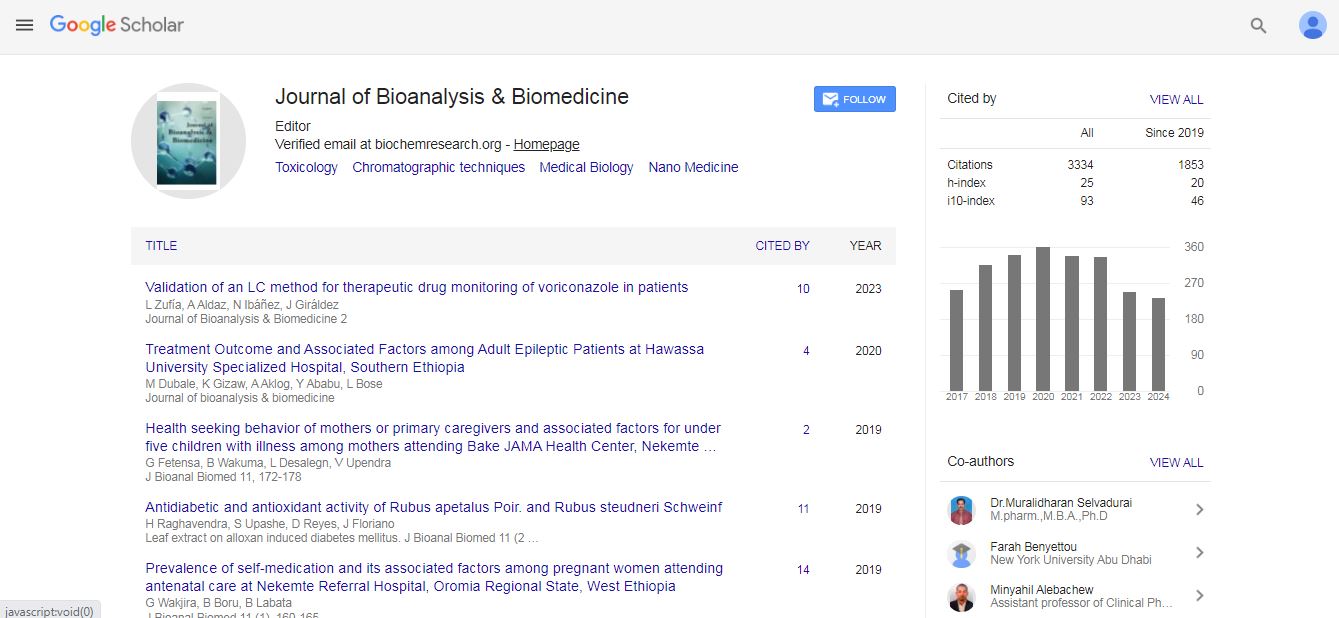
Journal of Bioanalysis & Biomedicine received 3099 citations as per Google Scholar report