Opinion - (2025) Volume 11, Issue 4
Received: 01-Jul-2025, Manuscript No. aso-26-184641;
Editor assigned: 03-Jul-2025, Pre QC No. P-184641;
Reviewed: 17-Jul-2025, QC No. Q-184641;
Revised: 22-Jul-2025, Manuscript No. R-184641;
Published:
29-Jul-2025
, DOI: 10.37421/2471-2671.2025.11.181
Citation: Hughes, Aaron. ”CRS HIPEC: Advanced Cancer Peritoneal
Metastasis Treatment.” Arch Surg Oncol 11 (2025):181.
Copyright: © 2025 Hughes A. This is an open-access article distributed under the terms of the Creative Commons Attribution License, which permits unrestricted use,
distribution and reproduction in any medium, provided the original author and source are credited.
Cytoreductive surgery (CRS) coupled with hyperthermic intraperitoneal chemotherapy (HIPEC) signifies a major stride in managing advanced cancers with peritoneal metastasis, offering a multimodal strategy to achieve complete tumor eradication and localized chemotherapy delivery, thereby enhancing survival and quality of life for selected patients [1].
The application of CRS and HIPEC is now extending to a wider spectrum of advanced gastrointestinal malignancies, with current evidence supporting improved survival and disease control in patients with peritoneal carcinomatosis originating from colorectal, appendiceal, and gastric cancers [2].
In the context of ovarian cancer with peritoneal carcinomatosis, CRS and HIPEC is an area of active investigation, with studies indicating potential benefits in progression-free and overall survival for highly selected patients, particularly those with platinum-sensitive disease [3].
For pseudomyxoma peritonei (PMP) and other appendiceal malignancies with peritoneal spread, CRS and HIPEC is widely recognized as the standard of care, aiming for complete cytoreduction to eradicate all visible tumor implants and residual microscopic disease [4].
The optimal selection of chemotherapeutic agents and temperature for HIPEC remains an active area of research, with common agents like cisplatin and mitomycin C being employed, and temperature optimization being crucial for maximizing drug efficacy while minimizing systemic toxicity [5].
Patient selection for CRS and HIPEC is a multifaceted process necessitating a multidisciplinary assessment, with crucial factors including the extent and location of peritoneal disease, tumor histology, patient performance status, and the absence of extra-abdominal disease [6].
The integration of novel targeted therapies and immunotherapies alongside CRS and HIPEC presents a promising avenue for improving outcomes in advanced malignancies by enhancing drug delivery, overcoming resistance, and stimulating anti-tumor immune responses [7].
Surgical expertise and strict adherence to perioperative protocols are paramount for achieving optimal outcomes with CRS and HIPEC, with high-volume centers demonstrating superior results and lower complication rates due to experienced multidisciplinary teams [8].
Long-term survivorship and quality of life following CRS and HIPEC are critical considerations, as patients may experience various acute and chronic toxicities, underscoring the need for comprehensive survivorship programs to address physical, psychological, and social well-being [9].
Technical aspects of CRS and HIPEC, including achieving complete cytoreduction and ensuring uniform drug distribution, are vital for efficacy, with ongoing exploration of advanced surgical techniques and innovative HIPEC delivery methods to enhance outcomes and reduce complexity [10].
Cytoreductive surgery (CRS) followed by hyperthermic intraperitoneal chemotherapy (HIPEC) represents a significant advancement in the management of advanced malignancies with peritoneal metastasis. This multimodal approach aims to achieve complete tumor removal and deliver localized chemotherapy directly to the peritoneal cavity, thereby improving survival and quality of life for select patients. The oncologic outcomes, while promising in well-selected cases, are heavily dependent on patient selection, surgical expertise, and the specific histology of the malignancy. Challenges include patient-specific factors, the complexity of the procedure, and the need for standardized protocols to optimize efficacy and minimize toxicity. Recent research highlights efforts to refine patient selection criteria, explore new chemotherapeutic agents for HIPEC, and investigate the molecular underpinnings of peritoneal carcinomatosis to better predict treatment response [1].
The role of cytoreductive surgery (CRS) and hyperthermic intraperitoneal chemotherapy (HIPEC) is expanding to include a broader range of advanced gastrointestinal malignancies. Current evidence suggests improved survival and disease control in specific patient populations with peritoneal carcinomatosis from colorectal, appendiceal, and gastric cancers. However, careful patient selection remains paramount to maximize benefits and minimize morbidity associated with this aggressive treatment. Ongoing investigations focus on perioperative management, technical refinements in surgical technique, and the integration of systemic therapies [2].
The application of CRS and HIPEC in ovarian cancer with peritoneal carcinomatosis is a subject of active research. While not universally adopted, studies indicate potential benefits in terms of progression-free and overall survival for highly selected patients, particularly those with platinum-sensitive disease. The challenge lies in defining optimal surgical completeness, selecting appropriate chemotherapy agents, and managing treatment-related toxicities. Future directions include exploring neoadjuvant HIPEC and identifying biomarkers for treatment response [3].
For pseudomyxoma peritonei (PMP) and other appendiceal malignancies with peritoneal spread, CRS and HIPEC is considered the standard of care. The goal is complete cytoreduction to eliminate all visible tumor implants, followed by HIPEC to eradicate microscopic residual disease. Long-term survival rates can be substantial when complete cytoreduction is achieved. However, the procedure is technically demanding, and challenges include managing extensive disease, ensuring adequate HIPEC distribution, and preventing recurrence [4].
The optimal chemotherapeutic agent and temperature for HIPEC remain areas of ongoing investigation. While cisplatin and mitomycin C are commonly used, the choice may depend on the tumor type and patient factors. Temperature optimization is critical for maximizing drug penetration and cytotoxic effect while minimizing systemic toxicity. Research is also exploring novel drug combinations and pharmacokinetic studies to improve HIPEC efficacy [5].
Patient selection for CRS and HIPEC is a complex process that involves multidisciplinary assessment. Factors such as the extent and location of peritoneal disease, tumor histology, performance status, and absence of extra-abdominal disease are crucial for determining candidacy. Advances in imaging and surgical staging are improving the accuracy of patient selection, leading to better outcomes and reduced morbidity [6].
The development of novel targeted therapies and immunotherapies in combination with CRS and HIPEC holds significant promise for improving outcomes in advanced malignancies. These agents may enhance drug delivery, overcome resistance mechanisms, and stimulate an anti-tumor immune response. Future research will likely focus on identifying patient subgroups who will benefit most from these combinatorial approaches [7].
Surgical expertise and adherence to strict perioperative protocols are critical for achieving optimal results with CRS and HIPEC. High-volume centers with experienced multidisciplinary teams demonstrate better outcomes and lower complication rates. Standardizing surgical techniques, HIPEC administration, and postoperative care is essential for widespread adoption and improved patient safety [8].
Long-term survivorship and quality of life are important considerations following CRS and HIPEC. While survival rates can be prolonged, patients may experience a range of acute and chronic toxicities. Comprehensive survivorship programs addressing physical, psychological, and social well-being are essential for optimizing long-term outcomes. Ongoing research is investigating strategies to mitigate treatment-related morbidity [9].
The technical aspects of CRS and HIPEC, including achieving complete cytoreduction and ensuring uniform drug distribution, are critical for efficacy. Advanced surgical techniques, such as those utilizing minimally invasive approaches, and innovative methods for HIPEC delivery are being explored to improve patient outcomes and reduce surgical complexity. Challenges remain in optimizing drug penetration to deep tumor sites and managing peritoneal adhesions [10].
Cytoreductive surgery (CRS) combined with hyperthermic intraperitoneal chemotherapy (HIPEC) is a critical treatment for advanced cancers with peritoneal metastasis. This approach aims for complete tumor removal and direct chemotherapy delivery to the peritoneum, improving survival and quality of life in carefully selected patients. Its application is expanding to various gastrointestinal cancers, including colorectal, appendiceal, and gastric malignancies, and shows promise in ovarian cancer and for pseudomyxoma peritonei. Key challenges involve precise patient selection, surgical expertise, optimizing chemotherapeutic agents and temperature, and managing treatment-related toxicities. Future research focuses on refining selection criteria, integrating novel systemic therapies, and improving technical aspects for better patient outcomes and long-term survivorship.
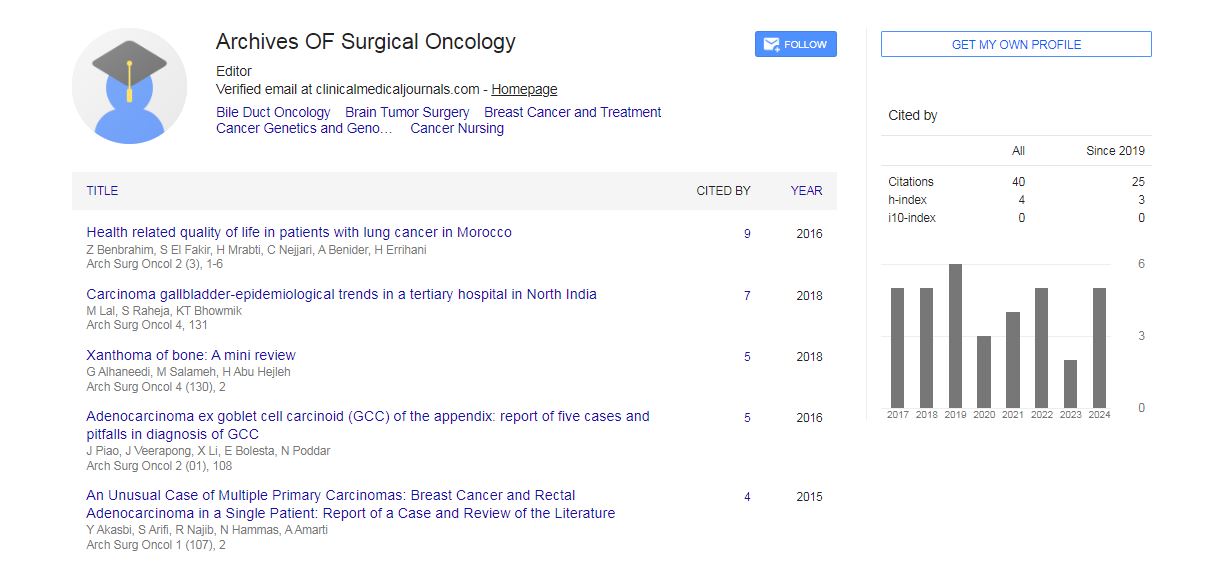
Archives of Surgical Oncology received 37 citations as per Google Scholar report