Perspective - (2025) Volume 15, Issue 2
Received: 03-Mar-2025, Manuscript No. jbpbt-25-178495;
Editor assigned: 05-Mar-2025, Pre QC No. P-178495;
Reviewed: 19-Mar-2025, QC No. Q-178495;
Revised: 24-Mar-2025, Manuscript No. R-178495;
Published:
31-Mar-2025
, DOI: 10.37421/2155-9821.2025.15.671
Citation: Silva, Maria P.. ”CRISPR Revolutionizing Industrial Biotechnology: Enhanced Bioproduction.” J Bioprocess Biotech 15 (2025): 671.
Copyright: © 2025 Silva P. Maria This is an open-access article distributed under the terms of the Creative Commons Attribution License, which permits unrestricted use,
distribution and reproduction in any medium, provided the original author and source are credited.
CRISPR-based tools are fundamentally reshaping industrial biotechnology by providing unparalleled precision and efficiency in genome editing capabilities. This technological advancement is paving the way for the development of superior microbial strains essential for bioproduction, leading to more robust and productive microorganisms tailored for various industrial processes. Furthermore, these tools are instrumental in enhancing enzyme engineering efforts, allowing for the fine-tuning of enzyme properties to optimize their performance in demanding industrial environments. The ability to create novel biomaterials with specific characteristics is also significantly boosted by CRISPR technology, opening new avenues for material science and manufacturing. By enabling rapid and accurate modifications to genetic blueprints, CRISPR accelerates the iterative design-build-test-learn cycle, a critical component in the efficient development of sustainable and cost-effective biotechnological solutions that are vital for a greener future [1].
The application of CRISPR-Cas systems is actively transforming the landscape of metabolic engineering, particularly in the production of essential chemicals and biofuels. These systems facilitate targeted modifications within complex metabolic pathways, enabling researchers to precisely steer cellular metabolism towards the overproduction of desired products. This level of control is crucial for minimizing the formation of unwanted by-products, thereby increasing the overall yield and purity of the target compounds. Additionally, CRISPR technology enhances the robustness of engineered microorganisms, making them more resilient to the stresses encountered during industrial fermentation processes. This precision editing is indispensable for designing and constructing microbial strains capable of sustainable and economically viable production of a broad spectrum of valuable chemicals, driving innovation in the chemical industry [2].
CRISPR technology has emerged as an invaluable asset in the field of enzyme engineering, offering the capacity for rapid and highly precise modifications to enzyme structures and functions. This capability is essential for tailoring enzymes to meet the stringent requirements of various industrial applications, where optimal performance under diverse conditions is paramount. Key improvements include significant enhancements in catalytic activity, leading to faster reaction rates and higher productivities. Moreover, CRISPR allows for increased stability of enzymes, enabling them to withstand harsh process conditions such as extreme temperatures, pH variations, or the presence of inhibitory substances. Altering substrate specificity is another critical advantage, allowing enzymes to act on novel substrates or exhibit improved selectivity for desired targets. The integration of directed evolution strategies with CRISPR editing further accelerates the discovery and optimization of enzymes, crucial for the advancement of biocatalysis across numerous industrial sectors [3].
The development of novel biomaterials is experiencing a significant impetus due to the application of CRISPR-based gene editing techniques. By enabling precise control over the expression of genes that govern polymer synthesis or assembly within microorganisms, researchers can effectively engineer these microbes to produce tailored biomaterials. These engineered materials possess specific mechanical, chemical, or biological properties that can be precisely tuned to suit a wide array of applications. This targeted genetic manipulation allows for the creation of advanced materials with predictable and desirable characteristics, facilitating innovation in fields ranging from medicine and agriculture to manufacturing and construction. The ability to design and produce biomaterials with custom-designed functionalities represents a major leap forward in sustainable material development [4].
CRISPR-Cas technology provides an unmatched level of specificity and efficiency when it comes to modifying microbial genomes, establishing it as a paramount tool for strain improvement in industrial fermentation processes. The precise nature of CRISPR edits allows for targeted alterations to enhance the yield of desired products, significantly reduce fermentation times, and increase the tolerance of microorganisms to challenging industrial conditions. These improvements collectively contribute to the development of more economical and sustainable bioprocesses, making biotechnological production more competitive and environmentally friendly. The capacity to fine-tune microbial physiology through precise genetic engineering is crucial for optimizing industrial fermentation and maximizing the efficiency of bio-based manufacturing [5].
The precision afforded by CRISPR-based tools is particularly beneficial for the targeted disruption or insertion of specific genes, a critical strategy for optimizing metabolic pathways involved in the production of value-added chemicals. This meticulous genetic manipulation is fundamental to the development of highly efficient microbial cell factories. These engineered microorganisms possess the enhanced capability to convert renewable feedstocks, such as biomass or agricultural waste, into valuable chemical products. This transition from fossil fuel-based chemical synthesis to bio-based production is essential for reducing the global reliance on non-renewable resources and mitigating the environmental impact of the chemical industry, fostering a more sustainable chemical economy [6].
CRISPR technology is increasingly being employed to engineer organisms for the enhanced production of biofuels and bioplastics, two critical areas for advancing a sustainable bioeconomy. Through precise genetic modifications, researchers can significantly increase the efficiency with which microorganisms utilize various feedstocks, leading to higher product titers and improved overall yields. Furthermore, these genetic interventions can enhance the robustness and sustainability of these bio-based manufacturing processes, making them more competitive with conventional petrochemical-based production. The ability to tailor microbial metabolism for the efficient conversion of renewable resources into biofuels and bioplastics is a key enabler of the circular economy and a reduced carbon footprint [7].
The exceptional versatility of CRISPR-based tools extends robustly to the engineering of microbial consortia for a multitude of industrial applications. By exerting precise control over the genetic makeup of the individual species within a consortium, researchers can engineer synergistic interactions between different microorganisms. These engineered interactions are designed to achieve complex biotransformations that would be challenging or impossible for single strains to accomplish. Furthermore, these controlled genetic modifications can significantly enhance the overall productivity and efficiency of mixed-culture fermentations, leading to more robust and effective industrial bioprocesses. This capability opens new possibilities for microbial community engineering in industrial settings [8].
CRISPR interference (CRISPRi) and CRISPR activation (CRISPRa) represent powerful derivative tools stemming from the broader CRISPR-Cas system, offering the unique ability to modulate gene expression levels without permanently altering the underlying DNA sequence. These innovative methods are paramount for optimizing the expression of specific genes within industrial microorganisms. By finely tuning gene expression, researchers can achieve desired product yields with greater accuracy and consistency, and significantly improve the overall efficiency of bioprocesses. This regulatory control without permanent genomic change provides a flexible and dynamic approach to strain optimization for industrial biotechnology applications [9].
The integration of high-throughput CRISPR-based screening platforms into industrial biotechnology workflows is dramatically accelerating the identification of genes and metabolic pathways that are critical for enhancing microbial performance. These advanced screening methodologies, leveraging the precision of CRISPR technology, allow for the rapid and systematic assessment of numerous genetic modifications. This efficient evaluation process leads to the accelerated discovery of improved microbial strains that are optimized for various bioproduction applications, streamlining the development pipeline and reducing the time and cost associated with strain engineering [10].
CRISPR-based tools are revolutionizing industrial biotechnology by offering precise and efficient genome editing capabilities, enabling the development of improved microbial strains for bioproduction, enhanced enzyme engineering for industrial processes, and the creation of novel biomaterials. This capability to rapidly and accurately modify genetic blueprints accelerates the design-build-test-learn cycle, leading to faster development of sustainable and cost-effective biotechnological solutions [1].
The application of CRISPR-Cas systems in metabolic engineering is transforming the production of chemicals and biofuels. By enabling targeted modifications of metabolic pathways, researchers can optimize flux towards desired products, reduce by-product formation, and enhance the robustness of engineered microorganisms. This precision editing facilitates the design of strains for the sustainable production of a wide range of valuable compounds, driving innovation in green chemistry and renewable energy [2].
CRISPR technology is proving invaluable for enzyme engineering, enabling the rapid and precise modification of enzyme properties for industrial applications. This includes enhancing catalytic activity, improving stability under harsh process conditions, and altering substrate specificity. Directed evolution strategies combined with CRISPR editing accelerate the discovery and optimization of enzymes crucial for biocatalysis in various industrial sectors, leading to more efficient and robust enzymatic processes [3].
The development of novel biomaterials is being significantly advanced by CRISPR-based gene editing. By precisely controlling the expression of genes involved in polymer synthesis or assembly in microorganisms, researchers can engineer strains to produce tailored biomaterials with specific mechanical, chemical, or biological properties for diverse applications, paving the way for advanced material design [4].
CRISPR-Cas technology offers unparalleled specificity and efficiency for modifying microbial genomes, making it a powerful tool for strain improvement in industrial fermentation. This enables precise edits to enhance yield, reduce fermentation time, and increase tolerance to industrial conditions, ultimately leading to more economical and sustainable bioprocesses, thereby improving the viability of bio-based manufacturing [5].
The precision of CRISPR-based tools allows for the targeted disruption or insertion of genes to optimize metabolic pathways for the production of value-added chemicals. This genetic manipulation is crucial for developing efficient microbial cell factories that can convert renewable feedstocks into sustainable chemical products, reducing reliance on fossil fuels and promoting a circular economy [6].
CRISPR technology is being employed to engineer organisms for enhanced production of biofuels and bioplastics. Precise genetic modifications can increase the efficiency of feedstock utilization, boost product titers, and improve the overall sustainability of these bio-based manufacturing processes, contributing to the transition towards a bioeconomy [7].
The versatility of CRISPR-based tools extends to the engineering of microbial consortia for industrial applications. By precisely controlling the genetic makeup of different species within a consortium, synergistic interactions can be established to achieve complex biotransformations or enhance overall productivity in mixed-culture fermentations, enabling sophisticated microbial community engineering [8].
CRISPR interference (CRISPRi) and CRISPR activation (CRISPRa) are powerful tools derived from the CRISPR-Cas system that allow for tunable gene regulation without altering the DNA sequence. These methods are crucial for optimizing gene expression levels in industrial microorganisms to achieve desired product yields and improve process efficiency, offering a flexible approach to strain optimization [9].
The integration of CRISPR-based screening platforms into industrial biotechnology accelerates the identification of genes and pathways that enhance microbial performance. High-throughput screens utilizing CRISPR allow for the rapid assessment of genetic modifications, leading to the efficient discovery of improved strains for bioproduction, significantly speeding up the strain development process [10].
CRISPR-based genome editing is revolutionizing industrial biotechnology by enabling precise modifications of microbial strains for enhanced bioproduction, improved enzyme engineering, and the development of novel biomaterials. It is transforming metabolic engineering for chemical and biofuel production, optimizing cellular pathways for higher yields and reduced byproducts. The technology also allows for fine-tuning enzyme properties like activity and stability for industrial processes and is crucial for creating tailored biomaterials with specific characteristics. CRISPR facilitates strain improvement in industrial fermentation by increasing yields and robustness, and it enables the development of microbial cell factories for producing value-added chemicals from renewable feedstocks. Furthermore, CRISPR is key to engineering organisms for sustainable biofuel and bioplastic production, enhancing microbial consortia for complex biotransformations, and enabling tunable gene regulation without DNA alteration. High-throughput CRISPR screening accelerates the discovery of superior strains for bioproduction.
None
None
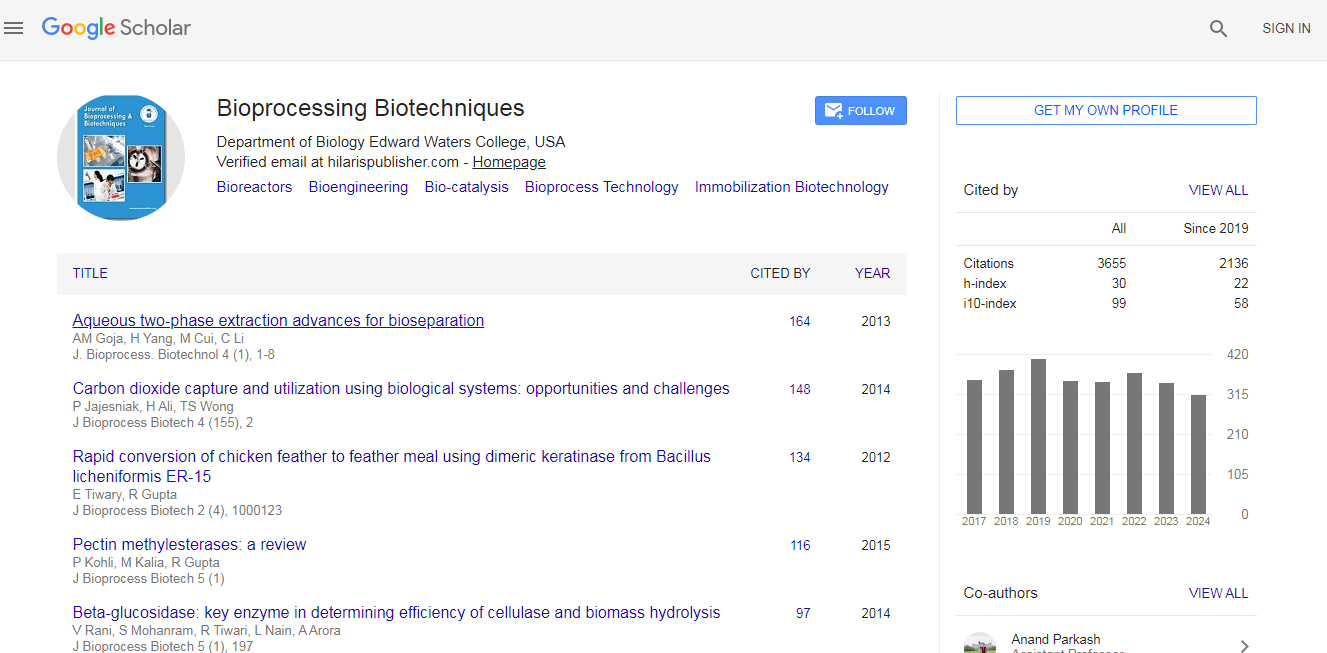
Journal of Bioprocessing & Biotechniques received 3351 citations as per Google Scholar report