Commentary - (2025) Volume 9, Issue 4
Received: 01-Aug-2025, Manuscript No. jgge-25-174626;
Editor assigned: 04-Aug-2025, Pre QC No. P-174626;
Reviewed: 18-Aug-2025, QC No. Q-174626;
Revised: 22-Aug-2025, Manuscript No. R-174626;
Published:
29-Aug-2025
, DOI: 10.37421/2684-4567.2025.9.181
Citation: Harper, Elliot J.. ”Computational Biology Transforms Genomic and Cellular Analysis.” J Genet Genom 09 (2025):181.
Copyright: © 2025 Harper J. Elliot This is an open-access article distributed under the terms of the Creative Commons Attribution License, which permits unrestricted use,
distribution and reproduction in any medium, provided the original author and source are credited.
The landscape of computational biology is rapidly evolving, driven by the need to analyze increasingly complex biological data. For instance, Seurat V3 represents a significant advance as a computational toolkit specifically designed for integrating diverse single-cell datasets, including multimodal data like CITE-seq. It presents methods for efficiently analyzing millions of cells and harmonizing data across different experimental batches or technologies, which is crucial for uncovering subtle biological patterns and cell states [1].
A major force behind these advancements is the growing influence of deep learning models across numerous computational biology challenges. This technology is being applied to genomics, proteomics, and imaging, demonstrating its capacity to predict functional consequences of genetic variations and classify disease states. Furthermore, deep learning accelerates drug discovery, although interpretability challenges still exist within this powerful framework [2].
Beyond individual cells, tools are emerging to analyze broader genomic landscapes and microbial communities. The Pangenome Graph Builder (PGB) is an example, specifically designed to construct and analyze graph-based pan-genomes derived from thousands of bacterial genomes. This enables researchers to efficiently identify core and accessory genes, discover structural variations, and gain insights into the evolutionary dynamics across diverse microbial populations [3].
The processing and interpretation of diverse sequencing data types remain a cornerstone of modern biology and medicine. For instance, computational strategies are well-developed for profiling and interpreting Whole-Genome Bisulfite Sequencing (WGBS) data to analyze DNA methylation. These methods cover essential steps such as alignment, methylation calling, differential methylation analysis, and functional interpretation, offering crucial guidance for epigenetics researchers [4].
Furthermore, the pursuit of a complete and accurate human genome sequence has been significantly boosted by advancements in long-read sequencing technologies, like PacBio and Oxford Nanopore. These innovations overcome the inherent limitations of short-read sequencing, particularly in resolving complex genomic regions, structural variants, and highly repetitive sequences [5].
In a clinical context, robust frameworks and best practices have been established for the clinical interpretation of somatic and germline sequence variants in cancer patients. These guidelines integrate various data types and evidence levels to classify variants based on their pathogenicity and clinical significance, thereby supporting precision oncology initiatives [6].
Building on deep learning applications, these methods are also revolutionizing the analysis of spatial transcriptomics data. Advanced algorithms are now available for denoising, dimension reduction, and cell type deconvolution. They are also adept at identifying spatially organized gene expression patterns, which are critical for gaining a deeper understanding of tissue biology [7].
Similarly, the field of metagenomics has seen significant advancements in computational tools. These approaches address challenges like taxonomic profiling, functional annotation, assembly, and binning of microbial communities, providing deeper insights into complex ecosystems and their roles in health and disease [8].
Moreover, the analysis of CRISPR-Cas screening data benefits from specialized bioinformatics tools and workflows. These methods are crucial for identifying essential genes, drug targets, and genetic interactions, offering the computational strategies needed to extract meaningful biological insights from large-scale perturbation experiments [9].
Finally, the broader field of population genetics leverages bioinformatics pipelines and tools for studies utilizing Next-Generation Sequencing (NGS) data. This includes critical topics such as variant calling, population structure analysis, inference of demographic history, and detection of selection signatures, all essential for understanding genetic diversity and evolutionary processes [10].
The analytical landscape of biological research is increasingly shaped by sophisticated computational tools. A prime example is Seurat V3, a computational toolkit engineered for the seamless integration of diverse single-cell datasets, including complex multimodal data such as CITE-seq. This platform provides efficient methodologies for analyzing millions of cells and is vital for harmonizing data across disparate experimental batches or technologies, a process critical for discerning subtle biological patterns and cell states [1]. Complementing this, deep learning models are profoundly reshaping numerous computational biology domains. Their application spans genomics, proteomics, imaging, demonstrating significant capability in predicting the functional outcomes of genetic variations and classifying various disease states. Deep learning also plays a crucial role in accelerating drug discovery, although considerations around interpretability persist [2]. Furthermore, deep learning methods are proving transformative in the analysis of spatial transcriptomics data. These advanced algorithms enable critical functions like denoising, dimension reduction, and cell type deconvolution, alongside identifying spatially organized gene expression patterns, all indispensable for a deep understanding of tissue biology [7].
Expanding on foundational genomic analysis, specialized tools address large-scale structural and compositional insights. The Pangenome Graph Builder (PGB), for instance, offers a robust framework for constructing and analyzing graph-based pan-genomes derived from thousands of bacterial genomes. This capability is essential for researchers aiming to identify core and accessory genes, uncover structural variations, and elucidate evolutionary dynamics across diverse microbial populations [3]. The pursuit of a complete and accurate human genome sequence has also seen remarkable progress due to advancements in long-read sequencing technologies, notably PacBio and Oxford Nanopore. These innovations are instrumental in overcoming the inherent limitations of short-read sequencing, particularly when resolving complex genomic regions, intricate structural variants, and highly repetitive sequences [5]. Moreover, the field of metagenomics benefits from recent advances in computational methods. These tools are tailored to address challenges in taxonomic profiling, functional annotation, assembly, and binning of microbial communities, thereby providing deeper insights into complex ecosystems and their roles in both health and disease contexts [8].
Interpreting epigenetic modifications and genetic variations within populations forms a critical pillar of modern biological inquiry, heavily relying on computational rigor. Computational strategies are well-established for processing and interpreting Whole-Genome Bisulfite Sequencing (WGBS) data to precisely profile DNA methylation. These methods encompass vital steps such as alignment, methylation calling, differential methylation analysis, and functional interpretation, offering invaluable guidance for researchers in epigenetics [4]. Simultaneously, bioinformatics pipelines and tools are indispensable for conducting population genetic studies that utilize Next-Generation Sequencing (NGS) data. These approaches are fundamental for tasks like variant calling, analyzing population structure, inferring demographic history, and detecting signatures of selection, all of which are crucial for understanding genetic diversity and broader evolutionary processes [10].
In a clinical context, a structured framework of best practices has been developed for the clinical interpretation of somatic and germline sequence variants in cancer patients. This framework integrates diverse data types and evidence levels to meticulously classify variants based on their pathogenicity and clinical significance, thereby forming a cornerstone for advancing precision oncology efforts [6]. The accurate assessment of these variants is paramount for guiding treatment decisions and improving patient outcomes, emphasizing the role of robust computational interpretation in personalized medicine.
Finally, the analysis of functional genomics, particularly through large-scale perturbation experiments like CRISPR-Cas screens, relies extensively on specialized computational tools and workflows. These bioinformatics approaches are crucial for dissecting CRISPR-Cas screening data, offering methods designed to identify essential genes, drug targets, and complex genetic interactions. The robust computational strategies embedded in these tools are indispensable for extracting meaningful biological insights from the vast datasets generated by such experiments, driving forward discovery in understanding gene function and therapeutic targets [9]. The integration of these diverse computational methodologies across various biological fields underscores their indispensable role in current and future research endeavors.
Recent advancements in computational biology are transforming how we analyze complex genomic and cellular data. Tools like Seurat V3 allow for the integration of diverse single-cell datasets, including multimodal data, facilitating the analysis of millions of cells and the harmonization of data across experiments. Deep learning models are increasingly important across genomics, proteomics, and imaging, predicting genetic variation consequences, classifying diseases, and accelerating drug discovery. For bacterial genomics, Pangenome Graph Builder efficiently analyzes thousands of genomes, identifying core and accessory genes and structural variations. Computational methods are also crucial for profiling DNA methylation from Whole-Genome Bisulfite Sequencing (WGBS) data, covering alignment, calling, and differential analysis. Long-read sequencing technologies are making significant strides toward complete human genome sequences by overcoming short-read limitations in complex regions. Precision oncology benefits from best practices for interpreting somatic and germline sequence variants in cancer patients. Deep learning extends its reach to spatial transcriptomics, enhancing denoising, dimension reduction, and identification of spatially organized gene expression. Metagenomics also sees advances in computational tools for taxonomic profiling, functional annotation, assembly, and binning of microbial communities. Finally, bioinformatics pipelines are vital for population genetic studies using Next-Generation Sequencing (NGS) data, covering variant calling, population structure, and evolutionary dynamics, providing broad insights into genetic diversity.
None
None
Timothy S, Andrew B, Paul H. "Integrated analysis of multimodal single-cell data".Cell 177 (2019):1888-1901.e21.
Indexed at, Google Scholar, Crossref
James Z, Mikael H, Ali A. "Deep learning for computational biology".Cell Syst 8 (2019):24-34.e11.
Indexed at, Google Scholar, Crossref
Adam AG, Simon S, Matthew TL. "The Pangenome Graph Builder: Graph-based pan-genome analysis of thousands of bacterial genomes".Genome Biol 21 (2020):206.
Indexed at, Google Scholar, Crossref
Yi L, Shuaicheng L, Yang S. "Computational methods for profiling and analyzing DNA methylation from whole-genome bisulfite sequencing".Genome Biol 22 (2021):167.
Indexed at, Google Scholar, Crossref
Gabriel AL, Matthew RV, Evan EE. "Towards a complete human genome sequence: Recent progress in long-read sequencing and assembly".Annu Rev Genomics Hum Genet 21 (2020):195-217.
Indexed at, Google Scholar, Crossref
Shana AS, Elena HT, Shirley KH. "Best practices for interpreting pathogenicity of sequence variants in cancer".Genet Med 24 (2022):833-843.
Indexed at, Google Scholar, Crossref
Wei Z, Xiangyu W, Qiong W. "Deep learning for spatial transcriptomics".Nat Rev Genet 24 (2023):605-621.
Indexed at, Google Scholar, Crossref
Du-Thien T, Alexander T, Edoardo P. "Recent advances in computational methods for metagenomics".Brief Bioinform 21 (2020):729-743.
Indexed at, Google Scholar, Crossref
Jiatong M, Hang H, Kevin T. "Computational tools for analyzing CRISPR-Cas screens".Genome Biol 21 (2020):172.
Indexed at, Google Scholar, Crossref
Shuaibin L, Mingming L, Shaobo W. "Bioinformatics approaches for population genetic studies with next-generation sequencing data".Genes (Basel) 11 (2020):410.
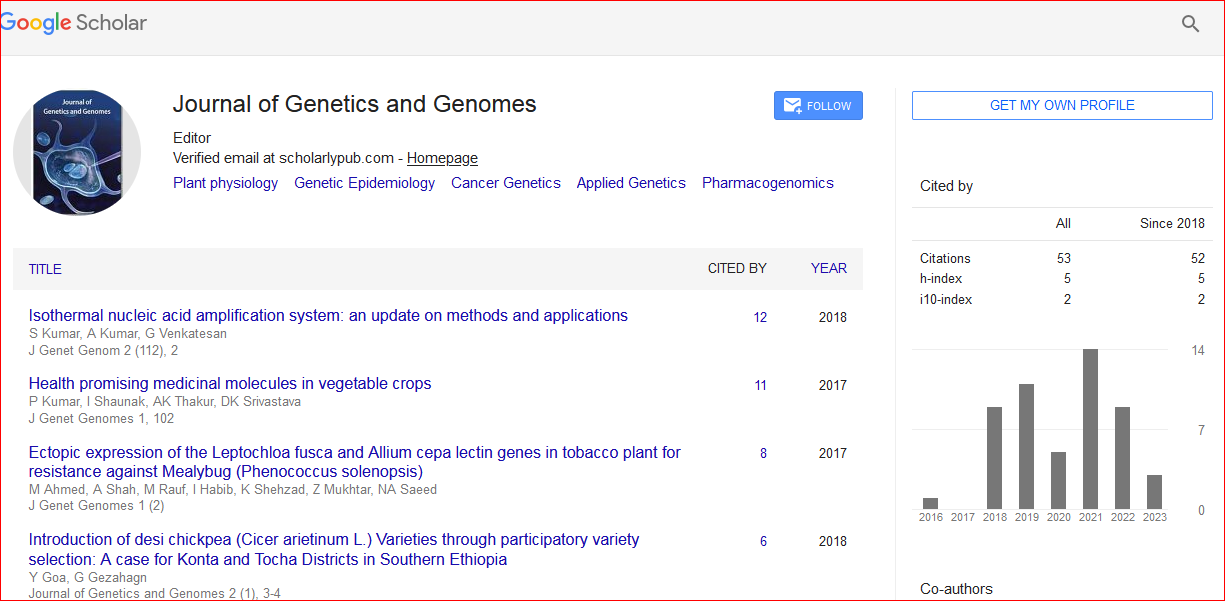
Journal of Genetics and Genomes received 65 citations as per Google Scholar report