Commentary - (127) Volume 15, Issue 2
Received: 01-Apr-2025, Manuscript No. jeat-26-188602;
Editor assigned: 03-Apr-2025, Pre QC No. P-188602;
Reviewed: 17-Apr-2025, QC No. Q-188602;
Revised: 22-Apr-2025, Manuscript No. R-188602;
Published:
29-Apr-2025
, DOI: 10.37421/2161-0525.2025.15.843
Citation: Hassan, Fatima. ”Agricultural Runoff: Threatening
Aquatic Ecosystem Health.” J Environ Anal Toxicol 15 (2025):843.
Copyright: © 2025 Hassan F. This is an open-access article distributed under the terms of the Creative Commons Attribution License, which permits unrestricted use,
distribution and reproduction in any medium, provided the original author and source are credited.
Agricultural runoff represents a significant conduit through which various contaminants infiltrate aquatic ecosystems. These pollutants, originating from diverse agricultural practices, pose a substantial threat to the health and integrity of freshwater and marine environments, necessitating a comprehensive understanding of their ecotoxicological impacts.
[1] The environmental toxicology of common agricultural contaminants, including pesticides, fertilizers, and heavy metals, has been synthesized, highlighting their persistence, bioaccumulation potential, and adverse effects on aquatic organisms. These effects range from endocrine disruption and developmental abnormalities to population declines, underscoring the urgency of addressing this issue. [2] Among the contaminants of concern are neonicotinoid insecticides, widely employed in agriculture and increasingly detected in surface waters due to runoff. Studies have investigated their sub-lethal effects on aquatic invertebrates, such as the freshwater shrimp Gammarus pulex, revealing impacts on oxidative stress biomarkers and behavioral changes. [3] Glyphosate, a prevalent herbicide in agricultural settings, is also a concern when present in agricultural runoff. Research has explored its environmental fate, persistence in soil and water, potential for leaching, and its impact on non-target aquatic organisms, including algae and fish, with findings indicating risks associated with formulated products. [4] Nitrate and phosphate pollution, stemming from agricultural fertilizers in runoff, is a primary driver of eutrophication in aquatic ecosystems. Elevated nutrient levels can negatively affect the physiological performance and community structure of phytoplankton, leading to significant ecological imbalances. [5] Heavy metals, such as copper and zinc, can accumulate in agricultural soils and subsequently be transported into surface waters via runoff. Chronic toxicity studies on aquatic invertebrates have revealed impacts on reproduction and survival, alongside concerns regarding biomagnification and long-term ecological consequences. [6] The endocrine-disrupting potential of pesticide metabolites, commonly found in agricultural runoff, is a critical area of investigation. These compounds can interfere with hormonal systems in aquatic vertebrates, leading to reproductive impairments, developmental abnormalities, and altered behavior. [7] Pharmaceutical residues, often originating from veterinary applications in agriculture, are emerging contaminants in surface waters. Their ecotoxicity on beneficial microbial communities in aquatic sediments can disrupt vital ecosystem processes, impacting functional diversity and microbial activity. [8] The combined toxic effects of multiple pesticides present in agricultural runoff on freshwater algae have been examined, revealing complex synergistic and antagonistic interactions. These mixtures can exhibit greater or lesser toxicity than individual compounds, complicating accurate risk assessment. [9] Surfactants, frequently incorporated into pesticide formulations, are also found in agricultural runoff. Their impact on fish gills, including histopathological changes and physiological stress, has been documented, along with their capacity to enhance the uptake of other pollutants.Agricultural runoff serves as a critical pathway for the introduction of a wide array of contaminants into aquatic ecosystems. These contaminants, stemming from agricultural activities, exert significant pressure on aquatic life and ecosystem health. Understanding the multifaceted nature of these pollutants and their interactions is paramount for effective environmental stewardship.
[1] The environmental toxicology of prevalent agricultural contaminants, namely pesticides, fertilizers, and heavy metals, has been extensively reviewed. This synthesis highlights their recalcitrance in the environment, their propensity for bioaccumulation within food webs, and their detrimental effects on aquatic organisms. These impacts are diverse, encompassing endocrine disruption, teratogenic effects, and population-level declines, emphasizing the broad ecological ramifications. [2] Neonicotinoid insecticides, a class of chemicals extensively used in modern agriculture, are frequently detected in surface waters due to their susceptibility to runoff. Research has delved into the sub-lethal impacts of specific neonicotinoids, such as imidacloprid, on key freshwater invertebrates like Gammarus pulex, identifying disruptions in oxidative stress pathways and significant alterations in locomotion, which raises considerable ecological concerns. [3] Glyphosate, a herbicide of global importance in agricultural production, presents environmental challenges when present in agricultural runoff. Investigations have focused on its persistence in both soil and aquatic matrices, its potential for groundwater contamination through leaching, and its ecotoxicological effects on non-target aquatic flora and fauna, revealing that formulated products may pose greater risks than the active ingredient alone. [4] The influx of nutrients, particularly nitrates and phosphates, from agricultural fertilizers carried by runoff is a principal cause of eutrophication in both freshwater and marine environments. Elevated nutrient concentrations can severely compromise the physiological integrity and disrupt the community dynamics of phytoplankton, the base of many aquatic food webs. [5] Heavy metals, including essential micronutrients like copper and zinc, can reach elevated levels in agricultural soils and subsequently enter surface waters via runoff. Chronic toxicity studies involving standard ecotoxicological test organisms like Daphnia magna have demonstrated adverse effects on reproductive output and survival rates, alongside potential biomagnification through the food chain. [6] The endocrine-disrupting capabilities of pesticide metabolites, frequently identified in agricultural runoff, are a significant concern. These transformation products can mimic or interfere with endogenous hormones in aquatic vertebrates, leading to a cascade of reproductive dysfunctions, developmental anomalies, and aberrant behaviors. [7] Pharmaceutical residues, often introduced into the environment through veterinary practices in agriculture, are increasingly recognized as emerging contaminants in aquatic systems. The ecotoxicity of common antibiotics found in agricultural runoff on crucial aquatic sediment microbial communities has been assessed, revealing potential disruptions to essential biogeochemical cycles. [8] The complex interactions and combined toxic effects of pesticide mixtures commonly found in agricultural runoff on freshwater algae have been investigated. These studies reveal that the aggregate toxicity of mixtures can be greater or lesser than that of individual components due to synergistic or antagonistic interactions, posing challenges for regulatory risk assessment. [9] Surfactants, widely utilized as adjuvants in agricultural pesticide formulations, are also transported to aquatic ecosystems via runoff. Their detrimental effects on fish gills, manifesting as histopathological damage and physiological stress, have been documented, alongside evidence suggesting they can enhance the absorption of other co-occurring contaminants.Agricultural runoff is a major source of contaminants like pesticides, fertilizers, and heavy metals entering aquatic ecosystems. These pollutants cause a range of adverse effects on aquatic organisms, including endocrine disruption, developmental issues, and population declines. Specific concerns include the sub-lethal impacts of neonicotinoid insecticides on invertebrates, the toxicity of glyphosate formulations, and nutrient pollution leading to eutrophication. Heavy metals can bioaccumulate, while pesticide metabolites and veterinary antibiotics disrupt hormonal systems and microbial communities, respectively. Mixtures of pesticides can have complex toxicological interactions, and surfactants can damage fish gills and increase pollutant uptake. Emerging contaminants like microplastics carrying pesticides also pose risks. Effective environmental management and policy development are crucial for mitigating these widespread threats to aquatic health.
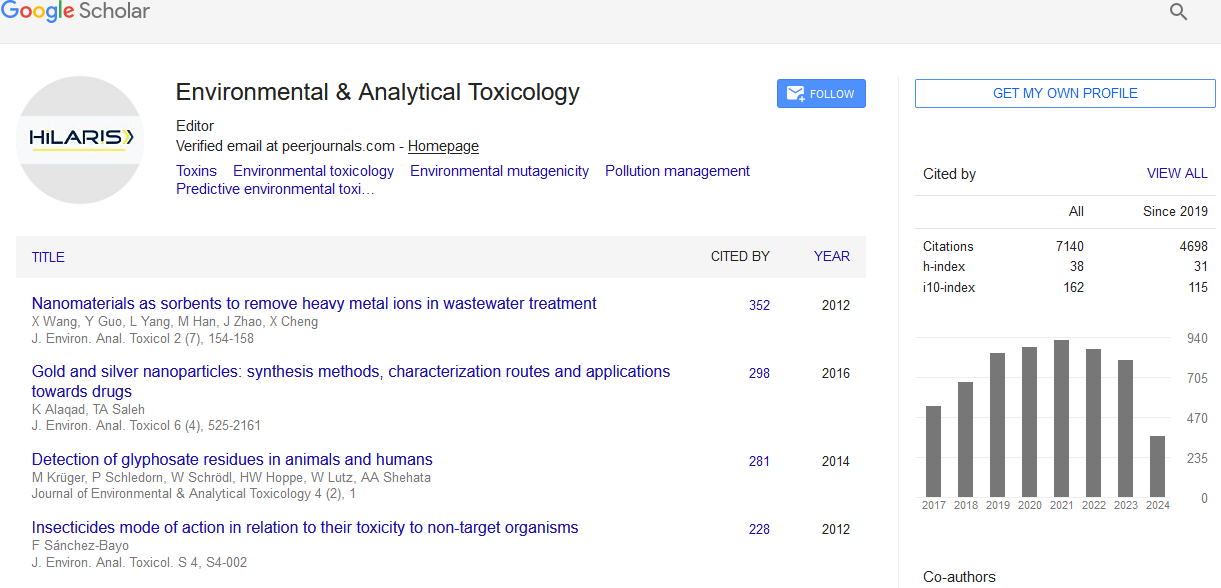
Environmental & Analytical Toxicology received 6818 citations as per Google Scholar report