Original Research Article - (2022) Volume 12, Issue 6
Received: 13-Jun-2022, Manuscript No. jeat-22-66455;
Editor assigned: 14-Jun-2022, Pre QC No. P-66455;
Reviewed: 20-Jun-2022, QC No. Q-66455;
Revised: 24-Jun-2022, Manuscript No. R-66455;
Published:
30-Jun-2022
, DOI: 10.37421/2161-0525.2022.12.660
Citation: Ogbe, Idoko, Okan Ehgomare Hillary, Jennifer Ene Idoko, and Ogbonye Chinedu Onyemaechi, et al. “Comparative Study of Formulated Mosquito Repellant Gel with Conventional Market Gel.” J Environ Anal Toxicol 12 (2022): 660.
Copyright: © 2022 Ogbe I, et al. This is an open-access article distributed under the terms of the Creative Commons Attribution License, which permits unrestricted use, distribution, and reproduction in any medium, provided the original author and source are credited.
Synthetic chemical mosquito repellents based on deet were discovered to be harmful to persons suffering from diseases such as urea cycle disorders and thus cause contraindication in humans. These worrisome conditions necessitated the search for natural mosquito repellents that is cheap, effective, non-toxic, environment-friendly, and biodegradable. The global needs inspired the passion to research on mosquito repellant gel formulation using carbopol 940 prepared from oils obtained from essential plant of lemongrass, black pepper, turmeric, ginger, nimes and garlic and further evaluating the formulated gels repellence, appearance, PH, viscosity, spread ability, and swelling index. The mosquito repellent potential was evaluated and simultaneously compared with the positive control (bnc). In many developing nations of the world including nigeria, majority of the people do not have access to mosquito net, expensive mosquito repellant creams, and miscellaneous physical methods, this optimized gel in this research were evaluated and found to be effectual, inexpensive, and easily accessible way to prevent mosquito-borne diseases with environmental friendly potential as a way of preventing outbreak of malaria, and other diseases.
Mosquito • Repellent • Malaria •Gel • Formulation • DEET
Living organisms known as vectors are responsible for transmitting infectious diseases between humans or from animals to humans. Two types of vectors exist, namely; mechanical vector which transmit pathogens usually by transporting them using their feet or mouthparts and biological vector whose life-cycle of parasite must pass through the vector in order to effectively mature to a stage capable of being transmitted to human or animal host when suck vector sucks a blood meal. Mosquitoes are typical disease vector that majorly of transmit most important vector-borne diseases. Internationally, tropical and sub-tropical regions are primarily affected by vector-borne diseases as reported [1]. Mosquitoes are liable to most of the important vector-borne diseases such as encephalitis, malaria, dengue, chikungunya, Zika virus, and yellow fever transmitted. Prior to the advent of synthetic pesticides which is widely used now today, every indigenous African communities including Nigeria were using various plants and animals based extracts to control pests from attacking and destroying their crops plants both before and after harvest. Currently, in order to prevent mosquito-borne diseases, control of mosquito larval growth and personal protection from mosquito bites, many residents use mosquito nets and mosquito repellent remains the best methods [2,3]. And observed that many scientific innovations include mosquito vaccines are underway; however, it is still at development level and not fully matured for human use. To complete eliminate adult mosquito and mosquito larva across the globe, synthetic pesticide like dichloro diphenyl trichloroethane (DDT) was used few decades, but mosquitoes have the potential to developed rapid resistance when applied, this became a great concerns for all humans and there is urgent need to for the solution [4].
Many brands of synthetic pesticide are commercially sold in the market today containing, Ndiethyl-meta-toluamide (DEET) based mosquito repellent. Larger population across the world started patronizing these DEET based mosquito repellents in order to overcome the menace caused by mosquito [5]. It was a big success for manufacturers of such products until it was observed that the active chemical component causes toxicity with hyperammonemia and encephalopathy in children when inhaled after ingestions and applications [6]. DEET was discovered to be harmful to the persons with urea cycle disorders such as ornithine transcarbamylase deficiency thus causes contraindication in individuals [7]. These conditions can leads to budding necessity of natural mosquito repellents which is, effectual, non-toxic, inexpensive, biodegradable attributes and environmental friendly. In an attempt to meet the global need, carbopol 940 which is a based mosquito repellent gel was formulated from the essential oils of lemongrass, black pepper, Turmeric, Nimes, Ginger and Garlic. Further evaluation was carried out on the formulated gels for their appearance, pH, ability to spread, viscosity, and swelling index.
The spectroscopic analysis was done using double beam ultraviolet-visible spectrophotometer in nasco group of company plateau state and connected to a computer. Samples were weighed with help of shimadzu balance. The PH was measured using digital PH meter. The brookfield digital viscometer was used to estimate the viscosity. Chemicals oils of lemongrass, black pepper, turmeric, ginger and garlic were commercially procured from chuks shop in terminus plateau state. All chemicals, solvents obtained and used for this research were of analytical grade.
Samples collections and preparation
The leaves of lemongrass, black pepper, turmeric, nimes, ginger and garlic were collected from jos plateau state and authenticated in the federal college of forestry jos plateau state.
Extraction of essential oils
The lemongrass, black pepper, turmeric, ginger, nimes and garlic leaves were suitably powdered (100 g) and subjected to hydro distillation. Water was added to plant weighed in a round bottom flask which was then placed on a heating mantle. Water was allowed to flow in the condenser while boiling to reduce overheating, the volatile oils were delivered along with the steam into the distillate receiving tube and excess water was made to return to the flask. A mixture of dichloromethane and diethyl ether at 1:1 ratio was added to the distillation arm. The essential oils were made to dissolve in the organic solvent mixture present in the graduated. Continuous heating was maintained for about 10 hours duration and was allowed to cool. Both the aqueous layer and the organic layer were collected separately. The organic part was allowed to dry over anhydrous sodium sulphate and the aqueous layer was extracted double with dichloromethane. Finally, to obtain the essential oil, the combined solvents were evaporated. The essential oils were weighed and stored in the refrigerator at the temperature of 4ºc ready for use in the experimental process [8].
Preparation of gel formulation
The formulated gel containing 12.5% v/v of active ingredients was prepared by using conventional method (Table 1).
| Essential oils | F1 | F2 | F3 |
|---|---|---|---|
| Lemongrass oil | 2 Ml | 2 mL | 2 mL |
| Black pepper oil | 2 mL | 2 mL | 2 mL |
| Turmeric oil | 2 mL | 1.5 mL | 1.5 mL |
| Ginger oil | 0.5 mL | 0.25 mL | 0.25 mL |
| Garlic oil | 2 mL | 1.5 mL | 1 mL |
| Nimes oil | 3 mL | 2.5 mL | 2.5 mL |
| Ethanol | 1 mL | 1 mL | 1 mL |
| Carbopol 940 | 1.3 g | 2.5 g | 2 g |
| Propylene glycol | 5 mL | 5 mL | 5 mL |
| Methyl paraban | 0.3 g | 0.3 g | 0.3 g |
| Tween 80 | 3 mL | 3 mL | 3 mL |
| Triethanolamin | qs | qs | qs |
| Distilled water | qs | qs | qs |
Evaluation of the formulated gel
Physical evaluation: The formulated gel was analyzed visually for appearance, color, and transparency. The smoothness of the gel was also determined by rubbing the formulations between the fingers to observe the level of smoothness, homogeneity clumps, and roughness accordingly [9].
Wash- ability: The ability of formulated gels to wash was determined by applying the gel on the skin and observing the ease and the degree of washing strength with distilled water and manually [10].
Skin irritation test: The formulations in the quantity of 1 g was applied to the normal hairless skin at area coverage of about 5 cm and then covered with a semi-occlusive bandage for the duration of 60 minutes. The bandage was removed after the application time, the applied gel was completely scrapped off, and the visually inspected for any rashes or similar symptoms. The test was done for a period of one week. The results were expressed in terms of grades [11].
Spreadability: The spreadability of the formulations was determined based on the principle of the slip-drag feature of the poly-herbal dermal gel. This involved taking 2 g of each formulation, placing it on a ground slide and sandwiching it by an analogous glide slide, containing a hook attached. A load of heavy mass was applied to the slides to remove the entrapped air so as to form a uniform film between the slides. The gel in excess content was scrapped off from the edges. Observing it, the top slide was made to drag 50 g intensity [12]. The time needed by the top slide to cover a distance of 5 cm was determined from the formula:
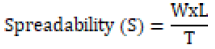
Where, W = weight tied to the upper slide (20 g); L = length of glass slide (5 cm); T = time taken (sec) to separate the glide slides from each other. The pH of the dermal gel was also determined with the digital calibrated pH meter. 1 g of the formulated gel was dissolved in 25 mL of distilled water and the glass electrode was dipped into it until constant reading obtained. The pH measurement was performed thrice for each formulation and the average reading was recorded [13].
Viscosity: The formulation viscosity was determined by using the Digital Brookfield Viscometer with spindle no. 6 at 10 rpm and temperature of about 25±1°C. Sufficient quantity of gel was applied in appropriate wide mouth container in such way that it should be able to allow one dipped the spindle and settle over 30 min before the measurements [14].
Swelling index: The prepared dermal polyhedral gel was evaluated for swelling index by taking 5g of gel in a beaker containing 10 mL of distilled water. After 60 minutes, the swelled formulation was removed from the beaker and was inserted on a petridish [15].
The composition was re-weighed and the swelling index was determined using the formula:

Where, Wt = means weight of swollen at t time; Wo = means original weight of gel at zero time.
Accelerated stability studies: The optimized formulated gel was subjected to accelerated stability study (40°C±5°C temperature; 65%±10% relative humidity) for the duration of 3 months. The formulated gel prepared was kept in a amber bottle container and covered with a black foil. Important parameters such as physical appearance, pH, viscosity, spreadibility, and were evaluated [16].
Bio-Mosquito repellent activity: The forearm of volunteers was thoroughly washed with soap and completely dried. The arm at the left served as the control that was kept inside the mosquito cage. The vector frequency at which the mosquito landed on the forearm is in the duration of 30 seconds. If the mosquitoes landed >10 then the study is commenced. After 30 seconds of the duration time, the arm was carefully removed from the mosquito cage. The right arm smudged with mosquito repellent gel formulation was entered and analogously the study was performed by varying the time at 1, 2, 4, and 8 hours respectively. The number of mosquitoes that landed was recorded and compared with the positive control [17-20]. The study was carried out in three times in the same manner.
All the three optimized gel formula F1-F3 showed a light brown colour, that is less translucent, the mixture is homogenously smooth with good appearance and no solid particles or grittiness observed when feels or touch between the fingers. The concentration of carbopol 940 in the fabricated gel formulations largely influenced the translucency. When the carbopol 940 percentage is lowered, it leads to enhanced clarity of the gel formulations. On the application of the gel formulations for 1 week, no skin irritation, no rashes, no dermatological reaction or specific inflammation. The washability shows brilliant attribute as observed in all the three developed formulations (Table 2). The pH of the formulated gels was found to be in the range of 7.0-7.2 which falls within the normal skin pH range. Viscosity which is an important parameter that influences pharmaceutical properties like spreadability, pourability was evaluated and it lies in the range of 44500- 52800 cps. The optimized gels demonstrated the spreadability in the range of 12.21-14.82 g.cm/sec which is an indication that the gel formulation could easily be spread by a small amount of forced applied. The spreadability and viscosity studies revealed that with an enhancement in the formulation viscosity, the spreadability reduces progressively. This was observed in the range of 104-118% was recorded as the swelling index of the formulations. The swelling index indicates the matrix nature of the gel formulation which enhances the controlled release of the gels (Table 3).
| Gels | Colour | Transparency | Smoothness | Washability | Irritability |
|---|---|---|---|---|---|
| F1 | Brown | Less Translucent | Smooth | Good | No irritation |
| F2 | Brown | Translucent | Smooth | Good | No irritation |
| F3 | Brown | More Translucent | Smooth | Good | No irritation |
| Formulation (g.cm/sec) | pH | Spreadability | Viscosity (cp) | Swelling index |
|---|---|---|---|---|
| F1 | 7.2 | 14.82 | 52800 | 104 |
| F2 | 7.1 | 13.44 | 48000 | 110 |
| F3 | 7.0 | 12.21 | 44500 | 118 |
The three formulations were subjected to accelerated conditions at (40±5°c and 75±10% rh) for 3 months, no substantial disparity in the ph was observed in f3, viscosity, spreadability, swelling index, and physical appearance were detected. A change in ph of f3 by 0.01, results in corresponding changes in viscosity by 300 cps, swelling index by 9%, and spreadability by 0.79 gcm/sec however, physical appearance, translucency, and smoothness do not record any changes as seen after the study. The formulation in general remains stable for the 3 months duration and is expected to remain in his original form for a longer period in tropical and sub-tropical regions. The optimized gel f3 has the highest mosquito repellent actions of 85.27% in the 0th hour and continued up to 83.06% in the 3rd hour. The formulations f1 and f2 demonstrated less activity 77.33% to 78.69% after 3 hours, while the standard product bnc presented nearly 98.01% efficacy after the lapse of 3rd hour (Tables 4,5).
| Duration | pH | Spreadability (g.cm/sec) | Viscosity (cp) | Swelling index (%) |
|---|---|---|---|---|
| 0th Day | 7.0 | 14.82 | 44500 | 118 |
| 90th Day | 7.01 | 15.61 | 44200 | 109 |
| Repellency (%) | ||||
|---|---|---|---|---|
| Treatment Stability | 0 | 1hr | 2 hr | 3 hr |
| Positive control | 100±0.16 | 99.15±0.23 | 98.46±0.26 | 98.01±0.39 |
| F1 | 82.19±0.86 | 80.28±0.13 | 79.45±0.21 | 77.33±0.33 |
| F2 | 84.29±0.46 | 81.39±0.96 | 79.07±0.59 | 78.69±0.44 |
| F3 | 85.27±0.15 | 84.03±0.55 | 83.84±0.88 | 83.06±0.99 |
The six different essential oil bio- mosquito repellent gel formula optimization was proved to be an effective alternative measure in preventing mosquito-borne diseases due to its effectiveness, non-toxic, inexpensive, biodegradable attributes and environmental friendly. In several developing nations, where the majority of the people do not have access to mosquito net, and high-cost mosquito repellents creams, this formulated gel may be used as a safe and effective ways to prevent mosquito-borne diseases.
Google Scholar, Crossref, Indexed at
Google Scholar, Crossref, Indexed at
Google Scholar, Crossref, Indexed at
Google Scholar, Crossref, Indexed at
Google Scholar, Crossref, Indexed at
Google Scholar, Crossref, Indexed at
Google Scholar, Crossref, Indexed at
Google Scholar, Crossref, Indexed at
Google Scholar, Crossref, Indexed at
Google Scholar, Crossref, Indexed at
Google Scholar, Crossref, Indexed at
Google Scholar, Crossref, Indexed at
Google Scholar, Crossref, Indexed at
Google Scholar, Crossref, Indexed at
Google Scholar, Crossref, Indexed at
Google Scholar, Crossref, Indexed at
Google Scholar, Crossref, Indexed at
Google Scholar, Crossref, Indexed at
Google Scholar, Crossref, Indexed at
Environmental & Analytical Toxicology received 6818 citations as per Google Scholar report