Commentary - (2025) Volume 16, Issue 3
Received: 01-Apr-2025, Manuscript No. hycr-25-172519;
Editor assigned: 03-Apr-2025, Pre QC No. P-172519;
Reviewed: 17-Apr-2025, QC No. Q-172519;
Revised: 22-Apr-2025, Manuscript No. R-172519;
Published:
29-May-2025
, DOI: 10.37421/2157-7587.2025.16.559
Citation: Hugo Lefevre. "Climate Change: Impacts, Strategies, Global Action."Hydrol Current Res 16(2025):559.
Copyright: © 2025 Lefevre.H This is an open-access article distributed under the terms of the Creative Commons Attribution License, which permits unrestricted use,
distribution and reproduction in any medium, provided the original author and source are credited.
The pervasive and escalating challenge of climate change is driving a cascade of impacts across the globe, necessitating an urgent and multifaceted response from societies worldwide. A significant body of research underscores the complexity and interconnectedness of these challenges, spanning environmental, social, and economic dimensions. This introduction compiles key insights from recent analyses that explore the broad spectrum of climate changeâ??s influence and the critical efforts towards mitigation and adaptation. Comprehensive reviews highlight the significant and often severe impacts of climate change on global agriculture and food security, meticulously analyzing vulnerabilities and the imperative for robust adaptation strategies. These impacts manifest through changes in crucial factors such as crop yields, the availability of water, increases in pest outbreaks, and shifts in livestock productivity, collectively emphasizing the undeniable need for the development of highly resilient agricultural systems to sustain future populations[1].
Alongside adaptation, mitigation remains a cornerstone of climate action. Recent developments in climate change mitigation policy within the European Union are actively reviewed, meticulously evaluating the effectiveness of diverse instruments like carbon pricing mechanisms, emissions trading schemes, and renewable energy mandates. This research provides a thorough discussion of the inherent challenges and substantial opportunities involved in striving to achieve ambitious emission reduction targets set by the Union[2].
Complementing these policy efforts, the critical and expanding role of renewable energy sources in actively mitigating climate change is examined, discussing the current technological status of key sources such as solar, wind, and hydropower. It further outlines the significant future prospects for their widespread deployment and more comprehensive integration into global energy systems, marking a crucial transition away from fossil fuels[4].
The health dimensions of climate change are profoundly impactful and global in scale. A comprehensive overview details the wide-ranging global health impacts of climate change, extending from the direct effects of heat-related illnesses and the accelerated spread of infectious diseases, to profound mental health challenges and escalating food insecurity. This overview critically underscores the extreme urgency for proactive public health interventions and robust policy responses to protect human well-being in a changing climate[3].
In a more focused analysis, the complex and often overlooked relationship between climate change and mental health is systematically explored, identifying precisely how various environmental stressors, including extreme weather events, forced displacement, and the phenomenon of ecological grief, significantly contribute to psychological distress. This area of research highlights the pressing need for integrated mental health support within broader climate action frameworks to address these growing human costs[10].
Ecological systems, the very foundation of planetary health, are under immense pressure. A global synthesis rigorously investigates the profound impacts of climate change on essential ecosystem services and biodiversity. It comprehensively details how pervasive phenomena such as rising temperatures, significantly altered precipitation patterns, and the increasing frequency of extreme weather events collectively threaten not only the delicate balance of ecological stability but also the vital services that underpin human well-being globally[5].
Similarly, the profound and detrimental impacts of ocean warming and acidification on critical marine organisms and their intricate ecosystems are synthesized, detailing how these fundamental climate change-driven processes pose severe threats to marine biodiversity, destabilize marine food webs, and ultimately compromise crucial marine ecosystem services that support vast populations[8].
Furthermore, the planetâ??s vital water resources are facing unprecedented changes. A global review thoroughly assesses the diverse impacts of climate change on water resources, encompassing significant changes in precipitation regimes, accelerated glacier melt rates, and ongoing sea-level rise. This review also proactively explores various adaptation strategies essential for achieving sustainable water management in regions most vulnerable to these hydrological shifts, ensuring future water security[6].
Addressing these environmental transformations at the local level, a specialized review delves into the significant challenges and burgeoning opportunities for building urban climate resilience. It meticulously examines how cities worldwide can effectively adapt to and actively mitigate the adverse effects of climate change through strategic implementation of green infrastructure, forward-thinking policy planning, and robust community engagement initiatives[7].
Finally, the critical intersection of climate change and pervasive social inequality is a vital area of research. This work clearly illustrates how vulnerable populations disproportionately bear the severe burdens of environmental degradation and the escalating impacts of climate change. It consequently proposes concrete solutions aimed at fostering genuine climate justice and promoting equitable adaptation strategies that protect and empower marginalized communities[9].
This collective body of research paints a compelling picture of a world grappling with the multifaceted consequences of climate change, emphasizing the indispensable role of both comprehensive scientific understanding and decisive global action.
Climate change manifests through a complex web of impacts spanning natural environments and human societies, necessitating extensive research into both its effects and potential solutions. The scientific community has actively documented how altered planetary conditions disrupt vital systems and disproportionately affect vulnerable communities, alongside exploring viable pathways for mitigation and adaptation.
One significant area of concern involves the natural environment. Research highlights the multifaceted impacts of climate change on global agriculture and food security, detailing changes in crop yields, water availability, pest outbreaks, and livestock productivity [1]. These findings emphasize the urgent need for resilient agricultural systems to cope with increasing volatility. Beyond agriculture, the profound impacts on ecosystem services and biodiversity are globally synthesized, revealing how rising temperatures, altered precipitation, and extreme weather threaten ecological stability and services crucial for human well-being [5]. Marine environments are similarly at risk, with studies synthesizing the severe impacts of ocean warming and acidification on marine organisms and ecosystems, which directly threaten biodiversity, food webs, and critical services provided by the oceans [8]. Water resources, too, are under threat; a global review assesses changes in precipitation, glacier melt, and sea-level rise, outlining various adaptation strategies for sustainable water management in vulnerable regions [6].
The human dimensions of climate change are equally pressing. The global health impacts are considerable, ranging from heat-related illnesses and the spread of infectious diseases to mental health challenges and exacerbated food insecurity, underscoring the necessity for robust public health interventions [3]. Notably, the complex interplay between climate change and mental health is systematically explored, identifying how environmental stressors like extreme weather events, displacement, and ecological grief contribute significantly to psychological distress, thereby emphasizing the crucial need for mental health support in climate action [10]. Moreover, the intersection of climate change and social inequality reveals how vulnerable populations disproportionately bear the burdens of environmental degradation and climate impacts, leading to calls for climate justice and equitable adaptation solutions [9].
In response to these pervasive challenges, significant efforts are focused on mitigation and resilience. Climate change mitigation policy within the European Union has been reviewed, evaluating the effectiveness of instruments such as carbon pricing, emissions trading, and renewable energy mandates, alongside discussions on achieving ambitious emission reduction targets [2]. Complementing policy, the critical role of renewable energy sources in mitigating climate change is examined, discussing the status of technologies like solar, wind, and hydropower, and outlining future prospects for their widespread deployment and integration into energy systems [4]. Building resilience is also paramount, particularly in urban settings. A review delves into the challenges and opportunities for urban climate resilience, examining how cities can adapt to and mitigate climate effects through green infrastructure, policy planning, and community engagement [7].
Collectively, this body of research underscores the immense scope of climate changeâ??s influence, from altering fundamental ecological processes to reshaping human well-being and societal structures. It provides comprehensive insights into the vulnerabilities faced by natural systems and human populations alike, while simultaneously highlighting innovative strategies for mitigation and adaptation. The findings across these reviews consistently advocate for urgent, integrated, and equitable approaches to address the ongoing climate crisis, emphasizing that successful responses will require a blend of technological innovation, informed policy, and robust community engagement to foster a sustainable and just future for all.
This collection of research highlights the extensive impacts of climate change across environmental, social, and economic spheres, alongside critical mitigation and adaptation strategies. Studies reveal profound effects on global agriculture and food security, impacting crop yields, water availability, and livestock, necessitating resilient systems [1]. Ecosystems and biodiversity suffer from rising temperatures and extreme weather, threatening ecological stability and vital services [5]. Marine life faces severe threats from ocean warming and acidification, impacting biodiversity and food webs [8]. Water resources are also compromised by changes in precipitation, glacier melt, and sea-level rise, requiring new management strategies [6]. Human populations experience significant health challenges, including heat-related illnesses, infectious disease spread, and mental health issues exacerbated by environmental stressors and displacement [3, 10]. Social inequality deepens as vulnerable communities disproportionately bear climate burdens, emphasizing the need for climate justice [9]. In response, mitigation efforts like the European Union's carbon pricing and renewable energy mandates are crucial for emission reduction [2, 4]. Cities are exploring green infrastructure and policy planning to build urban resilience [7]. Overall, this research collectively underscores the urgency for integrated, equitable, and comprehensive global action to address the multifaceted challenges of climate change and foster a sustainable future.
None
None
Indexed at, Google Scholar, Crossref
Indexed at, Google Scholar, Crossref
Indexed at, Google Scholar, Crossref
Indexed at, Google Scholar, Crossref
Indexed at, Google Scholar, Crossref
Indexed at, Google Scholar, Crossref
Indexed at, Google Scholar, Crossref
Indexed at, Google Scholar, Crossref
Indexed at, Google Scholar, Crossref
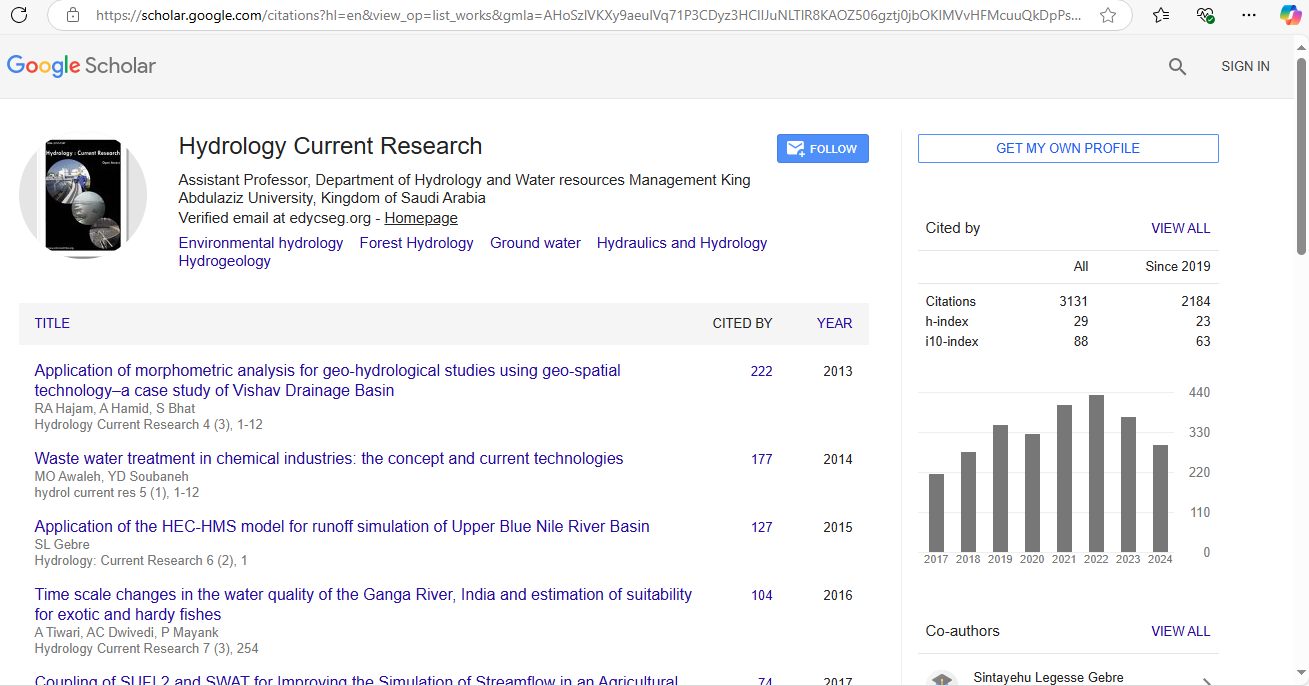
Hydrology: Current Research received 2843 citations as per Google Scholar report