Opinion - (2025) Volume 10, Issue 5
Received: 01-Oct-2025, Manuscript No. jcct-26-183268;
Editor assigned: 03-Oct-2025, Pre QC No. P-183268;
Reviewed: 17-Oct-2025, QC No. Q-183268;
Revised: 22-Oct-2025, Manuscript No. R-183268;
Published:
29-Oct-2025
, DOI: 10.37421/2577-0535.2025.9.331
Citation: OConnor, Benjamin T.. ”Cancer Prevention and Detection: Advancements Drive Progress.” J Cancer Clin Trials 10 (2025):331.
Copyright: © 2025 OConnor T. Benjamin This is an open-access article distributed under the terms of the Creative Commons Attribution License, which permits unrestricted use, distribution and reproduction in any medium, provided the original author and source are credited.
The landscape of cancer prevention and early detection is undergoing a significant transformation, driven by innovative research and clinical trials aimed at curbing the incidence and mortality of this devastating disease. These efforts are crucial for advancing our understanding of how to identify cancer at its earliest, most treatable stages, and for developing effective strategies to mitigate risk before cancer even develops. The integration of novel methodologies and technologies is paramount in this ongoing battle, promising a future where cancer is more effectively managed and potentially even prevented for a larger segment of the population. Central to these advancements are clinical trials that rigorously evaluate new approaches. These trials are instrumental in validating the efficacy of novel biomarkers, sophisticated imaging techniques, and promising chemoprevention agents. The imperative for including diverse patient populations in these studies cannot be overstated, as it ensures the generalizability of findings and promotes equitable application of new strategies across different demographics. This focus on inclusivity is reshaping the paradigm towards more personalized and effective cancer prevention efforts, with a growing emphasis on leveraging artificial intelligence to pinpoint individuals at higher risk and refine screening protocols. Complementing the molecular and technological approaches, significant research is dedicated to the impact of lifestyle interventions on cancer risk reduction. Prospective cohort studies and randomized controlled trials are meticulously assessing how modifications in diet and exercise can decrease the incidence of various cancers. Emerging data from these studies consistently suggest substantial benefits, particularly for common malignancies, underscoring the power of modifiable behaviors in cancer prevention. However, this area also presents unique challenges in trial design, ensuring participant adherence over long periods, and conducting thorough long-term follow-up. A particularly exciting frontier in early cancer detection involves the development and validation of liquid biopsies. These innovative approaches focus on analyzing biomarkers, such as circulating tumor DNA (ctDNA), microRNAs, and specific proteins found in bodily fluids, primarily blood. The ongoing large-scale clinical trials are exploring the potential of these methods to enable widespread, non-invasive screening, which could revolutionize how we detect cancer at its earliest, most treatable stages, making early detection more accessible and less burdensome for patients. The field of early cancer detection is also being profoundly impacted by advancements in imaging technologies. Clinical trials are actively investigating the effectiveness of AI-enhanced mammography and low-dose CT scans. These cutting-edge technologies are demonstrating a remarkable ability to improve both the sensitivity and specificity of cancer detection, leading to earlier and more accurate diagnoses. By identifying subtle indicators of malignancy that might otherwise be missed, these imaging modalities are crucial in the quest to catch cancer at its nascent stages. Chemoprevention remains a cornerstone of cancer prevention strategies, and clinical trials are vital for assessing the efficacy of agents designed to prevent specific cancers. Trials focusing on agents for conditions like colorectal or breast cancer are essential for refining these interventions. Key challenges in this domain include accurately identifying the most appropriate target populations who would benefit most, while meticulously managing potential side effects and definitively demonstrating the therapeutic efficacy of the chemopreventive agents under investigation. The integration of genomic information is increasingly shaping the landscape of cancer prevention and early detection. Clinical trials are exploring the utility of germline mutations and gene expression profiles to stratify cancer risk and personalize screening approaches. This data-driven methodology is propelling the field towards a true precision prevention paradigm, where interventions are tailored to an individual's unique genetic makeup, thereby maximizing effectiveness and minimizing unnecessary screening or interventions. Beyond the scientific and technological aspects, the ethical considerations and patient engagement strategies are fundamental to the success of cancer prevention and early detection clinical trials. Research in this area highlights the critical importance of robust informed consent processes, active community involvement, and dedicated efforts to address disparities in trial participation. Ensuring that trials are conducted ethically and that diverse populations can engage meaningfully is key to building trust and achieving equitable outcomes. Artificial intelligence (AI) and machine learning (ML) are emerging as powerful tools in the fight against cancer, particularly in risk prediction and early detection. Clinical trials are serving as crucial platforms for deploying and validating AI algorithms. These algorithms excel at analyzing vast datasets generated by clinical trials, enabling the identification of subtle patterns and correlations that are indicative of early-stage cancer, often before clinical symptoms manifest. Finally, the development of effective screening programs for rare cancers presents unique challenges. Designing clinical trials for these less common conditions is particularly difficult due to the limited number of eligible patients. These trials often require extensive international collaboration to accrue sufficient participants and gather robust data, underscoring the need for global cooperation in addressing all facets of cancer prevention and early detection.
The critical role of clinical trials in advancing cancer prevention and early detection strategies is highlighted, with research exploring novel biomarkers, imaging techniques, and chemoprevention agents currently under evaluation. A significant emphasis is placed on the importance of diverse patient populations to ensure the generalizability of trial findings, reflecting a shift towards precision prevention and the integration of artificial intelligence for identifying at-risk individuals and optimizing screening protocols [1].
Prospective cohort studies and randomized controlled trials are central to assessing the efficacy of lifestyle interventions, such as diet and exercise, in reducing cancer incidence. Emerging data from these trials indicate significant benefits, particularly for common cancers. The article also addresses the inherent challenges in trial design, maintaining participant adherence, and conducting long-term follow-up within this research domain [2].
The development and validation of novel blood-based biomarkers for the early detection of multiple cancer types are reviewed, with a focus on circulating tumor DNA (ctDNA), microRNAs, and proteins being investigated in large-scale clinical trials. The potential for widespread, non-invasive screening is a key theme emerging from this research, offering a promising avenue for earlier diagnosis [3].
Advancements in imaging technologies, including AI-enhanced mammography and low-dose CT scans, are being examined within the context of clinical trials for early cancer detection. These technologies are demonstrating improved sensitivity and specificity, leading to earlier and more accurate diagnoses. Their integration into clinical practice is a direct outcome of rigorous trial evaluations [4].
Chemoprevention trials are a significant focus, particularly those investigating agents aimed at preventing specific cancers like colorectal or breast cancer. The review outlines the inherent challenges in identifying appropriate target populations and effectively managing side effects while simultaneously demonstrating the efficacy of these preventive agents through robust clinical studies [5].
The integration of genetic and genomic data into cancer prevention and early detection trials is a growing area of interest. Research is exploring how germline mutations and gene expression profiles can be leveraged to stratify cancer risk and personalize screening approaches, thereby advancing the paradigm of precision prevention through detailed molecular analysis [6].
Ethical considerations and patient engagement strategies are recognized as crucial components for the successful execution of cancer prevention and early detection clinical trials. Emphasis is placed on the necessity of informed consent, active community involvement, and proactive measures to address disparities in trial participation to ensure equitable access and outcomes [7].
The latest developments in artificial intelligence and machine learning applications for cancer risk prediction and early detection are presented. The article highlights how AI algorithms are adept at analyzing large datasets from clinical trials to identify subtle patterns indicative of early-stage cancer, thereby enhancing diagnostic capabilities [8].
The progress and challenges associated with establishing effective screening programs for rare cancers are discussed. Unique difficulties in designing clinical trials for these conditions, largely due to limited patient populations, are examined, alongside the critical need for international collaboration to gather sufficient data and draw meaningful conclusions [9].
Vaccination strategies, such as HPV vaccination, are reviewed for their impact on cancer prevention. The article synthesizes evidence from ongoing clinical trials and epidemiological studies, demonstrating the effectiveness of these vaccines in substantially reducing the incidence of vaccine-preventable cancers and highlighting their public health significance [10].
This compilation of research underscores the dynamic advancements in cancer prevention and early detection, primarily driven by clinical trials. Key areas of progress include novel biomarkers, sophisticated imaging techniques, and chemoprevention agents, all evaluated for efficacy and safety. The importance of diverse patient populations in trials is emphasized to ensure broad applicability of findings. Lifestyle interventions like diet and exercise show significant promise in reducing cancer incidence. Liquid biopsies are emerging as a non-invasive method for early detection, while AI and genomics are facilitating precision prevention and personalized screening. Ethical considerations and patient engagement are crucial for trial success, and efforts are underway to address challenges in screening for rare cancers. Vaccination strategies are also highlighted for their preventive impact.
None
None
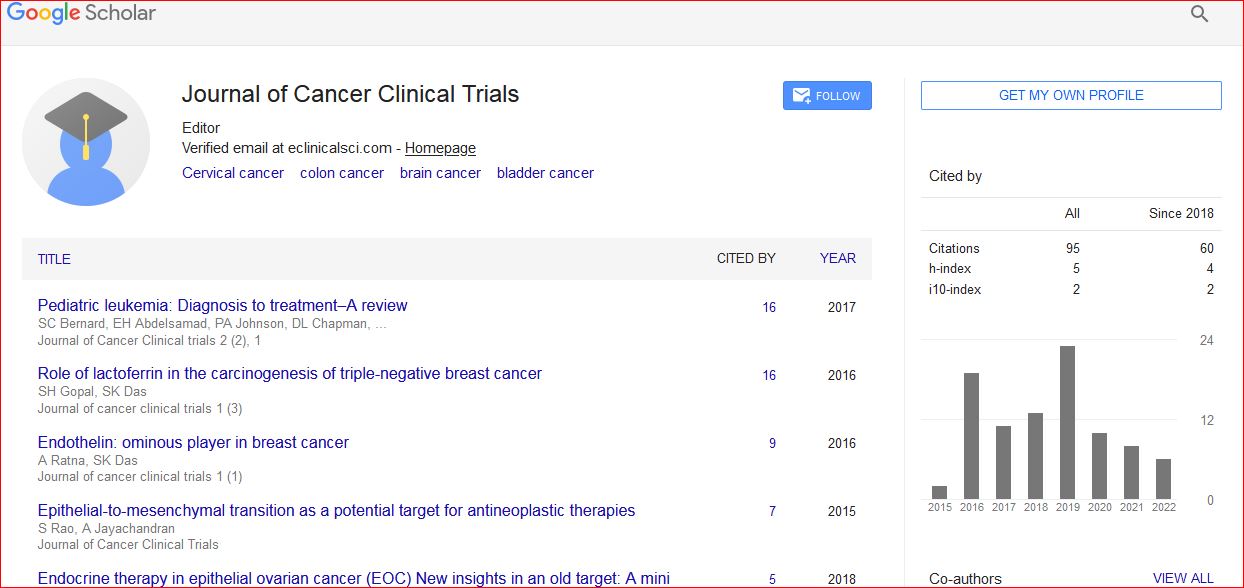
Journal of Cancer Clinical Trials received 95 citations as per Google Scholar report