Opinion - (2025) Volume 16, Issue 4
Received: 01-Jul-2025, Manuscript No. bej-26-182458;
Editor assigned: 03-Jul-2025, Pre QC No. P-182458;
Reviewed: 17-Jul-2025, QC No. Q-182458;
Revised: 22-Jul-2025, Manuscript No. R-182458;
Published:
29-Jul-2025
, DOI: 10.37421/2161-6219.2025.16.566
Citation: Olsen, David. ”Businesses: Engines of Economic
Growth and Stability.” Bus Econ J 16 (2025):566.
Copyright: © 2025 Olsen D. This is an open-access article distributed under the terms of the Creative Commons Attribution License, which permits unrestricted use, distribution
and reproduction in any medium, provided the original author and source are credited.
Businesses are fundamentally integral to the functioning and advancement of modern economies, serving as the primary drivers of innovation and the creators of employment opportunities. They are instrumental in generating wealth and responding effectively to the dynamic demands of the market. Through their operations, businesses facilitate the efficient allocation of resources, a critical factor in economic growth and stability [1].
Innovation emerging from within businesses acts as a principal catalyst for economic progress and development. Companies actively invest in research and development, which leads to the conception and implementation of novel products, services, and operational processes. This dedication to advancement not only enhances overall productivity and global competitiveness but also cultivates new markets and generates substantial employment opportunities [2].
The generation of employment is a core and indispensable function performed by businesses, providing essential livelihoods for individuals and significantly contributing to household income across economies. The sheer scale and diversity of the business sector directly correlate with the prevailing levels of employment within a given economy. Consequently, policies designed to foster business creation and expansion are of paramount importance for effectively reducing unemployment rates and improving overall social welfare [3].
Businesses play a crucial role in bolstering government revenue through various forms of taxation, including levies on profits, sales, and employment. The generated tax revenue is indispensable for the funding of essential public services, such as the development of critical infrastructure, the provision of quality education, and the delivery of comprehensive healthcare. A robust and thriving business sector, therefore, fundamentally underpins the fiscal capacity of governments to make vital investments in societal well-being [4].
In today's interconnected world, the globalized nature of modern economies means that businesses frequently operate beyond national borders, thereby facilitating international trade and cross-border investment. This extensive interconnectivity enables economies to achieve greater specialization, realize economies of scale, and promote the diffusion of advanced technologies and best practices worldwide. The significance of business operations in shaping international economic relations cannot be overstated [5].
Entrepreneurship, defined as the dynamic process of establishing new businesses, represents a vital and essential component of a thriving and progressive economy. Entrepreneurs are characterized by their ability to identify promising opportunities, their willingness to undertake calculated risks, and their capacity to introduce innovative products, services, or novel business models. Their dedicated efforts serve as a powerful engine for fostering innovation, intensifying competition, and driving overall economic growth [6].
The success achieved by businesses is frequently and intrinsically linked to their ability to engage in effective resource allocation, thereby ensuring that capital, labor, and raw materials are utilized with optimal efficiency. This meticulous approach to resource management invariably leads to enhanced productivity, reduced operational costs, and greater profitability, all of which yield considerable benefits for the broader economic landscape [7].
Corporate social responsibility (CSR) is increasingly being acknowledged and embraced as a critically important aspect of contemporary business operations. Modern businesses are now widely expected to conduct their operations ethically, conscientiously consider their environmental impact, and actively contribute in a positive manner to the welfare of society. Adherence to CSR principles not only strengthens a company's reputation but also actively promotes long-term sustainability and contributes to overall societal well-being [8].
The competitive environment in which businesses operate is a powerful stimulus for driving both efficiency and innovation. Competition compels businesses to continually enhance their products and services, reduce their operational costs, and respond more effectively to the evolving needs and preferences of consumers, ultimately resulting in significant benefits for the entire economy [9].
Business cycles, which are inherently characterized by distinct periods of economic expansion followed by contractions, represent an intrinsic and unavoidable feature of market-based economies. A thorough understanding of these cyclical patterns is absolutely crucial for both businesses and policymakers alike, enabling them to navigate economic fluctuations more effectively and to maintain a greater degree of economic stability [10].
Businesses form the bedrock of modern economic systems, serving as indispensable engines for innovation, job creation, and wealth generation. Their ability to respond dynamically to market demands and allocate resources efficiently makes them significant contributors to Gross Domestic Product (GDP). The vitality and dynamism of the business sector have a direct and profound impact on living standards, government revenue streams, and a nation's international competitiveness, underscoring the critical importance of effective business administration for fostering sustainable economic growth and societal well-being [1].
Within the corporate sphere, innovation stands out as a paramount driver of economic progress. Companies are actively engaged in investing in research and development, a process that culminates in the creation of new products, services, and operational methodologies. This commitment to innovation not only boosts productivity and enhances competitive standing on a global scale but also serves to forge new markets and generate valuable employment opportunities, making it a key determinant of enduring economic prosperity [2].
A primary function of businesses is the creation of employment, thereby providing individuals with the means for livelihood and bolstering household incomes. The extent and variety of businesses operating within an economy are directly proportional to the level of employment available. Therefore, policies that actively encourage the establishment and growth of businesses are vital for mitigating unemployment and elevating social welfare standards across the population [3].
Businesses contribute substantially to public finances through various taxation mechanisms, including taxes on corporate profits, sales transactions, and employee wages. The revenue collected from these sources is essential for funding crucial public services such as infrastructure development, educational programs, and healthcare systems. A strong and productive business sector is thus fundamental to a government's financial capacity to invest in initiatives that promote societal well-being [4].
In the contemporary globalized economic landscape, businesses routinely transcend national boundaries, playing a pivotal role in facilitating international trade and investment flows. This global interconnectedness fosters specialization, unlocks economies of scale, and accelerates the dissemination of cutting-edge technologies and best practices. Consequently, the influence of businesses on international economic relations is of immeasurable significance [5].
Entrepreneurship, the dynamic process of initiating new business ventures, is a cornerstone of a vibrant and evolving economy. Entrepreneurs possess the unique ability to identify market opportunities, embrace calculated risks, and introduce novel products, services, or business models. Their proactive endeavors stimulate innovation, intensify market competition, and propel overall economic growth [6].
A significant determinant of business success lies in the efficient allocation of resources, ensuring that capital, labor, and raw materials are utilized with maximum efficacy. This commitment to efficiency translates into heightened productivity, reduced costs, and improved profitability, benefits that extend positively to the wider economy [7].
Corporate social responsibility (CSR) is increasingly recognized as an essential component of responsible modern business practices. Businesses are increasingly expected to operate with ethical integrity, to be mindful of their environmental footprint, and to make positive contributions to society. Embracing CSR not only enhances corporate reputation but also cultivates long-term sustainability and contributes to the collective well-being of society [8].
The competitive nature of markets inherently drives businesses toward greater efficiency and innovation. Competition incentivizes firms to refine their offerings, decrease their production costs, and become more responsive to consumer demands, ultimately yielding advantages for the economy as a whole [9].
Business cycles, marked by predictable phases of economic expansion and contraction, are an intrinsic characteristic of market economies. Understanding the dynamics and implications of these cycles is paramount for both businesses and policymakers to effectively manage economic fluctuations and uphold stability within the economic system [10].
Businesses are central to modern economies, driving innovation, employment, and wealth creation. They respond to market needs, allocate resources efficiently, and contribute significantly to GDP. Innovation within businesses fuels economic progress by leading to new products and services, while job creation is a core business function vital for livelihoods and social welfare. Businesses also contribute to government revenue through taxes, funding public services. In a globalized world, they facilitate international trade and investment. Entrepreneurship is key to economic dynamism, and efficient resource allocation enhances productivity and profitability. Corporate social responsibility is increasingly important for ethical operations and sustainability. Market competition encourages efficiency and innovation, benefiting the economy. Understanding business cycles is crucial for navigating economic fluctuations and maintaining stability.
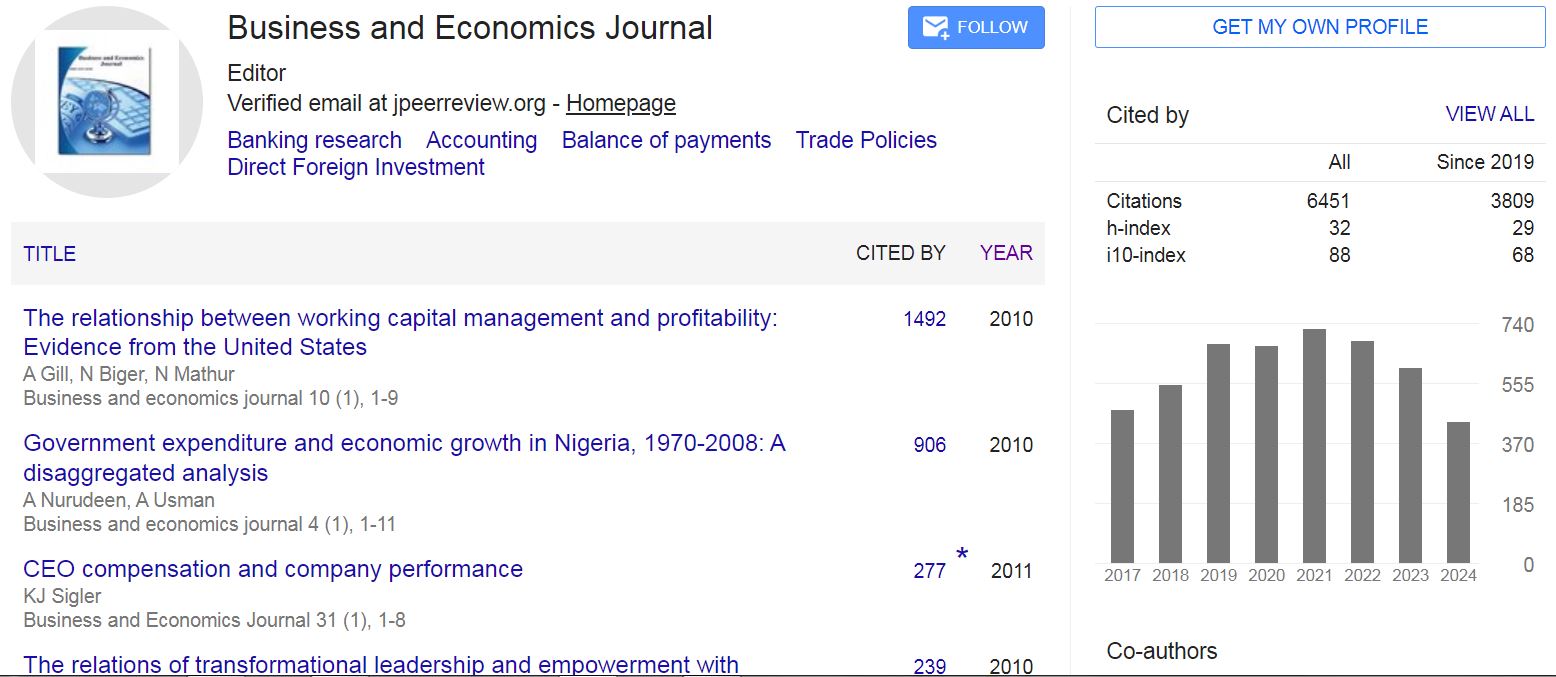
Business and Economics Journal received 6451 citations as per Google Scholar report