Opinion - (2025) Volume 16, Issue 6
Received: 01-Nov-2025, Manuscript No. bej-26-182558;
Editor assigned: 03-Nov-2025, Pre QC No. P-182558;
Reviewed: 17-Nov-2025, QC No. Q-182558;
Revised: 22-Nov-2025, Manuscript No. R-182558;
Published:
29-Nov-2025
, DOI: 10.37421/2161-6219.2025.16.587
Citation: Morales, Victoria. ”Businesses: Driving Growth, Shaping
Policy, Ensuring Sustainability.” Bus Econ J 16 (2025):587.
Copyright: © 2025 Morales V. This is an open-access article distributed under the terms of the Creative Commons Attribution License, which permits unrestricted use,
distribution and reproduction in any medium, provided the original author and source are credited.
Businesses are fundamental pillars of economic planning, acting as the primary catalysts for growth, innovation, and job creation within any given economy. Their strategic initiatives significantly shape the allocation of resources, influence investment trends, and dictate market dynamics, making their consideration paramount for comprehensive economic strategies. Effective economic plans must comprehensively assess the business sector's inherent capabilities, existing challenges, and emergent opportunities to cultivate sustainable development pathways and achieve overarching societal objectives. [1] Understanding the intricate relationship between business operations and public policy is indispensable for the formulation of effective economic plans. Government interventions, ranging from fiscal incentives designed to stimulate investment to regulatory frameworks intended to ensure market fairness, profoundly mold the environment in which businesses operate. Conversely, businesses dynamically respond to these policy signals, thereby impacting critical economic outcomes such as national productivity levels, rates of innovation, and the distribution of income across the populace. This continuous interplay necessitates meticulous consideration during the design and implementation of public policies. [2]
The business sector's intrinsic contribution to economic planning extends substantially to its pivotal role in generating employment and fostering the development of essential skills. As enterprises expand their operations and embrace innovation, they invariably create new avenues for employment, often demanding a workforce equipped with continuously evolving skill sets. Consequently, economic planning endeavors must be meticulously aligned with these evolving labor market dynamics to ensure a harmonious equilibrium between the availability of job opportunities and the presence of a sufficiently skilled labor pool. [3] Innovation originating from within the business sector stands as a critical determinant of long-term economic expansion and a nation's competitive standing on the global stage. Corporations that strategically invest in research and development (R&D) and proactively adopt novel technologies are instrumental in driving productivity enhancements and pioneering the creation of entirely new markets. Economic planning frameworks can actively nurture and accelerate this spirit of innovation through the implementation of supportive policies and the deliberate cultivation of an ecosystem conducive to such advancements. [4] Small and medium-sized enterprises (SMEs) occupy a position of significant importance within the realm of economic planning, largely owing to their substantial contributions to overall employment figures and the vitality of local economies. The implementation of targeted policies designed to bolster SMEs can significantly enhance their growth trajectories, augment their innovative capacities, and strengthen their ability to compete effectively, thereby reinforcing the resilience and robustness of the broader economic structure. [5] The increasing globalization of business activities introduces a layer of complexity into economic planning that demands careful consideration. The strategic decisions made by multinational corporations concerning investment flows, production methodologies, and international trade exert far-reaching influences on national economies, impacting key economic indicators such as overall growth, employment levels, and the extent of income inequality. [6] In contemporary economic discourse, sustainability and the adoption of corporate social responsibility (CSR) principles are emerging as increasingly critical factors in business operations and, by extension, in the strategic considerations of economic planning. Businesses that consciously integrate sustainable practices into their core operations can make significant contributions to environmental preservation and the enhancement of social well-being, thereby aligning their objectives with broader economic development goals. The seamless integration of these ethical and environmental dimensions into economic planning frameworks is paramount for achieving enduring prosperity. [7] The financial health and overall stability of the business sector form the bedrock upon which effective economic planning is built. Crucial elements such as accessible financing, the efficiency of capital markets, and the robustness of financial regulations directly influence a firm's capacity to undertake investments, pursue growth strategies, and ultimately contribute to macroeconomic stability. Therefore, economic plans must incorporate well-defined mechanisms to ensure the maintenance of a strong and resilient financial system that adequately supports the needs of businesses. [8] Digital transformation, a pervasive trend within the business landscape, is fundamentally reshaping economic structures and mandates its explicit inclusion within economic planning frameworks. The widespread adoption of advanced technologies, the proliferation of e-commerce platforms, and the sophisticated utilization of data analytics collectively exert a profound influence on productivity levels, market accessibility, and the very nature of work itself, necessitating agile and adaptive policy responses from governments. [9] A thorough comprehension of diverse market structures and the dynamics of competition is absolutely vital for the formulation of sound economic planning. The distinct behaviors exhibited by firms operating within various market environments have a direct bearing on price determination, production volumes, and the overall welfare of consumers. Consequently, economic plans frequently aim to foster competitive market conditions that are conducive to enhanced efficiency and accelerated innovation. [10]Businesses are indispensable engines of economic development, driving growth, fostering innovation, and creating employment opportunities. Their strategic decisions critically influence how resources are allocated, where investments are directed, and how markets function. To achieve sustainable development and societal goals, economic plans must accurately gauge the business sector's strengths, weaknesses, and potential. [1] The synergy between business activities and governmental policies is a cornerstone of successful economic planning. Public policies, whether through financial incentives or regulatory oversight, profoundly shape the operational landscape for businesses. In turn, firms adapt their strategies based on these policies, affecting key economic indicators like productivity, innovation, and income distribution, underscoring the need for careful policy design. [2]
A significant aspect of the business sector's role in economic planning lies in its capacity for job creation and skill development. As businesses expand and innovate, they generate new employment opportunities and frequently require a workforce with adaptable and advanced skills. Economic planning must therefore synchronize with these labor market trends to ensure a balanced supply and demand for skilled labor. [3] Innovation originating from businesses is a primary driver of long-term economic expansion and global competitiveness. Companies that invest in research and development and embrace new technologies contribute significantly to productivity gains and the emergence of new markets. Economic planning can effectively stimulate this innovation through targeted policies and the creation of supportive environments. [4] Small and medium-sized enterprises (SMEs) are crucial components of economic planning due to their substantial impact on employment and local economic health. Policies aimed at supporting SMEs can bolster their growth, enhance their innovative capabilities, and improve their competitive standing, thereby strengthening the overall economic fabric. [5] The increasing globalization of business operations introduces complex dynamics that economic planning must address. The investment, production, and trade decisions of multinational corporations have extensive consequences for national economies, influencing economic growth, employment figures, and disparities in income. [6] Sustainability and corporate social responsibility (CSR) are becoming increasingly significant considerations in business practices and, consequently, in economic planning. Businesses adopting sustainable methods can actively contribute to environmental protection and social welfare, aligning with broader economic development objectives. Integrating these elements into planning is vital for long-term prosperity. [7] The financial stability and soundness of the business sector are foundational to effective economic planning. Access to capital, functioning capital markets, and robust financial regulations directly impact a firm's ability to invest, grow, and contribute to economic stability. Economic plans must include strategies for maintaining a resilient financial system for businesses. [8] Digital transformation within businesses is fundamentally altering economic landscapes, necessitating its inclusion in economic planning. The adoption of new technologies, e-commerce, and data analytics impacts productivity, market access, and the nature of employment, requiring adaptive policy responses. [9] Understanding market structures and competitive dynamics is essential for economic planning. The conduct of firms within different market settings affects prices, output levels, and consumer well-being. Economic plans often seek to foster competitive markets that promote efficiency and drive innovation. [10]Businesses are central to economic planning, driving growth, innovation, and employment. Their strategic decisions impact resource allocation and market dynamics, necessitating careful consideration in policy design. The interplay between business activity and public policy is crucial, as government interventions shape the business environment, and firms' responses affect economic outcomes. The sector's role in job creation and skill development is vital, requiring economic plans to align with labor market trends. Innovation within businesses is a key driver of long-term growth and competitiveness, supported by economic policies. Small and medium-sized enterprises (SMEs) significantly contribute to employment and local economies, requiring supportive policies. Globalization introduces complex dynamics that influence national economies. Sustainability and corporate social responsibility are increasingly important, aligning business practices with broader development goals. The financial health of the business sector underpins economic stability, necessitating robust financial systems. Digital transformation is reshaping economies, requiring adaptive policy responses. Understanding market structures and competition is essential for fostering efficiency and innovation. The integration of these diverse aspects is crucial for effective and sustainable economic planning.
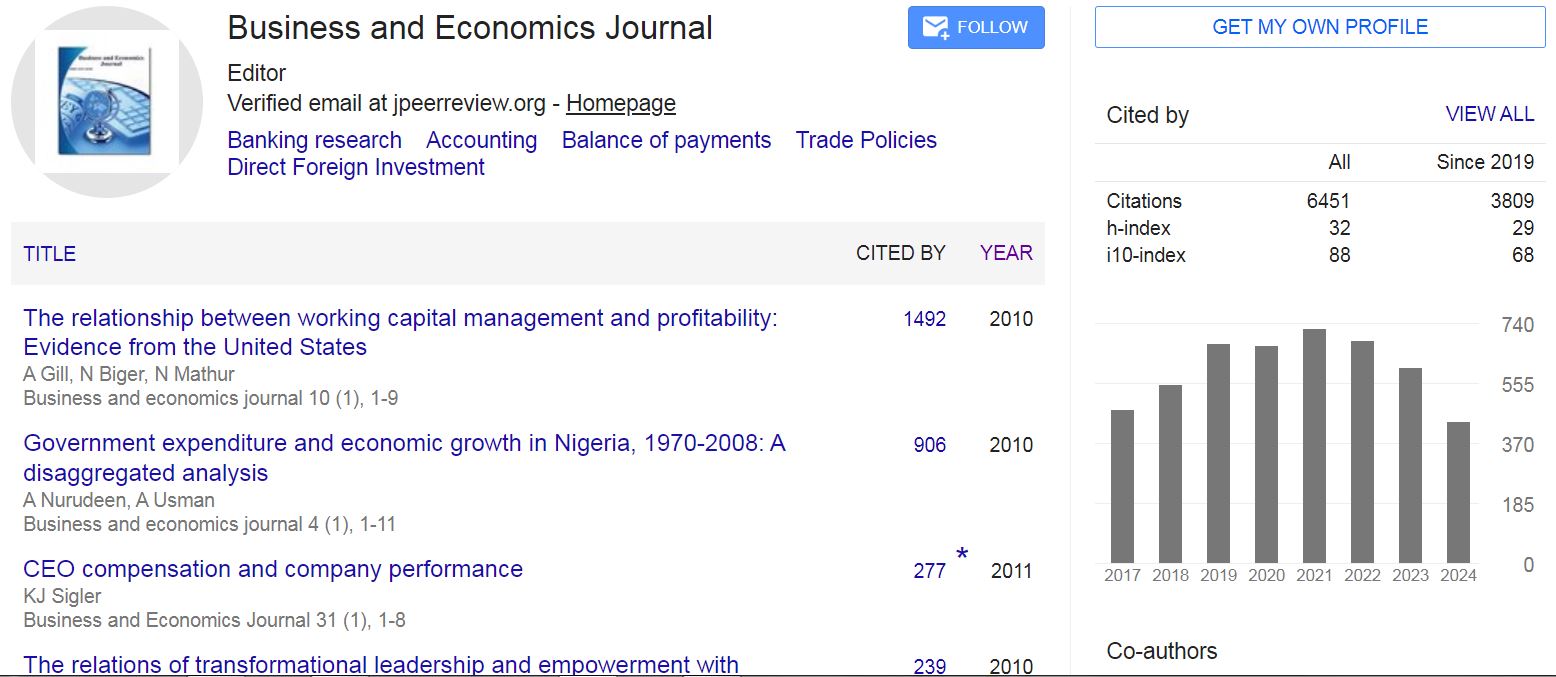
Business and Economics Journal received 6451 citations as per Google Scholar report