Perspective - (2025) Volume 16, Issue 5
Received: 01-Sep-2025, Manuscript No. bej-26-182521;
Editor assigned: 03-Sep-2025, Pre QC No. P-182521;
Reviewed: 17-Sep-2025, QC No. Q-182521;
Revised: 22-Sep-2025, Manuscript No. R-182521;
Published:
29-Sep-2025
, DOI: 10.37421/2161-6219.2025.16.578
Citation: Klein, Nadine. ”Business Systems and Economic Structures:
A Global View.” Bus Econ J 16 (2025):578.
Copyright: © 2025 Klein N. This is an open-access article distributed under the terms of the Creative Commons Attribution License, which permits unrestricted use, distribution
and reproduction in any medium, provided the original author and source are credited.
The complex interplay between diverse business systems and their profound impact on overarching economic structures is a subject of considerable academic interest. This field of study meticulously examines how organizational designs, strategic decisions, and the dynamics of market forces converge to sculpt the broader economic landscape. A key aspect of this investigation is acknowledging the inherent heterogeneity present in firm-level strategies and understanding their aggregate consequences on crucial economic indicators such as growth, innovation, and overall stability. The examination of these intricate relationships provides valuable insights into the mechanisms that drive economic progress and resilience. Furthermore, significant research has been dedicated to understanding the evolutionary trajectory of economic structures in direct response to modifications within business system configurations. This analysis delves into how alterations in corporate governance, the diverse forms of ownership structures, and evolving competitive strategies collectively influence the allocation of resources, the organization of industries, and the performance of economies on a larger scale, especially in the context of an increasingly globalized world. The insights gained from such studies are crucial for policymakers and business leaders alike. Another critical avenue of exploration involves comparing and contrasting the influence of different business system models on national economic structures.
This comparative approach allows for a detailed analysis of how distinct institutional frameworks and the specific practices adopted at the firm level contribute to divergent economic outcomes. Key areas of divergence often include labor market flexibility, the effectiveness of national innovation systems, and the provision of social welfare, highlighting the localized nature of economic development. In the contemporary era, the pervasive influence of digital transformation on business systems is fundamentally reshaping economic structures. Studies in this domain investigate the effects stemming from the rise of platform economies, the increasing reliance on data-driven decision-making processes, and the emergence of novel organizational forms. These shifts have demonstrable impacts on market concentration, employment patterns, and the equitable distribution of economic gains across society. Moreover, a growing body of literature addresses the intricate relationship between various business systems and the persistent issue of economic inequality. This research explores how specific variations in corporate structures, the nature of labor relations, and the extent of financialization within an economy contribute to differing levels of income and wealth distribution. Understanding these dynamics is essential for developing policies aimed at fostering more equitable economic outcomes. The impact of globalized business systems on developing economic structures is another area of significant scholarly attention. This research analyzes the multifaceted ways in which multinational corporations, the intricacies of international trade agreements, and the flow of foreign direct investment shape institutional development, encourage industrial diversification, and bolster economic resilience, particularly within emerging economies that are rapidly integrating into the global marketplace. The pivotal role of firm-level innovation strategies in the ongoing transformation of economic structures is also a subject of intense scrutiny. This line of inquiry investigates how diverse approaches to research and development, the strategic adoption of new technologies, and the methodologies employed in product development within established business systems ultimately influence industry dynamics, confer competitive advantages, and shape national innovation capacities. The ability to innovate is a critical determinant of long-term economic success. Further complicating the economic landscape is the profound impact of financialization on both business systems and the broader economic structures they inhabit. This research examines how the escalating prominence of financial markets and financial actors exerts a significant influence on corporate behavior, investment decision-making processes, and the overall stability of economic systems, with a particular emphasis on the potential for systemic risk to emerge and propagate. In an era defined by environmental consciousness, the ways in which sustainability considerations are actively reshaping business systems and, consequently, economic structures are gaining prominence. This analysis involves scrutinizing the adoption of corporate social responsibility initiatives, the implementation of circular economy principles, and the integration of environmental, social, and governance (ESG) criteria. These shifts have discernible effects on market competition and the trajectory of long-term economic development. Finally, the resilience of diverse business systems when confronted with economic shocks, and the subsequent implications for the stability of broader economic structures, form a crucial area of study. This research investigates how attributes such as organizational flexibility, the effective management of supply chains, and the implementation of adaptive strategies contribute significantly to the capacity of economies to withstand periods of crisis and to subsequently recover with greater strength and stability.The intricate relationship between varying business systems and their consequential impact on economic structures has been a focal point of extensive academic research. This field of inquiry meticulously dissects how the foundational elements of organizational design, the strategic choices made by firms, and the dynamic interplay of market forces collectively shape the broader economic architecture. Central to this understanding is the recognition of the inherent heterogeneity observed in firm-level strategies and an exploration of how these diverse approaches aggregate to influence critical economic outcomes, including sustained growth, the pace of innovation, and overall economic stability. The synthesis of these insights provides a robust framework for comprehending economic phenomena. Furthermore, a significant body of work has concentrated on elucidating the evolutionary processes of economic structures, particularly as they respond to shifts and transformations within business system configurations.
This research critically analyzes how modifications in corporate governance mechanisms, the diversification of ownership structures, and the adaptation of competitive strategies exert a tangible influence on the allocation of vital resources, the organization of industrial sectors, and the resultant economic performance. These dynamics are especially pertinent in the context of escalating globalization, which necessitates a nuanced understanding of cross-border economic interactions. Another vital dimension of this research landscape involves the comparative analysis of different business system models and their differential effects on national economic structures. By juxtaposing distinct models, such as liberal market economies and coordinated market economies, researchers can effectively scrutinize how divergent institutional frameworks and the specific operational practices of firms contribute to unique economic trajectories. These divergences are often manifest in areas like labor market dynamics, the efficacy of national innovation ecosystems, and the delivery of social welfare programs, underscoring the localized nature of economic development pathways. In the contemporary digital age, the transformative power of digital technologies within business systems is profoundly altering the very fabric of economic structures. Investigations in this area scrutinize the ramifications of burgeoning platform economies, the increasing reliance on data analytics for strategic decision-making, and the emergence of novel organizational paradigms. These digital shifts carry significant implications for the concentration of market power, the evolving nature of employment, and the distribution of economic prosperity among different segments of society. Moreover, a substantial contribution to the literature focuses on the complex nexus between business systems and the persistent challenge of economic inequality. This research line systematically examines how variations in corporate organizational forms, the prevailing labor relations within industries, and the extent of financial market integration contribute to disparities in income and wealth distribution across various economic systems. Understanding these intricate linkages is paramount for designing effective interventions aimed at promoting greater economic fairness. The influence of increasingly globalized business systems on the developmental trajectories of economic structures, particularly in emerging economies, constitutes another critical area of study. This research critically evaluates how the operations of multinational corporations, the negotiation and implementation of international trade agreements, and the patterns of foreign direct investment contribute to the development of robust institutions, foster industrial diversification, and enhance the overall economic resilience of nations seeking to integrate more fully into the global economy. The strategic imperatives of firm-level innovation and their direct role in shaping the evolution of economic structures are also a subject of considerable academic inquiry. This research probes how diverse approaches to research and development (R&D), the strategic adoption and diffusion of new technologies, and the methodologies employed in product conceptualization and development within business systems collectively impact industry dynamics, confer sustainable competitive advantages, and bolster national capacities for innovation. A proactive approach to innovation is increasingly seen as a prerequisite for economic vitality. Further adding to the complexity of economic systems is the pervasive phenomenon of financialization and its far-reaching implications for both business operations and the broader economic structures they inhabit. This research delves into how the expanding influence of financial markets and financial intermediaries affects corporate decision-making, shapes investment priorities, and influences the stability of economic systems, with a specific focus on identifying and mitigating potential sources of systemic risk. In light of growing global concerns about environmental sustainability, the manner in which these considerations are actively influencing business systems and, by extension, reshaping economic structures is becoming a significant research focus. This area of study involves an in-depth analysis of the adoption of corporate social responsibility (CSR) frameworks, the implementation of circular economy principles, and the integration of environmental, social, and governance (ESG) criteria into business strategies. The effects of these practices on market competition and long-term economic development are actively being investigated. Finally, the critical aspect of resilience within diverse business systems when confronted by unexpected economic shocks, and the subsequent impact of this resilience on the stability of overarching economic structures, represents a crucial area of ongoing research. This research examines how factors such as enhanced organizational flexibility, sophisticated supply chain management techniques, and the development of proactive adaptive strategies contribute to an economy's ability to withstand periods of severe disruption and to subsequently recover more effectively, thereby ensuring greater long-term stability.This collection of research explores the multifaceted relationship between business systems and economic structures. It highlights how organizational designs, strategic choices, and market dynamics interact to shape economic landscapes, emphasizing the impact of firm-level heterogeneity on growth and innovation. The studies examine the evolution of economic structures in response to changes in corporate governance, ownership, and competitive strategies, particularly in a globalized context. Comparative analyses reveal how different business models influence national economies, impacting labor markets and innovation. Digital transformation is shown to be reshaping economies through platform economies and data-driven approaches, affecting market concentration and employment. The research also investigates the links between business systems and economic inequality, as well as the influence of globalized business on developing economies. Furthermore, firm-level innovation strategies are identified as key drivers of economic structural change. The impact of financialization on corporate behavior and economic stability is analyzed, alongside the growing role of sustainability considerations like CSR and ESG in business and economic development. Finally, the resilience of business systems to economic shocks and its contribution to overall economic stability is explored.
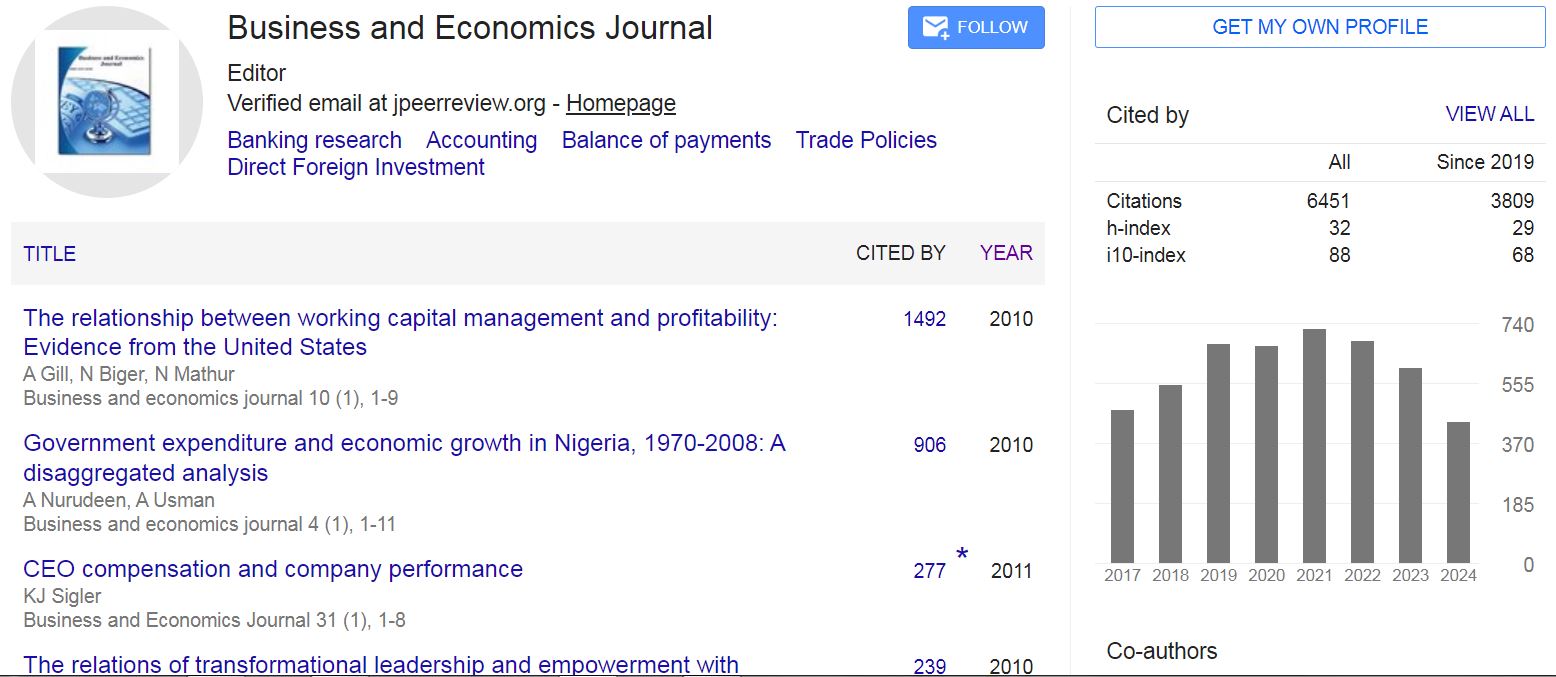
Business and Economics Journal received 6451 citations as per Google Scholar report