Brief Report - (2025) Volume 16, Issue 6
Received: 01-Nov-2025, Manuscript No. bej-26-182548;
Editor assigned: 03-Nov-2025, Pre QC No. P-182548;
Reviewed: 17-Nov-2025, QC No. Q-182548;
Revised: 22-Nov-2025, Manuscript No. R-182548;
Published:
29-Nov-2025
, DOI: 10.37421/2161-6219.2025.16.583
Citation: Lee, Jessica. ”Business Strategy: Navigating Economic
and Global Shifts.” Bus Econ J 16 (2025):583.
Copyright: © 2025 Lee J. This is an open-access article distributed under the terms of the Creative Commons Attribution License, which permits unrestricted use, distribution
and reproduction in any medium, provided the original author and source are credited.
Understanding the intricate economic environment is paramount for the formulation of effective business strategy. This foundational analysis necessitates a thorough examination of both macroeconomic forces, such as inflation, interest rates, GDP growth, and unemployment levels, and microeconomic factors, including market structure, competitive landscapes, and consumer behavior patterns [1].
Businesses must possess the agility to adapt to the dynamic shifts within these environments to sustain their competitive edge, to proactively identify emerging opportunities, and to effectively mitigate potential risks. Furthermore, government policies, the relentless pace of technological advancements, and prevailing global economic trends profoundly shape the contemporary business landscape, influencing strategic decision-making and operational frameworks. An incisive analysis of these interconnected elements empowers informed strategic choices, optimized resource allocation, and the development of robust and resilient business models capable of weathering economic volatility. The strategic imperative to understand the economic environment cannot be overstated in its importance for long-term business success and sustainability [1].
In the contemporary globalized marketplace, businesses are increasingly confronted with the profound implications of global supply chain disruptions. These disruptions are often amplified by complex geopolitical instabilities and the tangible impacts of climate change, directly affecting firm performance and overall resilience. Consequently, there is a growing imperative for businesses to strategically diversify their sourcing strategies, to proactively build substantial inventory buffers, and to enhance operational visibility across their intricate supply networks. The empirical findings from rigorous studies consistently suggest that the adoption of proactive risk management strategies, coupled with agile operational adjustments, are absolutely critical for businesses aiming to successfully navigate the inherent volatilities of present-day economic conditions [2].
The evolving landscape of monetary policy, characterized by the deliberate implementation of interest rate hikes and quantitative tightening measures, exerts a significant and direct influence on critical corporate investment and financing decisions. These monetary policy actions fundamentally alter the cost of capital, directly impacting the availability of essential credit, and substantially influencing investor sentiment, all of which collectively affect the trajectory of business expansion and overall profitability. In response to these shifts, businesses are strongly advised to rigorously stress-test their existing financial structures and to proactively explore and secure alternative funding sources to ensure financial stability and operational continuity [3].
The pervasive influence of inflation expectations on a business's fundamental pricing strategies and delicate wage negotiations cannot be underestimated. Persistent high inflation, in particular, possesses the inherent capacity to significantly erode the purchasing power of consumers and to foster an environment of pervasive uncertainty. This uncertainty necessitates a meticulous and careful management of price adjustments across product lines and employee compensation strategies to effectively maintain market share and preserve operational stability. Therefore, a deep understanding and strategic management of inflation expectations are presented as a paramount strategic challenge for businesses operating in such economic climates [4].
Technological disruption, particularly the rapid integration of artificial intelligence and advanced automation, is fundamentally reshaping the demand for labor and overall productivity across a diverse array of economic sectors. While certain job roles may experience displacement, the concurrent emergence of new roles, which necessitate distinct and evolving skill sets, is also a significant consequence. Consequently, it is imperative for businesses to make substantial investments in upskilling their existing workforce and to strategically adapt their organizational structures to effectively harness the transformative benefits offered by these rapidly advancing technologies [5].
Evolving regulatory frameworks, encompassing stringent environmental standards and comprehensive data privacy laws, exert a considerable influence on business compliance costs and the intricate processes of strategic planning. The increasing prominence of Environmental, Social, and Governance (ESG) factors in corporate decision-making is undeniable, and adherence to these progressively developing regulations can serve as a powerful catalyst for innovation and the attainment of a significant market advantage. Businesses must therefore integrate these regulatory considerations into their core strategic frameworks [6].
Significant demographic shifts, such as the observable trend of an aging population and the dynamic fluctuations in workforce participation rates, have a demonstrable economic impact on both consumer demand and the available labor supply. This necessitates a strategic reorientation for businesses, compelling them to adapt their product offerings, service models, and marketing strategies to effectively cater to the evolving preferences of consumers and to competently manage an increasingly diverse workforce [7].
The intensifying forces of globalization present a complex interplay of economic consequences, profoundly impacting international trade dynamics, the patterns of foreign direct investment, and the overarching competitive landscape. Businesses that aspire to thrive in this interconnected global marketplace must possess the strategic acumen to effectively navigate a diverse range of international economic conditions, intricate trade agreements, and the inherent fluctuations in currency exchange rates [8].
The growing imperative for sustainable economic practices, coupled with the escalating consumer demand for environmentally friendly products, exerts a significant influence on contemporary business strategy. Embracing sustainability is increasingly recognized not only as an ethical consideration but also as a source of tangible benefits, including potential cost savings, an enhanced brand reputation, and improved access to new and expanding markets, positioning it as a critical determinant of long-term business viability [9].
Fluctuating commodity prices present a considerable challenge for businesses heavily reliant on these essential resources. Effective strategies for hedging against price volatility, optimizing inventory management, and actively exploring alternative materials are crucial for ensuring stable production cycles and maintaining profitability within the unpredictable context of the global market [10].
The economic environment forms the bedrock of strategic business planning, encompassing a multifaceted analysis of macroeconomic indicators like inflation, interest rates, GDP growth, and unemployment, alongside microeconomic forces such as market structure, competition, and consumer behavior. Businesses must demonstrate adaptability to changes in these conditions to maintain competitiveness, identify opportunities, and mitigate risks. Government regulations, technological advancements, and global economic shifts are pivotal in shaping the business landscape. Precise analysis enables informed decision-making, efficient resource allocation, and the creation of resilient business models capable of adapting to evolving economic realities [1].
Global supply chain disruptions, exacerbated by geopolitical instability and climate change, significantly impact firm performance and resilience. This underscores the critical need for businesses to diversify their sourcing strategies, establish robust inventory buffers, and enhance supply chain visibility. Proactive risk management and agile operational adjustments are identified as essential components for navigating volatile economic conditions and ensuring business continuity [2].
Shifts in monetary policy, particularly the implementation of interest rate hikes and quantitative tightening, have direct consequences for corporate investment and financing decisions. These policies influence the cost of capital, credit availability, and investor confidence, thereby impacting business expansion and profitability. Businesses are advised to conduct thorough financial stress tests and explore diverse funding avenues to safeguard their financial health [3].
Inflation expectations play a crucial role in shaping business pricing strategies and wage negotiations. Persistent high inflation erodes purchasing power and introduces uncertainty, demanding careful management of price adjustments and employee compensation to preserve market share and operational stability. Strategic engagement with inflation expectations is a key challenge for businesses [4].
Technological advancements, especially in AI and automation, are transforming labor demand and productivity across sectors. While some jobs may be displaced, new roles requiring different skill sets are emerging. Businesses must invest in workforce upskilling and adapt their organizational structures to leverage these technologies effectively and maintain competitiveness [5].
Regulatory changes, including environmental standards and data privacy laws, influence business compliance costs and strategic planning. The growing emphasis on ESG factors necessitates that businesses integrate these considerations into their decision-making processes, as adherence to evolving regulations can foster innovation and create market advantages [6].
Demographic trends, such as an aging population and changes in workforce participation, affect consumer demand and labor supply. Businesses need to adapt their products, services, and marketing approaches to meet changing consumer preferences and effectively manage a diverse workforce to remain relevant and competitive [7].
Globalization intensifies the impact on international trade, foreign direct investment, and competitive dynamics. Businesses operating in the global arena must adeptly manage diverse international economic conditions, trade agreements, and currency fluctuations to achieve success in an increasingly interconnected marketplace [8].
Sustainable economic practices and the rising demand for green products are becoming critical business imperatives. Embracing sustainability can lead to cost efficiencies, improved brand image, and access to new markets, positioning it as a vital element for long-term business success and competitive advantage [9].
Fluctuations in commodity prices pose significant risks for businesses dependent on these resources. Implementing strategies for price volatility hedging, effective inventory management, and the exploration of alternative materials are essential for ensuring stable operations and profitability in an unpredictable global market [10].
The economic environment significantly impacts business strategy, requiring analysis of macroeconomic and microeconomic factors, government policies, and global trends. Businesses must adapt to disruptions like supply chain volatility, geopolitical instability, and climate change by diversifying sources and managing risks. Monetary policy shifts affect investment and financing, while inflation expectations influence pricing and wage strategies. Technological advancements, particularly AI and automation, necessitate workforce upskilling and organizational adaptation. Evolving regulations, including ESG requirements, influence compliance costs and strategic planning. Demographic changes demand adjustments in products, services, and workforce management. Globalization requires navigating international economic conditions and currency fluctuations. Sustainable practices and green product demand are becoming crucial for long-term viability. Managing commodity price volatility is essential for stable operations and profitability.
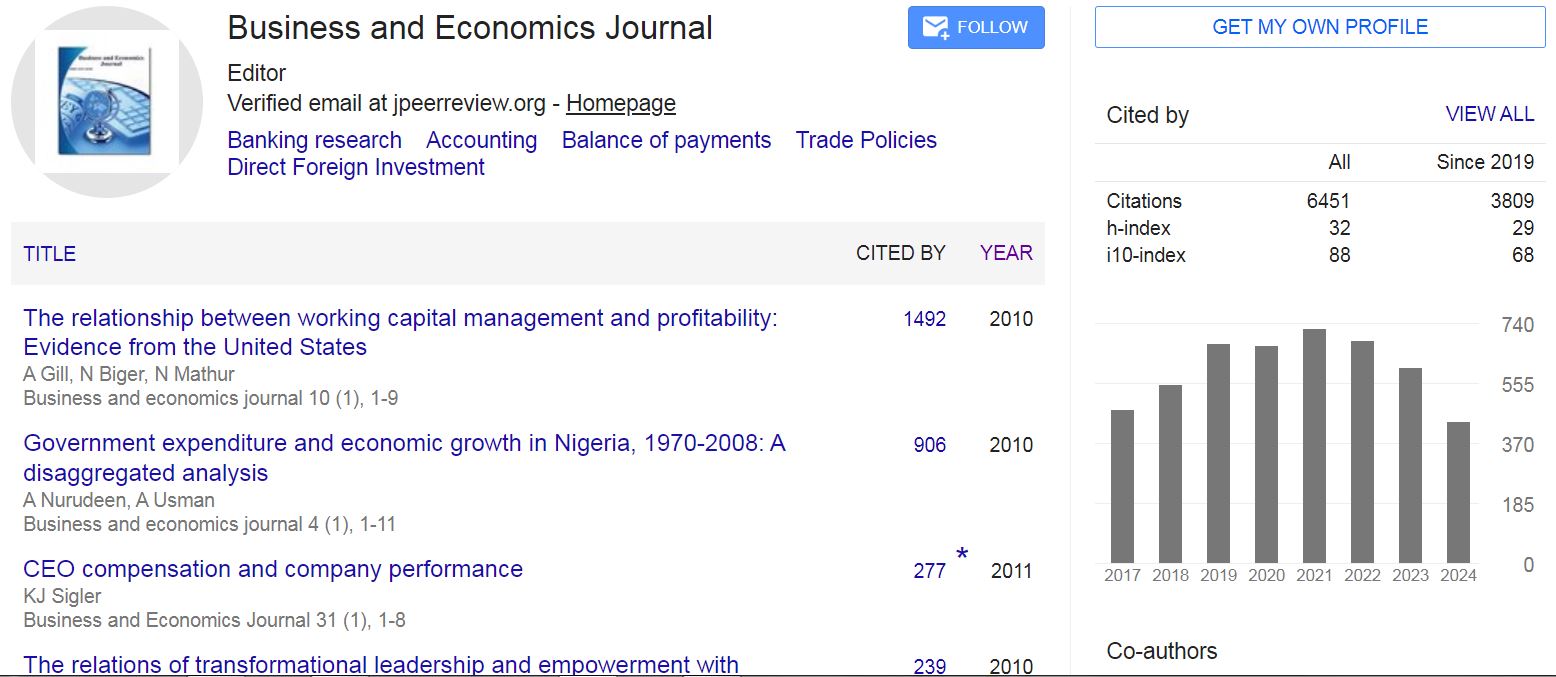
Business and Economics Journal received 6451 citations as per Google Scholar report