Brief Report - (2025) Volume 16, Issue 5
Received: 01-Sep-2025, Manuscript No. bej-26-182495;
Editor assigned: 03-Sep-2025, Pre QC No. P-182495;
Reviewed: 17-Sep-2025, QC No. Q-182495;
Revised: 22-Sep-2025, Manuscript No. R-182495;
Published:
29-Sep-2025
, DOI: 10.37421/2161-6219.2025.16.573
Citation: Schmidt, Sebastian. ”Business Operations And Economic
System Dynamics.” Bus Econ J 16 (2025):573.
Copyright: © 2025 Schmidt S. This is an open-access article distributed under the terms of the Creative Commons Attribution License, which permits unrestricted use,
distribution and reproduction in any medium, provided the original author and source are credited.
The intricate relationship between business operations and the broader economic landscape is a fundamental area of study, exploring how individual firm-level decisions interact with macroeconomic trends. Understanding market structures, the efficient allocation of resources, and the pervasive influence of government policies are crucial for comprehending the dynamics that shape business activities. This foundational knowledge helps elucidate the impact of innovation on a firm's competitive advantage and the ever-changing nature of consumer behavior as a significant driver of economic activity [1].
The modern economy is increasingly shaped by digitalization, which profoundly influences business models and overall economic competitiveness. As firms embrace digital transformation, they unlock opportunities for greater operational efficiency, access to wider markets, and the creation of novel revenue streams. Adapting to rapid technological advancements is no longer optional but a necessity for businesses seeking to remain viable and actively contribute to economic growth, with significant implications for labor markets and innovation ecosystems [2].
Entrepreneurship plays a pivotal role in fostering economic development, particularly in emerging economies where innovative startups can be powerful engines for job creation, the introduction of new technologies, and the stimulation of market competition. These ventures contribute significantly to a dynamic economic framework, and the surrounding policy environment is a critical factor in supporting their success and overall economic impact [3].
The integration of corporate social responsibility (CSR) and sustainability principles into business strategies carries significant economic implications. Businesses that embed ethical and environmental considerations into their core operations often benefit from enhanced brand reputation, greater ability to attract top talent, and the cultivation of long-term economic value. Sustainable practices are increasingly recognized as vital for building a more resilient and equitable economic future [4].
Global supply chains, while offering potential for efficiency gains, also introduce complex dynamics of vulnerability and resilience for businesses. The interconnectedness inherent in these chains means that disruptions can have far-reaching consequences. Therefore, developing robust strategies for supply chain resilience is paramount for businesses operating within the global economic framework, especially considering factors like geopolitical risks and the pace of technological innovation [5].
The symbiotic relationship between government policy and business strategy is a critical determinant of economic development. Regulatory frameworks, fiscal policies, and international trade agreements profoundly influence business decision-making, investment, and overall competitiveness. A thoughtfully designed policy environment is indispensable for nurturing innovation, encouraging investment, and promoting sustained economic growth [6].
Market competition acts as a powerful catalyst for firm performance and economic efficiency. Intense competitive pressures compel businesses to innovate relentlessly, enhance product quality, and strive for cost reductions. Recognizing and upholding fair competition through appropriate antitrust policies is essential for ensuring a level playing field and promoting broader economic welfare [7].
The financial health and strategies of businesses are deeply intertwined with economic cycles. A firm's ability to access capital, make sound investment decisions, and effectively manage risk is critical for navigating economic downturns and capitalizing on periods of growth. Robust financial planning and literacy are therefore fundamental pillars of business sustainability [8].
Innovation and technological adoption are key drivers shaping business activities and economic competitiveness. Firms that strategically invest in research and development and readily embrace new technologies are better positioned to capture market share and propel economic progress. Navigating the challenges and opportunities presented by rapid technological change is a constant imperative [9].
Labor market dynamics are intrinsically linked to the broader economic framework, with business activities directly influencing employment levels, wage structures, and the demand for specific skills. The interplay of globalization, automation, and evolving policy landscapes significantly impacts the workforce. Fostering adaptable labor markets and promoting continuous skill development are essential for achieving sustained economic growth and social equity [10].
The foundational understanding of how businesses operate within the broader economic system necessitates an appreciation for the interconnectedness of firm-level decision-making and overarching macroeconomic trends. Key to this comprehension is a thorough grasp of market structures, the principles of resource allocation, and the significant role government policies play in shaping the contours of business activities. The impact of innovation on a firm's ability to establish and maintain a competitive advantage, alongside the dynamic and often unpredictable nature of consumer behavior as a driving force in economic activity, are critical insights for any business leader [1].
In the contemporary economic era, the pervasive influence of digitalization on business models and national economic competitiveness cannot be overstated. Businesses that proactively engage in digital transformation are poised to achieve remarkable gains in operational efficiency, expand their market reach significantly, and pioneer innovative revenue models. The imperative for firms to adapt to the ceaseless advancements in technology is paramount for their continued relevance and their contribution to the overall trajectory of economic growth, with noteworthy consequences for labor market structures and the development of innovation ecosystems [2].
The role of entrepreneurship as a potent force in driving economic development, particularly within the context of emerging economies, is a subject of considerable academic interest. The emergence of innovative startups serves as a vital mechanism for generating employment opportunities, introducing cutting-edge technologies, and fostering robust market competition, thereby injecting dynamism into the broader economy. Furthermore, the policy landscape surrounding entrepreneurship is a crucial determinant of the success and impact of these ventures on the economic framework [3].
The economic ramifications of integrating corporate social responsibility (CSR) and sustainability into corporate strategy are increasingly being recognized and studied. Businesses that demonstrate a commitment to ethical conduct and environmental stewardship within their strategic planning often experience a positive enhancement in brand reputation, a heightened capacity to attract and retain skilled personnel, and the generation of sustainable long-term economic value. This focus on sustainable business practices is integral to fostering an economic framework that is both more resilient and equitable [4].
An in-depth analysis of global supply chains reveals their profound impact on business operations and overall economic stability. The intricate web of interconnectedness that defines modern supply chains can lead to substantial efficiency improvements, yet it simultaneously heightens vulnerability to various disruptions. Consequently, the development and implementation of strategies aimed at building resilient supply chains are of utmost importance for businesses navigating the complexities of the global economic framework, especially when considering emerging threats such as geopolitical instability and the rapid pace of technological evolution [5].
The dynamic interplay between government policy and business strategy is a fundamental determinant of economic development and progress. Various governmental interventions, including regulatory frameworks, fiscal policies, and international trade agreements, exert a significant influence on corporate decision-making processes, investment strategies, and the overall competitive positioning of firms. A carefully crafted and supportive policy environment is therefore indispensable for stimulating innovation, attracting investment, and ensuring the continuity of sustainable economic growth [6].
The relationship between market competition and a firm's performance, alongside broader economic efficiency, is a well-established area of economic inquiry. Heightened competitive pressures serve as a powerful incentive for businesses to engage in continuous innovation, elevate the quality of their products and services, and pursue greater cost-effectiveness. The role of governmental antitrust policies in maintaining a fair competitive landscape and safeguarding overall economic welfare is also a critical aspect of this dynamic [7].
The financial architecture of businesses and their inherent susceptibility to or resilience against economic cycles are critical considerations for economic stability. Factors such as the accessibility of capital, the strategic nature of investment decisions, and the effectiveness of risk management practices significantly influence a firm's capacity to weather economic downturns and leverage periods of economic expansion. Consequently, a strong emphasis on financial literacy and meticulous financial planning is paramount for ensuring sustained business viability [8].
The integral role of innovation and the adoption of new technologies in shaping the trajectory of business activities and enhancing economic competitiveness is a persistent theme in economic research. Firms that demonstrate a proactive commitment to investing in research and development initiatives and a readiness to embrace novel technological advancements are inherently better positioned to expand their market presence and act as catalysts for economic progress. The associated challenges and burgeoning opportunities presented by the accelerating pace of technological change require continuous strategic adaptation [9].
Examining the intricacies of labor market dynamics within the contemporary economic framework reveals a direct correlation between business activities and key employment indicators such as job creation, wage levels, and the evolving demand for specific skills. The multifaceted influences of globalization, the accelerating trend of automation, and shifts in policy landscapes significantly shape the composition and demands of the workforce. To foster robust economic growth and promote social equity, emphasis must be placed on cultivating adaptable labor markets and encouraging continuous investment in skill development among the populace [10].
This collection of research explores the multifaceted relationship between business operations and the broader economic system. It highlights how firm-level decisions are influenced by macroeconomic trends, market structures, and government policies. The impact of digitalization, entrepreneurship, corporate social responsibility, and global supply chains on economic competitiveness and stability is examined. Additionally, the role of market competition, financial strategies, innovation, and labor market dynamics in driving economic growth and development is discussed. Key themes include the need for adaptation to technological advancements, sustainable business practices, and resilient supply chains, all within a framework influenced by government policy and competition.
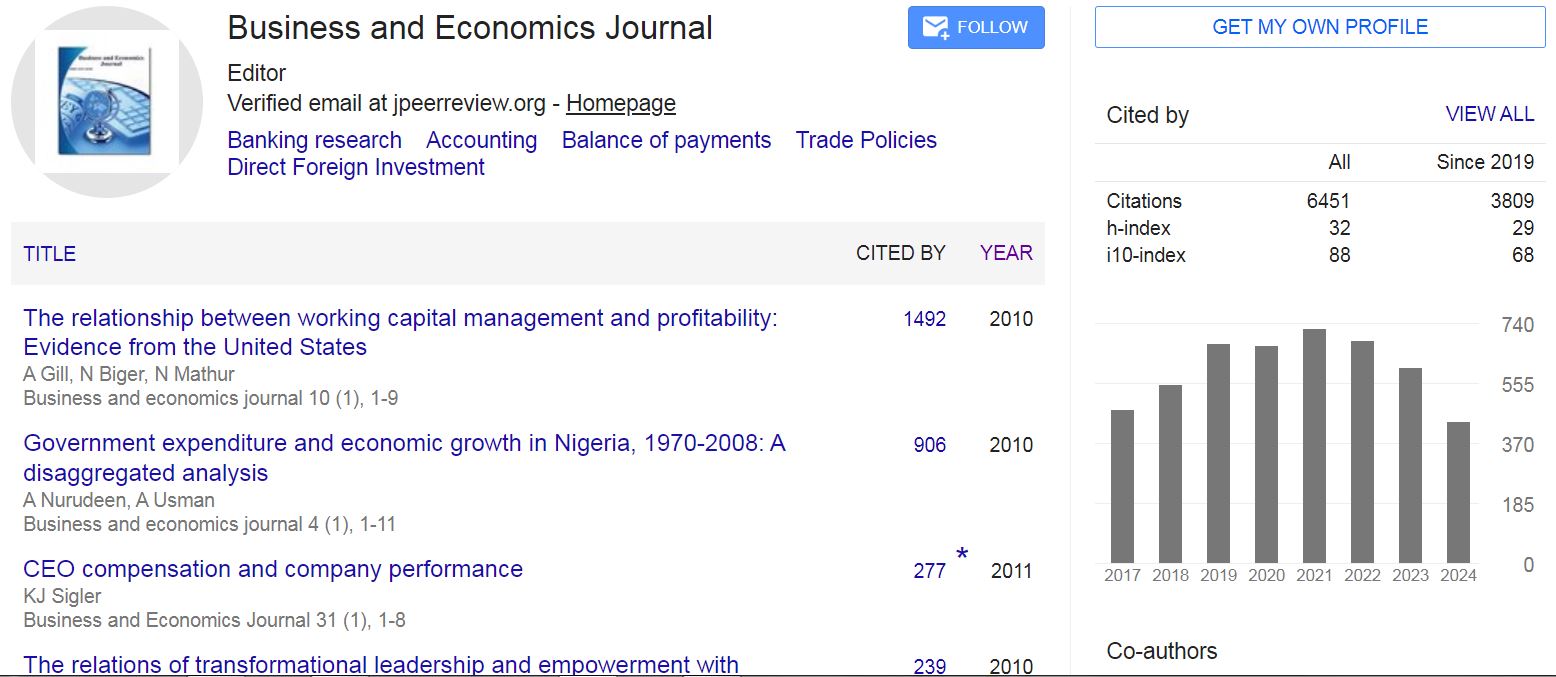
Business and Economics Journal received 6451 citations as per Google Scholar report