Short Communication - (2025) Volume 16, Issue 4
Received: 01-Jul-2025, Manuscript No. bej-26-182476;
Editor assigned: 03-Jul-2025, Pre QC No. P-182476;
Reviewed: 17-Jul-2025, QC No. Q-182476;
Revised: 22-Jul-2025, Manuscript No. R-182476;
Published:
29-Jul-2025
, DOI: 10.37421/2161-6219.2025.16.571
Citation: Ivanova, Anastasia. ”Business Functions Drive Economic
Performance: Integrated Strategies.” Bus Econ J 16 (2025):571.
Copyright: © 2025 Ivanova A. This is an open-access article distributed under the terms of the Creative Commons Attribution License, which permits unrestricted use,
distribution and reproduction in any medium, provided the original author and source are credited.
The contemporary business landscape is characterized by an intricate web of interconnected functions, each playing a pivotal role in driving economic outcomes. Understanding how these diverse elements synergize is crucial for organizational success and long-term viability. This review embarks on an exploration of these relationships, synthesizing insights from various scholarly contributions to provide a comprehensive overview. The interplay between core business functions and tangible economic results is a subject of significant academic and practical interest. Strategic alignment across marketing, operations, finance, and human resources has been shown to directly influence profitability, market share, and overall sustainability. The utilization of data-driven decision-making across these departments is paramount for optimizing performance and navigating the complexities of dynamic market environments [1].
Innovation stands as a key determinant of economic prosperity, particularly in competitive sectors. Firms that cultivate environments fostering creativity and substantially invest in research and development often achieve superior financial outcomes. The safeguarding of intellectual property and the development of robust market sensing capabilities are instrumental in translating innovative concepts into tangible economic value, thereby driving growth and competitive advantage in high-tech industries [2].
The efficiency of supply chain management profoundly impacts a company's financial health. Empirical investigations have identified critical performance indicators within supply chains, such as inventory turnover rates, lead times, and the cost of goods sold, demonstrating their significant influence on a firm's bottom line. The adoption of integrated supply chain strategies is thus advocated for achieving optimal economic returns and operational superiority [3].
Marketing strategies exert a considerable influence on economic growth and consumer behavior. Diverse approaches, encompassing digital marketing, brand development, and customer relationship management, are instrumental in driving revenue generation and facilitating market expansion. A deep understanding of consumer psychology is fundamental to achieving successful economic outcomes through effective marketing initiatives [4].
Effective human resource management practices are intrinsically linked to economic prosperity. Strategic talent acquisition, comprehensive employee development programs, performance appraisal systems, and equitable compensation strategies demonstrably impact organizational productivity and overall financial performance. Investment in human capital is recognized as a critical driver of sustained economic success [5].
The domain of financial management plays a critical role in shaping economic outcomes. Robust financial planning, astute capital budgeting, proactive risk management, and well-defined investment strategies are essential for enhancing firm value and ensuring economic stability. Financial literacy and sound corporate governance are indispensable for maximizing economic benefits and achieving financial objectives [6].
Operational efficiency is a cornerstone of economic success, contributing directly to positive financial results. Methodologies such as lean manufacturing, Six Sigma, and continuous process optimization are vital for reducing costs, enhancing product or service quality, and improving customer satisfaction, all of which culminate in greater economic returns. The pursuit of operational excellence is therefore a strategic imperative [7].
The integration of information technology with established business functions is increasingly recognized as a catalyst for improved economic performance. Digital transformation, advanced data analytics, and enterprise resource planning systems are key enablers of enhanced efficiency, more informed decision-making, and the development of a sustainable competitive advantage, leading to substantial economic benefits. Alignment between IT strategy and overall business strategy is essential for maximizing these advantages [8].
Corporate social responsibility (CSR), while often perceived as a cost center, can yield significant long-term economic benefits. Enhanced corporate reputation, increased customer loyalty, and improved employee morale are among the advantages that can arise from well-executed CSR initiatives. The relationship between CSR and economic performance is mediated by various factors that warrant careful consideration [9].
The interconnectedness of business functions and their direct impact on economic performance forms the bedrock of modern business strategy. Strategic coordination across marketing, operations, finance, and human resources is a well-established pathway to enhanced profitability, expanded market share, and enduring organizational sustainability. Central to this is the pervasive adoption of data-driven decision-making, enabling organizations to fine-tune operations and effectively respond to evolving market dynamics [1].
Innovation serves as a powerful engine for economic growth, particularly within industries characterized by rapid technological advancement and intense competition. Companies that cultivate a vibrant culture of creativity and make substantial commitments to research and development are frequently positioned to achieve superior financial results. The strategic protection of intellectual property and the cultivation of keen market awareness are essential for transforming nascent innovative ideas into concrete economic value, thereby securing a competitive edge [2].
The effectiveness of supply chain management is directly correlated with a company's economic health and profitability. Key performance indicators such as inventory turnover rates, order fulfillment lead times, and the cost of goods sold are demonstrably linked to a firm's financial performance. The implementation of cohesive and integrated supply chain strategies is therefore crucial for achieving optimal economic outcomes and operational efficiencies [3].
Marketing strategies play a substantial role in influencing economic growth patterns and shaping consumer behavior. A multifaceted approach that incorporates digital marketing techniques, robust branding initiatives, and sophisticated customer relationship management practices is vital for driving revenue streams and achieving market expansion. A profound understanding of consumer psychology is indispensable for the successful economic realization of marketing efforts [4].
High-performing human resource management is intrinsically tied to an organization's economic success. Strategic approaches to talent acquisition, continuous employee development, objective performance appraisal systems, and competitive compensation structures directly influence organizational productivity and financial outcomes. Investing in human capital is consistently identified as a primary driver of economic advancement and competitive advantage [5].
Financial management functions are critically important in steering economic outcomes. Disciplined financial planning, prudent capital budgeting, comprehensive risk management protocols, and strategic investment decisions are fundamental to increasing firm value and ensuring financial stability. A strong emphasis on financial literacy and robust corporate governance is essential for maximizing economic returns and achieving financial objectives [6].
Operational excellence is a significant contributor to positive economic results. The application of methodologies like lean manufacturing, Six Sigma, and advanced process optimization techniques leads to tangible benefits such as cost reduction, improved product or service quality, and heightened customer satisfaction, ultimately contributing to enhanced economic performance. The pursuit of operational superiority is a strategic imperative for sustained economic success [7].
The synergistic integration of information technology with core business functions is a transformative force for improving economic outcomes. Digital transformation initiatives, the strategic deployment of data analytics capabilities, and the implementation of integrated enterprise resource planning systems are instrumental in boosting efficiency, enhancing decision-making processes, and building sustainable competitive advantages, thereby generating significant economic benefits. A critical aspect is ensuring close alignment between IT strategies and overarching business objectives [8].
While corporate social responsibility (CSR) initiatives may involve upfront investments, they often yield substantial long-term economic advantages. These benefits can manifest as an improved corporate reputation, increased customer loyalty, and a more motivated workforce. The complex relationship between CSR activities and economic performance is influenced by a variety of mediating factors that require careful analysis and management [9].
This compilation of research highlights the critical impact of various business functions and strategic initiatives on economic performance. It underscores how integrated marketing, operations, finance, and human resource management, alongside innovation and supply chain efficiency, are vital for profitability and sustainability. Digital transformation and strategic partnerships further enhance competitive advantage. The studies emphasize data-driven decision-making and human capital investment as key drivers of economic success, while also noting the long-term economic benefits of corporate social responsibility.
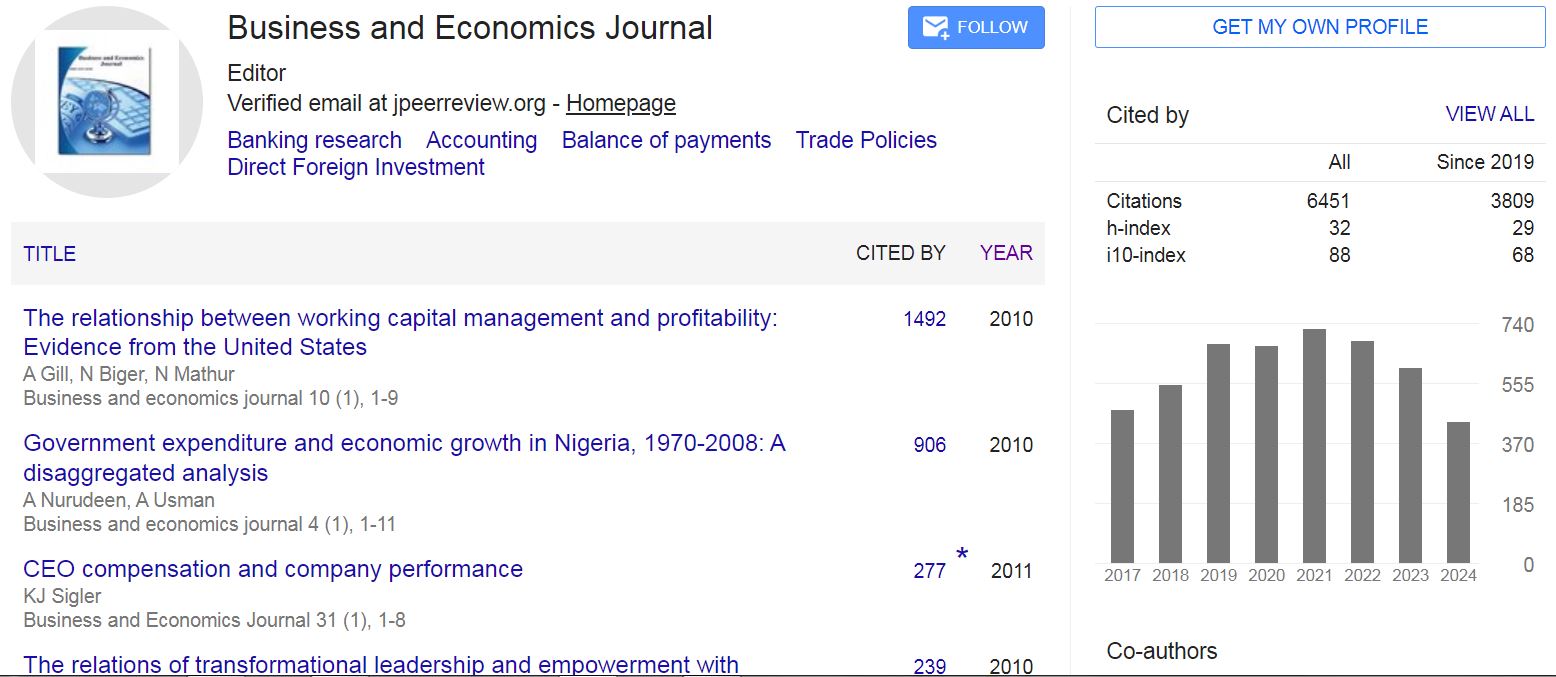
Business and Economics Journal received 6451 citations as per Google Scholar report