Brief Report - (2025) Volume 16, Issue 4
Received: 01-Jul-2025, Manuscript No. bej-26-182449;
Editor assigned: 03-Jul-2025, Pre QC No. P-182449;
Reviewed: 17-Jul-2025, QC No. Q-182449;
Revised: 22-Jul-2025, Manuscript No. R-182449;
Published:
29-Jul-2025
, DOI: 10.37421/2161-6219.2025.16.563
Citation: Delgado, Carmen. ”Business Drivers of Economic
Growth: Innovation, Investment, Policy.” Bus Econ J 16 (2025):563.
Copyright: © 2025 Delgado C. This is an open-access article distributed under the terms of the Creative Commons Attribution License, which permits unrestricted use,
distribution and reproduction in any medium, provided the original author and source are credited.
The intricate relationship between business dynamics and economic expansion forms a cornerstone of macroeconomic understanding, with innovation, investment, and productivity emerging as fundamental drivers of broader economic growth. Supportive business environments, characterized by favorable policies and access to resources, are empirically shown to foster stronger economic outcomes and are essential for stimulating overall economic development [1].
The vital role of small and medium-sized enterprises (SMEs) in the economy cannot be overstated, as they act as significant engines of economic growth through job creation, innovation, and export activities. Policy interventions aimed at enhancing SME performance, particularly in terms of access to finance and regulatory burden reduction, are crucial for stimulating their growth and, consequently, overall economic development [2].
Foreign direct investment (FDI) exerts a considerable influence on economic growth, primarily by elevating domestic business productivity and facilitating technological diffusion. The transfer of advanced technologies, managerial expertise, and the enhancement of local market competition through FDI can significantly boost economic growth, provided host country policies are designed to maximize these benefits [3].
Corporate governance within businesses plays a critical role in economic growth, with strong governance structures leading to more efficient resource allocation and increased investor confidence. Empirical evidence consistently links improved corporate governance practices to positive macroeconomic outcomes, thereby contributing to sustained economic expansion [4].
Business innovation, particularly through research and development (R&D) investment and the adoption of new technologies, is a key contributor to productivity gains and long-term economic development. Cross-country data demonstrate a positive correlation between firm-level innovation and national economic performance, underscoring its importance [5].
Entrepreneurship serves as a powerful driver of economic growth by fostering the creation of new ventures that subsequently contribute to economic output, employment, and innovation. An ecosystem that actively supports new business formation and growth is essential for dynamic economic development and the revitalization of economies [6].
Financial market development is intrinsically linked to business growth, as efficient financial systems provide the crucial funding necessary for businesses to invest and expand. Enhanced access to credit and capital markets positively influences firm-level growth and contributes significantly to aggregate economic expansion [7].
Infrastructure development has a demonstrable impact on business performance and, consequently, on economic growth. Improvements in transportation, communication, and energy infrastructure reduce business costs, boost efficiency, and facilitate trade, all of which foster economic expansion and improve the business environment [8].
Trade liberalization enhances business competitiveness and drives economic growth by allowing businesses access to larger customer bases and enabling economies of scale. Increased competition resulting from open markets also spurs innovation and efficiency, contributing to overall economic development [9].
Government policies, including tax incentives and regulatory frameworks, significantly influence business investment and economic growth. Well-designed policies can effectively stimulate business activity, leading to higher productivity and sustained economic expansion, with stability and predictability being key factors for success [10].
The nexus of business dynamics and economic growth is a multifaceted subject, with innovation, investment, and productivity within businesses serving as fundamental drivers of broader economic expansion. Theoretical frameworks and empirical evidence suggest that supportive business environments, bolstered by favorable policies and accessible resources, are instrumental in fostering stronger economic outcomes, underscoring the importance of the interplay between entrepreneurial ventures and established corporations in shaping growth trajectories [1].
Small and medium-sized enterprises (SMEs) are recognized as crucial engines of economic growth, contributing significantly through job creation, innovation, and export activities. The research highlights that specific policy interventions, such as enhancing access to finance and reducing regulatory burdens, can effectively improve SME performance and, by extension, stimulate overall economic development [2].
Foreign direct investment (FDI) plays a pivotal role in economic growth, primarily by enhancing domestic business productivity and promoting technological diffusion. The influx of FDI can significantly boost economic growth through the transfer of advanced technologies, managerial expertise, and by fostering increased competition within local markets, with host country policies being key to maximizing these benefits [3].
The impact of corporate governance on economic growth is substantial, with robust governance structures within businesses leading to more efficient resource allocation and bolstering investor confidence. Empirical investigations consistently demonstrate a link between improved corporate governance practices and positive macroeconomic outcomes, ultimately contributing to higher economic growth rates [4].
Business innovation, driven by R&D investment and the adoption of new technologies by firms, is a critical factor in achieving productivity gains and fostering long-term economic development. The evidence from cross-country data underscores the positive correlation between firm-level innovation and overall national economic performance, emphasizing its role in sustained growth [5].
Entrepreneurship acts as a significant catalyst for economic growth through the establishment of new ventures that contribute to economic output, employment, and innovation. The development of an entrepreneurial ecosystem that supports new business formation and facilitates their growth is vital for achieving dynamic economic development [6].
The development of financial markets is essential for business growth, as efficient financial systems provide the necessary capital for businesses to undertake investments and expand their operations. Evidence suggests that improved access to credit and capital markets positively influences firm-level growth and contributes to aggregate economic expansion [7].
Infrastructure development significantly influences business performance and, consequently, economic growth. Enhanced transportation, communication, and energy infrastructure reduce operational costs for businesses, improve efficiency, and facilitate trade, thereby fostering economic expansion and creating a more conducive business environment [8].
Trade liberalization offers substantial benefits for business competitiveness and economic growth by providing businesses with access to larger markets and enabling economies of scale. The resultant increase in competition also incentivizes innovation and efficiency, contributing positively to overall economic growth [9].
Government policies, encompassing tax incentives and regulatory frameworks, are critical determinants of business investment and economic growth. Properly formulated policies can effectively stimulate business activity, leading to increased productivity and sustained economic expansion, with policy stability and predictability being paramount for attracting and retaining investment [10].
This collection of research explores the multifaceted relationship between business activities and economic growth. Key themes include the role of innovation, investment, and productivity as fundamental drivers of economic expansion. Supportive business environments, favorable policies, and access to resources are highlighted as crucial for fostering economic growth. The contributions of small and medium-sized enterprises (SMEs) through job creation and innovation are emphasized, alongside the impact of foreign direct investment on productivity and technological diffusion. Corporate governance, entrepreneurship, financial market development, infrastructure, and trade liberalization are also identified as significant factors influencing business competitiveness and economic growth. Finally, the study examines how government policies can stimulate business investment and, consequently, economic growth.
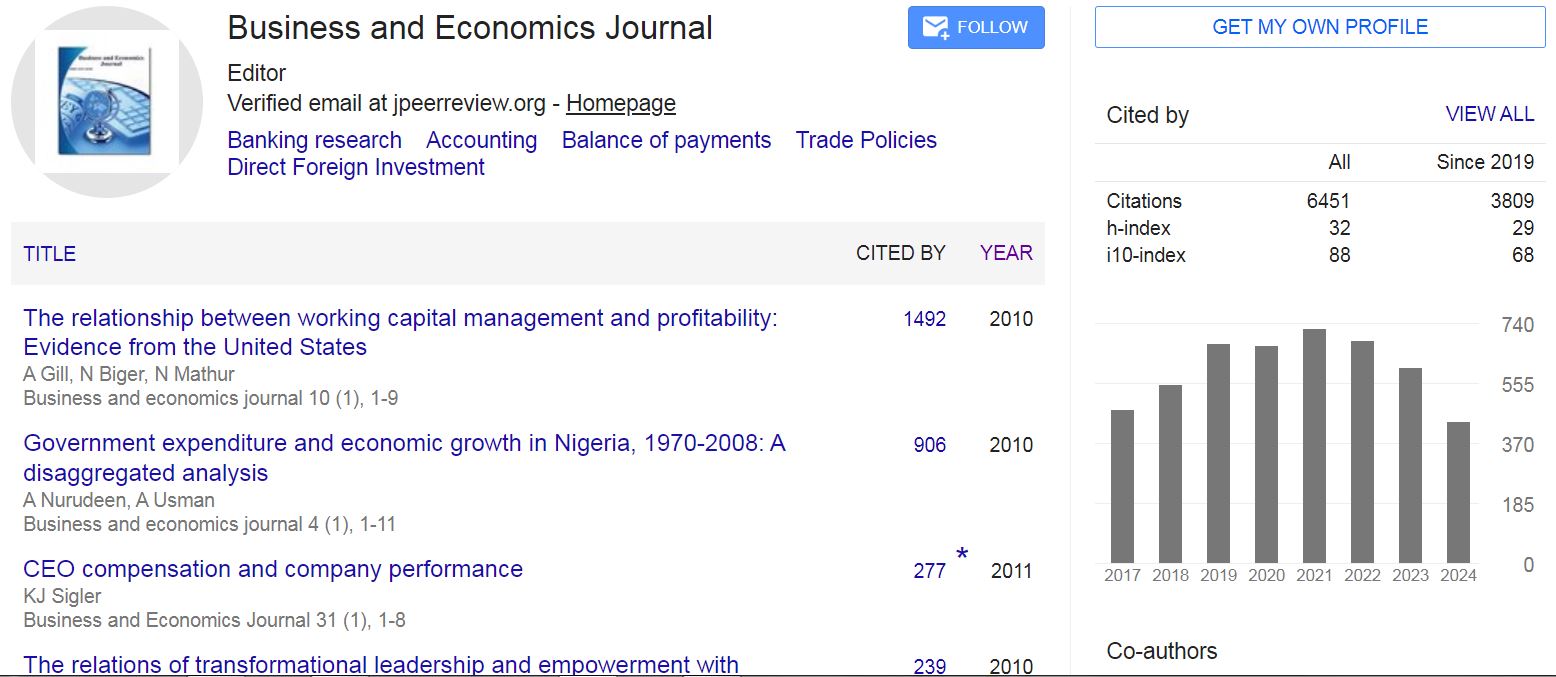
Business and Economics Journal received 6451 citations as per Google Scholar report