Brief Report - (2025) Volume 9, Issue 5
Received: 02-Sep-2025, Manuscript No. fsb-26-189963;
Editor assigned: 04-Sep-2025, Pre QC No. P-189963;
Reviewed: 18-Sep-2025, QC No. Q-189963;
Revised: 23-Sep-2025, Manuscript No. R-189963;
Published:
30-Sep-2025
, DOI: 10.37421/2577-0543.2025.9.249
Citation: Ribeiro, Amanda. ”Buccal And Sublingual Delivery: Rapid Action, Enhanced Bioavailability.” J. Formul. Sci. Bioavailability 09 (2025):249.
Copyright: © 2025 Ribeiro A. This is an open-access article distributed under the terms of the Creative Commons Attribution License, which permits unrestricted use, distribution and reproduction in any medium, provided the original author and source are credited.
Buccal and sublingual drug delivery systems represent a significant advancement in pharmaceutical science, offering a promising route for achieving rapid bioavailability by bypassing first-pass metabolism and enabling direct absorption into the systemic circulation. These approaches are particularly beneficial for drugs with low oral bioavailability, those susceptible to degradation in the gastrointestinal tract, and for achieving rapid onset of action in critical situations. Recent advancements in this field focus on novel formulations like mucoadhesive films, nanoparticles, and orally disintegrating tablets to enhance drug permeation, stability, and patient compliance, with the key lying in optimizing formulation design to overcome barriers such as saliva flow, enzymatic degradation, and the limited surface area of the oral mucosa [1].
Sublingual administration, in particular, provides a direct pathway to the systemic circulation via the rich vasculature beneath the tongue, leading to rapid absorption and circumventing hepatic first-pass metabolism. This method is ideally suited for drugs requiring quick action, such as analgesics or treatments for acute conditions. Recent developments in this area involve nano- and microparticulate systems, ion-pairing techniques, and permeation enhancers to improve the solubility and absorption of poorly water-soluble drugs. Research continues to explore the design of specialized dosage forms that maintain contact time with the sublingual mucosa and prevent swallowing [2].
Orally disintegrating tablets (ODTs) have emerged as a highly popular dosage form for both buccal and sublingual delivery, offering the distinct advantage of ease of administration without the need for water. The rapid disintegration within the oral cavity, followed by absorption through the oral mucosa, ensures a swift onset of action and improved patient compliance, which is especially crucial for pediatric and geriatric populations. Innovations in ODT technology are continuously being developed, including the use of superdisintegrants, taste-masking agents, and freeze-drying techniques, all aimed at enhancing dissolution rate and masking unpleasant tastes, thereby increasing the acceptance and efficacy of delivered drugs [3].
Mucoadhesive buccal films are specifically designed to adhere to the buccal mucosa, thereby prolonging drug contact time and facilitating sustained drug release and absorption. This innovative approach offers a viable alternative to conventional dosage forms, enabling the efficient delivery of drugs that undergo significant first-pass metabolism or are poorly absorbed orally. Current research endeavors are concentrated on developing advanced film formulations that incorporate permeation enhancers, mucoadhesive polymers, and controlled-release mechanisms to optimize drug diffusion and therapeutic outcomes, while simultaneously addressing challenges related to film stability and patient comfort [4].
Nanotechnology has undeniably revolutionized buccal and sublingual drug delivery by facilitating the formulation of sophisticated nanoparticles, nanocarriers, and nanoemulsions. These advanced nanoformulations offer substantial improvements in drug solubility, enhanced mucoadhesion, and facilitated permeation across the oral mucosa. The increased surface area to volume ratio inherent in nanoparticles also significantly aids in faster dissolution and absorption. Current research efforts are strategically directed towards developing targeted nanocarriers capable of delivering drugs more efficiently to specific sites within the oral cavity or enhancing transmucosal transport, ultimately leading to improved bioavailability and a reduction in dosing frequency [5].
Permeation enhancers play an indispensable role in significantly improving the absorption of drugs across the oral mucosa, which inherently acts as a natural barrier to drug entry. These agents function by reversibly disrupting the tight junctions between epithelial cells or by increasing the lipophilicity of the drug. A wide variety of permeation enhancers, including surfactants, bile salts, and natural compounds, are currently being explored for buccal and sublingual delivery applications. The primary challenge in this area lies in the careful selection of enhancers that are not only safe and effective but also do not cause significant irritation or damage to the delicate oral tissues, while simultaneously optimizing their concentration for maximal therapeutic benefit [6].
The inherent physiological properties of the oral mucosa, such as its stratified epithelium, relatively low surface area, and continuous saliva flow, collectively present substantial challenges for achieving effective drug delivery. A profound understanding of these physiological barriers is therefore paramount for the successful design of buccal and sublingual formulations. Strategies employed to overcome these limitations primarily involve optimizing drug formulation for enhanced mucoadhesion, judiciously employing permeation enhancers, and utilizing advanced dosage forms that can ensure adequate residence time and drug dissolution within the oral cavity to facilitate optimal absorption [7].
The development and application of mucoadhesive polymers are critical for significantly enhancing the retention time of buccal and sublingual drug delivery systems, thereby promoting localized drug action and improving systemic absorption. Commonly utilized mucoadhesive materials include chitosan, various cellulose derivatives, and carbomers. Contemporary research is actively exploring novel bio-based and synthetic polymers that exhibit improved mucoadhesive properties, possess muco-penetrating capabilities, and demonstrate stimuli-responsive behavior. The overarching aim is to engineer advanced systems capable of adhering robustly to the oral mucosa, effectively controlling drug release, and withstanding the shear forces exerted by saliva and tongue movement [8].
The incorporation of bio-inspired approaches, such as the integration of natural compounds possessing intrinsic mucoadhesive and permeation-enhancing properties, is increasingly gaining traction in the field of buccal and sublingual drug delivery. Plant-derived extracts and polysaccharides are being meticulously investigated for their potential to enhance drug solubility, stability, and absorption across the oral mucosa. This trend aligns harmoniously with the escalating demand for safer and more sustainable drug delivery solutions. However, a significant challenge remains in the standardization of these natural products and ensuring their consistent performance and predictable safety profiles for pharmaceutical applications [9].
Furthermore, the advancement of sophisticated analytical techniques is absolutely essential for the thorough characterization of the performance of buccal and sublingual drug delivery systems. Techniques such as in vitro dissolution testing, permeation studies employing artificial membranes or excised tissues, and in vivo pharmacokinetic evaluations are indispensable for accurately assessing drug release kinetics, absorption rates, and overall bioavailability. Recent breakthroughs in microfluidics and imaging technologies are paving the way for more sophisticated and high-throughput analysis of these intricate delivery systems, providing deeper insights into their performance and significantly guiding the process of formulation optimization [10].
Buccal and sublingual drug delivery systems have emerged as a vital area of pharmaceutical research, offering a strategic advantage by bypassing the gastrointestinal tract and the associated first-pass metabolism, thereby leading to enhanced bioavailability and a more rapid onset of action. These routes are especially pertinent for drugs that are poorly absorbed orally, susceptible to enzymatic degradation in the gut, or when immediate therapeutic effects are required. Innovations in this domain are continually expanding, with a strong emphasis on novel formulations such as mucoadhesive films, advanced nanoparticle systems, and rapidly dissolving oral tablets. The success of these systems hinges on meticulous formulation design to surmount the inherent physiological barriers of the oral mucosa, including the constant presence of saliva, enzymatic activity, and the limited surface area available for absorption [1].
Sublingual administration, characterized by its direct access to the systemic circulation through the rich venous network beneath the tongue, offers rapid drug absorption and effectively circumvents hepatic first-pass metabolism. This makes it an ideal route for medications necessitating swift therapeutic intervention, such as potent analgesics or emergency treatments. Current research is actively exploring the utilization of nano- and microparticulate systems, along with ion-pairing techniques and permeation enhancers, to augment the solubility and absorption efficiency of challenging, poorly water-soluble drugs. A considerable focus remains on designing specialized dosage forms that ensure prolonged contact with the sublingual mucosa and prevent inadvertent swallowing [2].
Orally disintegrating tablets (ODTs) have garnered significant attention as a versatile dosage form for both buccal and sublingual drug delivery, providing unparalleled ease of administration as they dissolve rapidly in the mouth without requiring water. This rapid disintegration initiates prompt absorption via the oral mucosa, resulting in a quick onset of action and a marked improvement in patient compliance, particularly among vulnerable populations like children and the elderly. The evolution of ODT technology is driven by the incorporation of advanced excipients such as superdisintegrants and taste-masking agents, alongside innovative manufacturing techniques like freeze-drying, all contributing to enhanced dissolution rates and a more palatable patient experience [3].
Mucoadhesive buccal films represent a sophisticated approach to drug delivery, engineered to adhere tenaciously to the buccal mucosa. This adhesion prolongs the residence time of the drug, thereby facilitating sustained release and enhanced absorption. Such films offer a compelling alternative to traditional dosage forms, particularly for drugs that are subject to extensive first-pass metabolism or exhibit poor oral absorption. Ongoing research is dedicated to creating cutting-edge film formulations that integrate permeation enhancers, highly effective mucoadhesive polymers, and sophisticated controlled-release mechanisms to optimize drug diffusion and achieve superior therapeutic outcomes, while also addressing practical concerns like film stability and user comfort [4].
The advent of nanotechnology has profoundly transformed the landscape of buccal and sublingual drug delivery, enabling the creation of highly engineered nanoparticles, nanocarriers, and nanoemulsions. These nano-sized delivery systems offer significant advantages, including improved drug solubility, enhanced mucoadhesion, and more efficient permeation through the oral mucosa. The remarkably high surface area-to-volume ratio characteristic of nanoparticles further expedites drug dissolution and absorption processes. Contemporary research is heavily invested in the development of targeted nanocarriers, designed to deliver drugs with greater precision to specific locations within the oral cavity or to enhance transmucosal transport, ultimately boosting bioavailability and reducing the frequency of drug administration [5].
Permeation enhancers are indispensable components in the strategy to overcome the natural barriers presented by the oral mucosa, thereby facilitating improved drug absorption. These enhancers operate by transiently modulating the integrity of the epithelial cell tight junctions or by increasing the drug's lipophilicity. A diverse array of permeation enhancers, encompassing surfactants, bile salts, and various naturally occurring compounds, are currently under investigation for their utility in buccal and sublingual delivery. A critical challenge remains in identifying and selecting enhancers that are both safe and effective, ensuring they do not induce significant irritation or damage to the oral tissues, while simultaneously optimizing their concentrations for maximal therapeutic impact [6].
The inherent physiological characteristics of the oral mucosa, including its stratified epithelial structure, limited surface area, and the continuous presence of saliva, pose considerable challenges to achieving effective drug delivery. A comprehensive understanding of these physiological hurdles is thus fundamental to the successful design of buccal and sublingual formulations. Strategies to surmount these obstacles typically involve tailoring drug formulations for optimal mucoadhesion, employing carefully selected permeation enhancers, and utilizing advanced dosage forms designed to ensure sufficient contact time and drug dissolution within the oral cavity, thereby maximizing absorption potential [7].
The development and application of advanced mucoadhesive polymers are pivotal for extending the residence time of drug delivery systems within the buccal and sublingual environments. This extended contact is crucial for both localized therapeutic effects and enhanced systemic absorption. Common classes of mucoadhesive materials include chitosan, various cellulose derivatives, and carbomers. Current research is actively exploring novel bio-based and synthetic polymers that exhibit superior mucoadhesive properties, demonstrate muco-penetrating capabilities, and possess stimuli-responsive characteristics. The ultimate goal is to engineer sophisticated systems that can form a strong bond with the oral mucosa, provide controlled drug release, and withstand the mechanical stresses imposed by saliva flow and tongue movements [8].
Bio-inspired strategies, such as the integration of natural compounds with inherent mucoadhesive and permeation-enhancing properties, are increasingly being explored and adopted in the development of buccal and sublingual drug delivery systems. Plant-derived extracts and polysaccharides are under active investigation for their potential to improve drug solubility, enhance stability, and facilitate absorption across the oral mucosa. This trend aligns with a growing societal preference for safer and more environmentally sustainable pharmaceutical solutions. A primary hurdle involves the standardization of these natural products to ensure consistent performance and a well-defined safety profile for pharmaceutical applications [9].
Complementing the formulation advancements, the development of sophisticated analytical techniques is paramount for the comprehensive evaluation of buccal and sublingual drug delivery systems. Essential techniques include in vitro dissolution testing, permeation studies using model membranes or ex vivo tissues, and in vivo pharmacokinetic assessments to accurately quantify drug release, absorption kinetics, and overall bioavailability. Recent innovations in microfluidics and advanced imaging technologies are enabling more intricate and high-throughput analyses of these complex delivery systems, providing invaluable insights into their performance characteristics and guiding the optimization of future formulations [10].
Buccal and sublingual drug delivery systems offer rapid absorption by bypassing first-pass metabolism, making them ideal for drugs with low oral bioavailability or those requiring fast action. Innovations include mucoadhesive films, nanoparticles, and orally disintegrating tablets, which enhance drug permeation and stability. Sublingual administration utilizes the rich vasculature under the tongue for swift systemic entry. Orally disintegrating tablets provide easy administration without water, improving compliance. Nanotechnology enhances solubility and permeation, while permeation enhancers help overcome oral mucosal barriers. Mucoadhesive polymers are crucial for prolonging drug contact time. Bio-inspired materials and advanced analytical techniques are also key areas of development for optimizing these delivery systems.
None
None
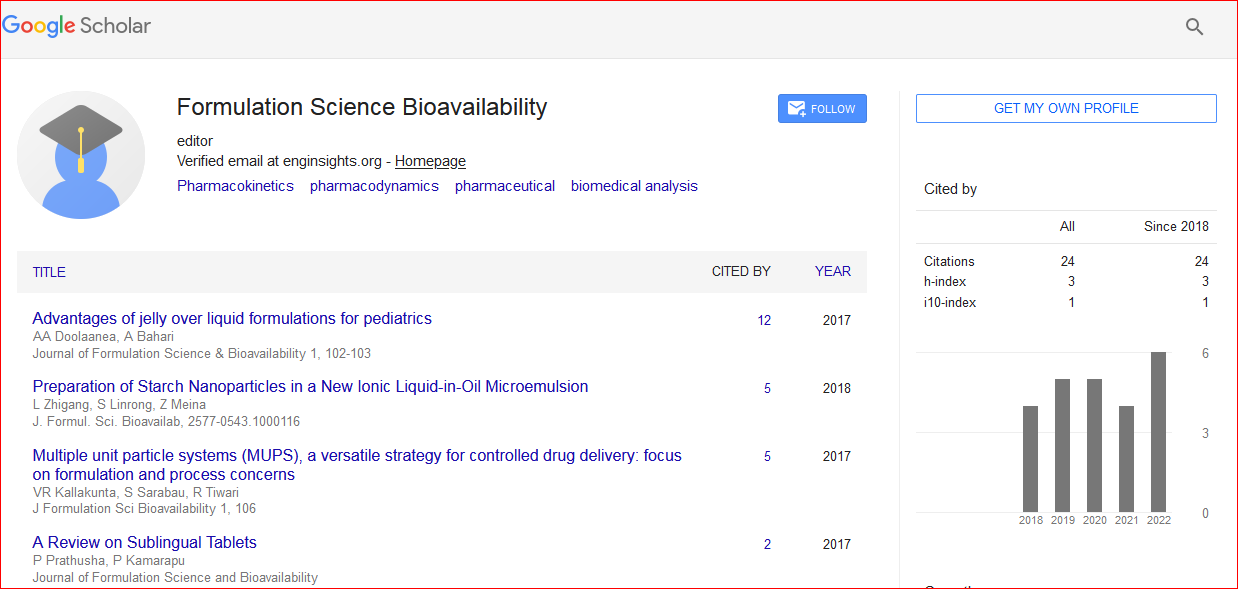
Journal of Formulation Science & Bioavailability received 23 citations as per Google Scholar report