Perspective - (2025) Volume 16, Issue 6
Received: 01-Dec-2025, Manuscript No. jbsbe-26-183334;
Editor assigned: 03-Dec-2025, Pre QC No. P-183334;
Reviewed: 17-Dec-2025, QC No. Q-183334;
Revised: 22-Dec-2025, Manuscript No. R-183334;
Published:
29-Dec-2025
, DOI: 10.37421/2165-6210.2025.16.538
Citation: Saeed, Yara. ”Biosensors: Revolutionizing Therapeutic Drug Monitoring.” J Biosens Bioelectron 16 (2025):538.
Copyright: © 2025 Saeed Y. This is an open-access article distributed under the terms of the Creative Commons Attribution License, which permits unrestricted use, distribution and reproduction in any medium, provided the original author and source are credited.
The burgeoning field of biosensors designed for therapeutic drug monitoring (TDM) holds immense promise for revolutionizing patient care through real-time, personalized drug regimen adjustments. Advancements in sensor design, targeting specific biomarkers, and the integration of microfluidics are key to improving sample handling and enabling this paradigm shift [1].
Traditional TDM methods often suffer from being retrospective and labor-intensive. Novel electrochemical biosensors are emerging as a promising alternative, offering high sensitivity and selectivity for critical drugs, paving the way for point-of-care applications and more agile treatment adjustments [2].
The integration of nanotechnology represents a significant leap forward in biosensor performance. Nanomaterials enhance the sensitivity and reduce the response time of biosensors, crucial for optimizing drug dosing and minimizing risks associated with under- or overdosing in patients [3].
Developing wearable biosensors for continuous drug monitoring presents unique challenges, including biocompatibility, power consumption, and signal processing. However, flexible electrochemical patches are demonstrating the feasibility of non-invasive, continuous TDM for various conditions [4].
The diagnostic accuracy of biosensors is a critical factor for their clinical utility. Optical biosensors, such as those employing surface plasmon resonance (SPR), are being optimized for high precision and accuracy in quantifying therapeutic drugs, which is vital for managing critical illnesses [5].
Navigating the regulatory and clinical translation landscape is essential for the widespread adoption of biosensors in TDM. Standardized validation protocols, robust quality control, and clear regulatory guidelines are paramount for ensuring patient safety and therapeutic efficacy [6].
The choice of biorecognition element profoundly influences biosensor specificity. Aptamers, for instance, offer high specificity and stability, making them ideal for accurately detecting drug levels in diverse patient populations, particularly in resource-limited settings [7].
The integration of microfluidics with biosensors, particularly in lab-on-a-chip devices, facilitates simultaneous monitoring of multiple drugs. This miniaturization promises faster analysis, reduced reagent consumption, and automated, high-throughput TDM, thereby improving clinical decision-making [8].
Developing cost-effective and portable biosensors is key to their accessibility. Paper-based analytical devices (PADs) functionalized with enzymes offer a low-cost, disposable solution for point-of-care monitoring of drug levels, especially in settings lacking specialized laboratory equipment [9].
Looking ahead, the integration of artificial intelligence (AI) and machine learning (ML) with biosensor data is poised to transform TDM. This synergy will enable sophisticated data analysis, predictive modeling, and adaptive drug delivery, ushering in an era of truly personalized medicine [10].
Biosensors for therapeutic drug monitoring (TDM) are rapidly evolving, with a significant focus on improving patient care through real-time, personalized adjustments to drug regimens. Innovations in sensor design, the identification of specific biomarkers, and the incorporation of microfluidic technologies are crucial for enhancing sample handling and enabling these advancements [1].
The limitations of traditional TDM, such as its retrospective nature and labor-intensive processes, are being addressed by novel electrochemical biosensors. These devices demonstrate high sensitivity and selectivity for various therapeutic drugs, making them suitable for point-of-care applications and enabling more responsive treatment adjustments [2].
Nanotechnology plays a pivotal role in boosting biosensor performance by enhancing sensitivity and reducing response times. The use of nanomaterials in biosensor development is critical for achieving precise drug dosing, thereby minimizing the risks of both under- and overdosing in clinical practice [3].
Efforts in developing wearable biosensors for continuous drug monitoring are tackling key challenges related to biocompatibility, power efficiency, and data processing. Promising results from flexible electrochemical patches indicate the potential for non-invasive, continuous TDM solutions [4].
The accuracy of biosensor readings is fundamental to their clinical acceptance. Optical biosensing techniques, including surface plasmon resonance (SPR), are being refined to achieve high precision and reliability in quantifying drug concentrations, which is essential for managing critical infections and optimizing treatment outcomes [5].
Bridging the gap between biosensor development and clinical implementation involves overcoming regulatory and translational hurdles. Establishing standardized validation methods, robust quality control systems, and clear regulatory frameworks are imperative for ensuring the safe and effective use of biosensors in TDM [6].
The selection of appropriate biorecognition elements is paramount for achieving high biosensor specificity. Aptamers, known for their specificity and stability, are being utilized in biosensors for accurate drug level detection, particularly beneficial for diverse patient populations and challenging clinical scenarios [7].
The synergy between microfluidics and biosensors, particularly in lab-on-a-chip designs, enables multiplexed drug monitoring. These integrated systems offer advantages such as accelerated analysis, reduced reagent usage, and the potential for automated, high-throughput TDM, significantly aiding clinical decision-making [8].
The development of cost-effective and portable biosensor platforms, such as paper-based analytical devices (PADs), is crucial for democratizing TDM. These disposable devices provide a viable option for monitoring drug levels in resource-limited settings without requiring extensive laboratory infrastructure [9].
Future advancements in biosensor technology for TDM are heavily influenced by the integration of artificial intelligence (AI) and machine learning (ML). This fusion promises enhanced data interpretation, predictive analytics for treatment efficacy and toxicity, and the development of adaptive drug delivery systems, driving personalized medicine forward [10].
This collection of research highlights the transformative potential of biosensors in therapeutic drug monitoring (TDM). Advancements in sensor design, including nanotechnology and microfluidics, are enabling real-time, personalized drug regimen adjustments. Electrochemical, optical, and paper-based biosensors are being developed with high sensitivity, specificity, and accuracy for various drug classes, addressing limitations of traditional TDM. Wearable biosensors offer continuous monitoring, while AI and machine learning integration promise predictive capabilities. Overcoming regulatory and clinical translation challenges is key to widespread adoption, ultimately aiming to improve patient outcomes through more precise and efficient drug management.
None
None
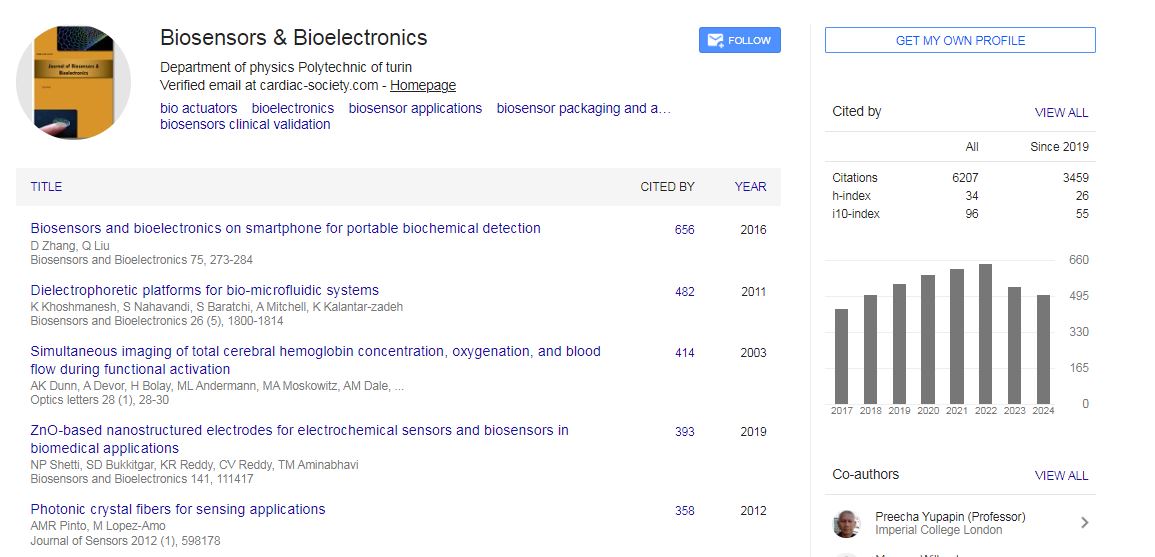
Biosensors & Bioelectronics received 6207 citations as per Google Scholar report