Brief Report - (2025) Volume 16, Issue 4
Received: 01-Aug-2025, Manuscript No. jbsbe-26-183305;
Editor assigned: 04-Aug-2025, Pre QC No. P-183305;
Reviewed: 18-Aug-2025, QC No. Q-183305;
Revised: 22-Aug-2025, Manuscript No. R-183305;
Published:
29-Aug-2025
, DOI: 10.37421/2165-6210.2025.16.511
Citation: Grant, Oliver. ”Biosensors: Revolutionizing Disease Detection and Diagnostics.” J Biosens Bioelectron 16 (2025):511.
Copyright: © 2025 Grant O. This is an open-access article distributed under the terms of the Creative Commons Attribution License, which permits unrestricted use, distribution and reproduction in any medium, provided the original author and source are credited.
Biosensors represent a transformative technology for the rapid and sensitive detection of infectious diseases, offering a critical pathway for early diagnosis and prompt therapeutic intervention. This advanced field harnesses a diverse array of transduction mechanisms, encompassing electrochemical, optical, and piezoelectric principles, to identify specific biomarkers such as antigens, antibodies, or nucleic acids that are indicative of infection. Significant advancements in nanotechnology and microfluidics are continuously pushing the boundaries of biosensor performance, leading to enhanced sensitivity, specificity, and portability, thereby facilitating the development of point-of-care diagnostic solutions. The synergistic integration of these sophisticated biosensor technologies with artificial intelligence is also emerging as a powerful tool for optimizing data analysis and elevating diagnostic accuracy, promising a new era in infectious disease management. Electrochemical biosensors have demonstrated particular efficacy in the domain of infectious disease detection owing to their inherent high sensitivity, cost-effectiveness, and inherent potential for miniaturization. Contemporary research efforts are heavily focused on the design and implementation of novel electrode materials and refined immobilization strategies aimed at augmenting signal transduction efficiency and mitigating undesirable non-specific binding events. Furthermore, the incorporation of microfluidic systems into electrochemical biosensor platforms enables sophisticated on-chip sample processing and precise reagent delivery, paving the way for highly efficient multiplexed detection of a wide spectrum of pathogens or their associated biomarkers. Optical biosensors, which include established technologies like surface plasmon resonance (SPR) and advanced fluorescence-based platforms, provide either label-free or exceptionally sensitive methods for identifying markers of infectious diseases. Current investigative avenues are exploring the strategic application of nanomaterials, such as gold nanoparticles and quantum dots, with the dual objective of amplifying optical signals and enabling the simultaneous detection of multiple analytes. The ongoing development of portable optical biosensor systems is paramount for facilitating decentralized testing strategies and bolstering global outbreak surveillance capabilities. Nucleic acid-based biosensors hold a pivotal position in the detection of infectious agents by targeting their specific genetic material, thereby offering unparalleled specificity and sensitivity. The advent of CRISPR-Cas systems has profoundly revolutionized this area, providing precise and programmable detection mechanisms for distinct DNA or RNA sequences. The burgeoning field of CRISPR-based biosensors, particularly when integrated with paper microfluidics, is actively facilitating the creation of rapid, low-cost diagnostic tools, which are especially vital for resource-limited settings worldwide. The sophisticated integration of microfluidic technology with biosensor platforms represents a significant and ongoing trend in the advancement of infectious disease diagnostics. Microfluidic devices excel at precisely manipulating samples, facilitating reagent mixing, and controlling reaction environments at a minuscule scale, collectively contributing to marked improvements in assay performance, a reduction in required sample volumes, and significantly faster analysis durations. This powerful combination is a key enabler for the development of effective point-of-care devices designed for rapid and accurate disease detection. Point-of-care (POC) biosensors are fundamentally reshaping the landscape of infectious disease diagnostics by enabling swift and accessible testing directly at the patient's bedside or within remote geographical locations. The primary objective of these innovative devices is to deliver accurate diagnostic results within minutes, thereby empowering immediate clinical decision-making and alleviating the substantial workload on centralized laboratory facilities. Nevertheless, critical challenges persist, including the imperative to ensure the robustness, user-friendliness, and overall cost-effectiveness of these portable POC biosensor platforms. Nanomaterials play an indispensable and multifaceted role in significantly enhancing the performance characteristics of biosensors specifically designed for the detection of infectious diseases. Their inherent high surface area-to-volume ratio, coupled with unique optical and electrical properties and facile functionalization capabilities, allows for substantial improvements in signal amplification, achievement of higher sensitivity levels, and more effective immobilization of capture molecules. Prominent examples of nanomaterials frequently employed in this rapidly evolving field include gold nanoparticles, quantum dots, and graphene. The development and implementation of multiplexed biosensors are of paramount importance for the simultaneous detection of multiple infectious agents or their corresponding biomarkers. This advanced approach not only provides a more comprehensive diagnostic profile but also aids significantly in the differentiation between coinfections or conditions presenting with similar clinical manifestations. Breakthroughs in microarray technology, digital microfluidics, and innovative particle-based assay formats are collectively driving progress in high-throughput multiplexed detection, which is crucial for effective infectious disease surveillance efforts. Antimicrobial resistance (AMR) represents a profound and escalating global health crisis, underscoring the critical need for rapid and accurate detection of resistant pathogens to guide effective treatment strategies. Biosensors are actively being developed and refined to identify specific resistance genes or phenotypic markers of resistance directly from clinical samples. This capability empowers clinicians to promptly select the most appropriate antimicrobial agents, leading to improved patient outcomes and contributing to efforts aimed at slowing the dissemination of AMR. The application of artificial intelligence (AI) and machine learning (ML) methodologies to the analysis of biosensor data is demonstrably accelerating the development trajectory of sophisticated infectious disease diagnostic systems. AI and ML algorithms possess the remarkable ability to process intricate biosensor signals, discern subtle patterns that may indicate the presence of disease, and ultimately enhance both diagnostic accuracy and predictive capabilities. This powerful synergy holds immense potential for the creation of intelligent, autonomous, and highly effective diagnostic solutions for a wide range of infectious diseases.
Biosensors are revolutionizing infectious disease diagnostics by offering a rapid and sensitive platform for early detection and timely treatment. They utilize various transduction mechanisms like electrochemical, optical, and piezoelectric methods to identify specific biomarkers such as antigens, antibodies, or nucleic acids. Advances in nanotechnology and microfluidics are enhancing sensitivity, specificity, and portability, leading to point-of-care diagnostics. The integration of biosensors with artificial intelligence is further improving data analysis and diagnostic accuracy [1].
Electrochemical biosensors are particularly suitable for infectious disease detection due to their high sensitivity, low cost, and potential for miniaturization. Current research focuses on developing novel electrode materials and immobilization techniques to improve signal transduction and reduce non-specific binding. Microfluidic systems integrated into these biosensors allow for on-chip sample processing and reagent delivery, enabling multiplexed detection of various pathogens or biomarkers [2].
Optical biosensors, including surface plasmon resonance (SPR) and fluorescence-based platforms, offer label-free or highly sensitive detection of infectious disease markers. Research is exploring the use of nanomaterials like gold nanoparticles and quantum dots to enhance optical signals and enable multiplexed detection. The development of portable optical biosensor systems is crucial for decentralized testing and outbreak surveillance [3].
Nucleic acid-based biosensors are vital for detecting the genetic material of infectious agents, providing high specificity and sensitivity. CRISPR-Cas systems have significantly advanced this field, enabling precise and programmable detection of specific DNA or RNA sequences. The integration of CRISPR-based biosensors with paper microfluidics facilitates rapid, low-cost diagnostics, especially for resource-limited settings [4].
The integration of microfluidic technology with biosensors is a key trend in infectious disease diagnostics. Microfluidic devices enable precise sample manipulation, reagent mixing, and reaction control on a small scale, leading to improved assay performance, reduced sample volume, and faster analysis times. This combination is essential for developing point-of-care devices for rapid and accurate disease detection [5].
Point-of-care (POC) biosensors are transforming infectious disease diagnostics by enabling rapid testing at the patient's bedside or in remote locations. These devices aim to provide accurate results within minutes, facilitating immediate clinical decision-making and reducing the burden on centralized laboratories. Key challenges include ensuring the robustness, user-friendliness, and cost-effectiveness of POC biosensor platforms [6].
Nanomaterials are crucial for enhancing the performance of biosensors in infectious disease detection. Their high surface area-to-volume ratio, unique optical and electrical properties, and ease of functionalization lead to improved signal amplification, higher sensitivity, and better immobilization of capture molecules. Gold nanoparticles, quantum dots, and graphene are commonly used nanomaterials in this field [7].
Multiplexed biosensors are essential for simultaneously detecting multiple infectious agents or biomarkers. This approach allows for a more comprehensive diagnostic profile and helps differentiate between coinfections or similar clinical presentations. Advances in microarray technology, digital microfluidics, and particle-based assays are enabling high-throughput multiplexed detection for infectious disease surveillance [8].
Antimicrobial resistance (AMR) is a major global health threat, making rapid detection of resistant pathogens crucial for effective treatment. Biosensors are being developed to identify resistance genes or phenotypic markers of resistance directly from clinical samples. This enables prompt selection of appropriate antimicrobial agents, improving patient outcomes and slowing AMR spread [9].
Artificial intelligence (AI) and machine learning (ML) are accelerating the development of advanced infectious disease diagnostics through biosensor data analysis. AI/ML algorithms can process complex biosensor signals, identify subtle disease patterns, and improve diagnostic accuracy and prediction. This synergy promises smarter, more autonomous diagnostic systems [10].
Biosensors offer a rapid and sensitive platform for detecting infectious diseases, enabling early diagnosis and treatment. Various transduction mechanisms like electrochemical, optical, and nucleic acid-based methods are employed, enhanced by nanotechnology, microfluidics, and nanomaterials. CRISPR-Cas systems have revolutionized nucleic acid detection. Microfluidics and point-of-care (POC) devices are crucial for decentralized and rapid testing. Multiplexed biosensors allow for simultaneous detection of multiple agents. Artificial intelligence and machine learning are improving data analysis and diagnostic accuracy. Biosensors are also being developed to detect antimicrobial resistance, a significant global health threat.
None
None
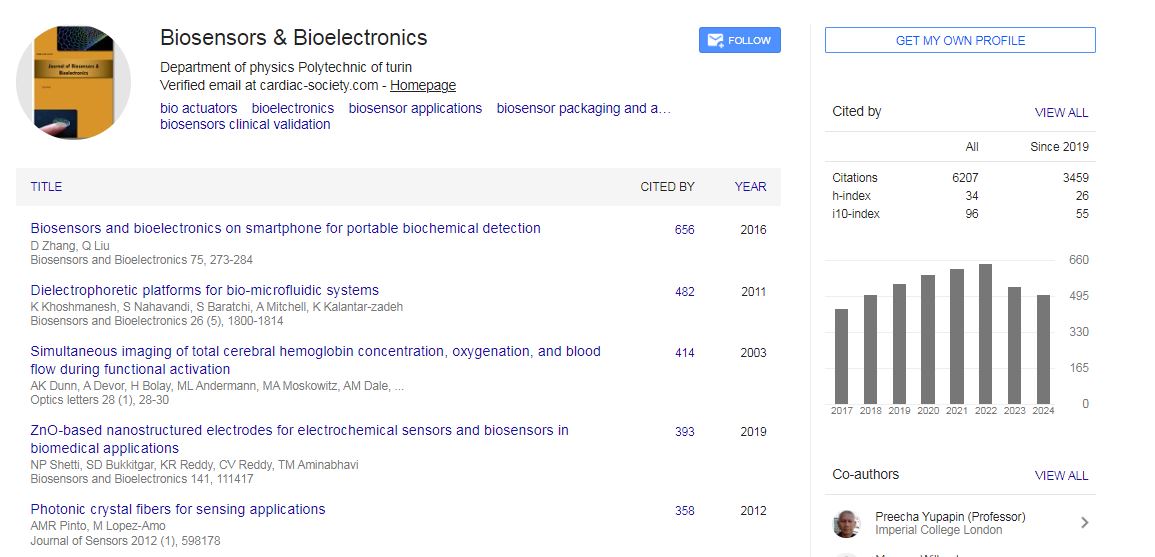
Biosensors & Bioelectronics received 6207 citations as per Google Scholar report