Opinion - (2025) Volume 16, Issue 4
Received: 01-Aug-2025, Manuscript No. jbsbe-26-183308;
Editor assigned: 04-Aug-2025, Pre QC No. P-183308;
Reviewed: 18-Aug-2025, QC No. Q-183308;
Revised: 22-Aug-2025, Manuscript No. R-183308;
Published:
29-Aug-2025
, DOI: 10.37421/2165-6210.2025.16.514
Citation: Matsuda, Keiko. ”Biosensor Advancements for Endocrine Hormone Detection.” J Biosens Bioelectron 16 (2025):514.
Copyright: © 2025 Matsuda K. This is an open-access article distributed under the terms of the Creative Commons Attribution License, which permits unrestricted use, distribution and reproduction in any medium, provided the original author and source are credited.
The field of biosensing has witnessed remarkable advancements, particularly in the development of devices capable of detecting crucial biological molecules. Among these, hormone detection holds significant importance for diagnostics, monitoring, and personalized health management. Electrochemical biosensors have emerged as a powerful tool for this purpose, offering high sensitivity, selectivity, and the potential for miniaturization. One such innovation is an electrochemical biosensor designed for the sensitive and selective detection of cortisol, a vital stress hormone, which is crucial for monitoring conditions like Cushing's syndrome and Addison's disease, with potential for point-of-care diagnostics [1].
Simultaneously, the detection of multiple endocrine disruptors has become a critical area of research, given their widespread impact on human and environmental health. A microfluidic-based biosensing platform has been detailed for the simultaneous detection of various endocrine disruptors, including estrogenic compounds. This integrated system provides high throughput and requires reduced sample volumes, which are essential for environmental monitoring and assessing the effects of these chemicals [2].
In the realm of continuous health monitoring, the development of wearable biosensors is a significant trend. A wearable electrochemical biosensor has been explored for the continuous monitoring of testosterone levels in sweat. This non-invasive device aims to deliver real-time data for athletes and individuals managing hormonal imbalances, showcasing the feasibility of personalized endocrine health tracking [3].
Optical biosensing techniques also play a crucial role in sensitive biomolecule detection. A novel optical biosensor employing surface plasmon resonance (SPR) has been reported for the detection of thyroid-stimulating hormone (TSH). This label-free approach facilitates rapid and sensitive quantification of TSH, offering a valuable diagnostic tool for various thyroid disorders [4].
Field-effect transistor (FET)-based biosensors represent another promising avenue for sensitive detection. This study introduces a FET-based biosensor, functionalized with antibodies, for the detection of progesterone. The inherent high sensitivity and low-power operation of FET sensors make them highly suitable for portable diagnostic devices aimed at reproductive health monitoring [5].
Nanotechnology has significantly contributed to biosensor development, particularly through the use of nanoparticles. A novel aptasensor based on gold nanoparticles has been presented for the selective detection of estradiol. The aptamer-ligand interaction on the nanoparticle surface provides a robust signal amplification strategy for the sensitive detection of this key estrogen hormone [6].
Chemiluminescent immunoassays offer another highly sensitive method for hormone detection. A chemiluminescent immunoassay has been described for the detection of follicle-stimulating hormone (FSH). The synergy between the high sensitivity of chemiluminescence and immunoassay principles provides a powerful method for diagnosing reproductive issues linked to FSH levels [7].
Advancements in smartphone integration are transforming personal health monitoring. The development of a smartphone-integrated biosensor for salivary cortisol detection has been reported. This portable system enables convenient, non-invasive monitoring of stress hormones, with potential applications in mental health assessment and stress management [8].
For targeted applications like fertility tracking, specific hormone detection is paramount. This research focuses on a peptide-based biosensor designed for the detection of luteinizing hormone (LH) in urine. The peptide recognition element offers superior specificity and stability, making it ideal for home-use ovulation prediction kits and fertility monitoring [9].
Given the diverse array of biosensors being developed, a comprehensive understanding of the field is essential. A review article surveys the progress and challenges in developing biosensors for endocrine hormone monitoring. It covers various detection principles, materials, and emerging trends, underscoring the critical need for robust, accurate, and user-friendly devices for both clinical and personal health management [10].
The development of advanced biosensors for endocrine hormone detection is a rapidly evolving area with significant implications for healthcare. Electrochemical biosensors, characterized by their sensitivity and selectivity, are at the forefront of this innovation. A prime example is the novel electrochemical biosensor developed for the sensitive and selective detection of cortisol. This device, utilizing modified electrodes for enhanced signal transduction, holds promise for early and accurate monitoring of conditions such as Cushing's syndrome and Addison's disease, and offers potential for point-of-care diagnostics [1].
In parallel, addressing the environmental and health concerns posed by endocrine disruptors necessitates sophisticated detection platforms. A microfluidic-based biosensing platform has been designed for the simultaneous detection of multiple endocrine disruptors, including estrogenic compounds. This integrated system is noteworthy for its high throughput capabilities and its requirement for minimal sample volume, crucial aspects for environmental monitoring and assessing the impact of these chemicals on human health [2].
Wearable technology is revolutionizing continuous health monitoring, and biosensors are integral to this revolution. The creation of a wearable electrochemical biosensor for the continuous monitoring of testosterone levels in sweat exemplifies this trend. This non-invasive device aims to provide real-time physiological data, benefiting athletes and individuals managing hormonal imbalances by enabling personalized endocrine health tracking [3].
Beyond electrochemical methods, optical biosensing techniques offer distinct advantages in terms of sensitivity and label-free detection. A novel optical biosensor employing surface plasmon resonance (SPR) has been developed for the detection of thyroid-stimulating hormone (TSH). This method allows for rapid and sensitive quantification of TSH, providing a valuable tool for the diagnosis of thyroid disorders [4].
Field-effect transistor (FET) technology is also making significant inroads into biosensing. A FET-based biosensor functionalized with antibodies has been developed for the detection of progesterone. The inherent high sensitivity and low-power consumption of FET sensors position them as strong candidates for portable diagnostic devices focused on reproductive health monitoring [5].
Nanomaterials have been instrumental in enhancing biosensor performance. A novel aptasensor utilizing gold nanoparticles has been engineered for the selective detection of estradiol. The principle involves aptamer-ligand interactions on the nanoparticle surface, providing a robust signal amplification strategy for sensitive detection of this critical estrogen hormone [6].
Chemiluminescent immunoassays represent a highly sensitive diagnostic approach. The development of a sensitive chemiluminescent immunoassay for follicle-stimulating hormone (FSH) detection has been reported. This approach combines the high sensitivity of chemiluminescence with immunoassay principles, offering a powerful method for diagnosing reproductive issues related to FSH levels [7].
Smartphone integration is democratizing health monitoring by making advanced diagnostics more accessible. A smartphone-integrated biosensor for salivary cortisol detection has been developed. This portable system facilitates convenient and non-invasive monitoring of stress hormones, with promising applications in mental health assessment and stress management [8].
For specific applications like fertility prediction, highly targeted hormone detection is essential. This research highlights a peptide-based biosensor designed for the detection of luteinizing hormone (LH) in urine. The peptide recognition element offers exceptional specificity and stability, making it well-suited for home-use ovulation prediction kits and broader fertility monitoring [9].
The collective advancements in biosensor technology for endocrine hormone monitoring underscore the need for a holistic view of the field. A comprehensive review explores the progress and challenges in this domain, examining various detection principles, materials, and emerging trends. The review emphasizes the critical requirement for robust, accurate, and user-friendly devices to support both clinical and personal health management [10].
This compilation of research highlights the significant progress in biosensor technology for detecting various endocrine hormones. Studies present novel electrochemical biosensors for cortisol and testosterone, a microfluidic platform for endocrine disruptors, and wearable devices for continuous monitoring. Optical biosensors employing SPR are discussed for thyroid hormone detection, while FET-based sensors are explored for progesterone. Nanotechnology, specifically gold nanoparticles, enhances estradiol detection via aptasensors. Highly sensitive chemiluminescent immunoassays are noted for FSH detection. Furthermore, smartphone integration enables portable cortisol monitoring, and peptide-based sensors target luteinizing hormone for fertility tracking. A comprehensive review synthesizes these advancements, emphasizing the need for robust and user-friendly devices for diverse health management applications.
None
None
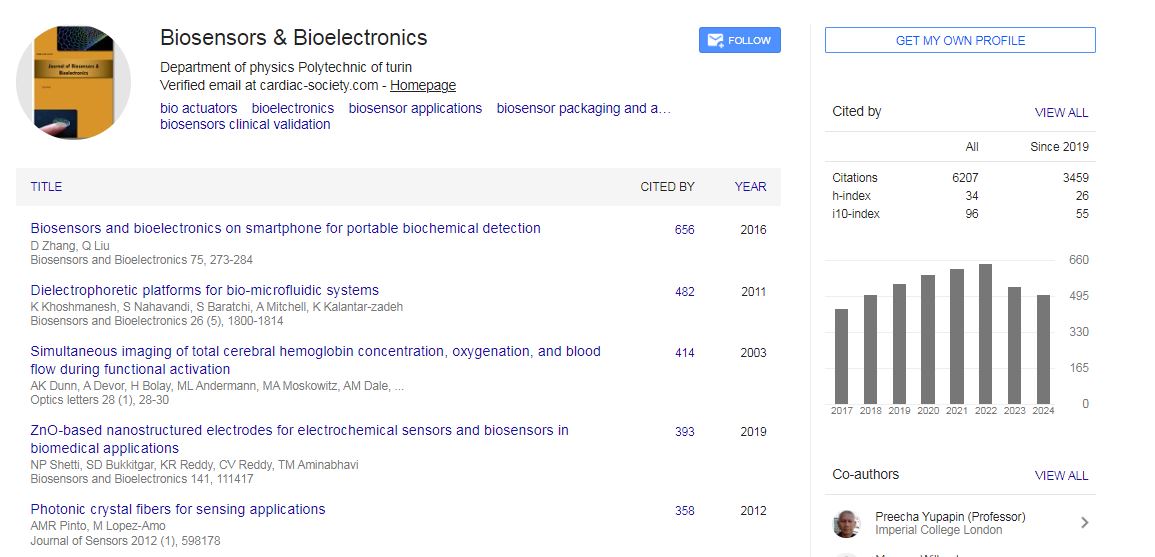
Biosensors & Bioelectronics received 6207 citations as per Google Scholar report