Short Communication - (2025) Volume 16, Issue 6
Received: 01-Dec-2025, Manuscript No. jbmbs-26-183424;
Editor assigned: 03-Dec-2025, Pre QC No. P-183424;
Reviewed: 17-Dec-2025, QC No. Q-183424;
Revised: 22-Dec-2025, Manuscript No. R-183424;
Published:
29-Dec-2025
, DOI: 10.37421/2155-6180.2025.16.309
Citation: Farouk, Ibrahim. ”Biometric and Clinical Data for Enhanced Risk Prediction.” J Biom Biosta 16 (2025):309.
Copyright: © 2025 Farouk I. This is an open-access article distributed under the terms of the Creative Commons Attribution License, which permits unrestricted use, distribution and reproduction in any medium, provided the original author and source are credited.
The integration of diverse data streams is revolutionizing the field of predictive modeling, particularly in healthcare, where early and accurate risk assessment is paramount for patient well-being. This approach leverages the complementary strengths of various data types to build more robust and insightful predictive tools. Biometric data, encompassing a wide range of physiological and behavioral measurements, offers a granular and often continuous insight into an individual's current state. When combined with established clinical data, which includes patient history, diagnoses, and laboratory results, these models can achieve unprecedented levels of predictive power. The convergence of biometric and clinical information is enabling the development of advanced risk prediction models across numerous health domains. In cardiovascular health, the integration of physiological measurements such as heart rate variability and blood pressure with clinical indicators like age and comorbidities has demonstrated a significant improvement in the accuracy and early detection capabilities for various cardiovascular conditions, paving the way for personalized risk stratification and proactive interventions [1].
Similarly, in the realm of metabolic disorders, machine learning algorithms are being employed to construct predictive models for diabetes risk. By analyzing a comprehensive set of biometric markers, including glucose levels and body mass index, alongside demographic and lifestyle data, ensemble methods have shown superior performance over traditional statistical models in identifying individuals at high risk, facilitating targeted preventative strategies [2].
The application of data fusion extends to the prediction of neurodegenerative diseases, where combining facial biometrics with electronic health records is proving invaluable. Subtle facial changes captured through advanced imaging, when correlated with clinical history and genetic predispositions, can serve as early indicators, offering a novel, non-invasive approach to early disease detection [3].
For chronic conditions such as chronic obstructive pulmonary disease (COPD), the potential of wearable sensor-derived biometric data, like activity levels and sleep patterns, is being harnessed. When used in conjunction with routine clinical assessments, this continuous biometric monitoring improves predictive accuracy for hospital readmission risk, allowing for timely interventions to prevent readmissions [4].
Mental health risk prediction is also benefiting from these integrated approaches. Deep learning techniques are being applied to fuse complex biometric patterns, such as gait analysis and voice recognition, with clinical data to predict the onset of mental health disorders. This framework leverages temporal dynamics to identify at-risk individuals earlier and with greater precision [5].
In pharmacotherapy, the development of risk prediction models for adverse drug reactions is being enhanced by integrating patient-specific biometric data, including genetic markers and physiological responses, with their clinical profiles and medication history. This enables the identification of individuals with a higher propensity for severe reactions, leading to more personalized and safer treatment regimens [6].
The utility of multimodal biometric data, such as iris patterns and fingerprints, when combined with clinical history, is being explored for predicting the risk of infectious diseases. Subtle changes in biometric markers, analyzed alongside clinical susceptibility factors, can act as early warning signals for increased infection risk [7].
Forecasting the risk of cardiovascular events like atrial fibrillation is also being advanced through the integration of physiological biometric data, including ECG and PPG, with clinical variables. Advanced signal processing techniques applied to biometric data, alongside standard clinical assessments, facilitate earlier and more precise identification of at-risk individuals [8].
Furthermore, the application of behavioral biometrics, such as typing cadence and mouse movements, in conjunction with electronic health record data, is being examined for predicting healthcare fraud and identity theft. Anomalous patterns in behavioral biometrics, coupled with clinical data anomalies, can form a robust early warning system [9].
Finally, the critical issue of fall prediction in elderly populations is being addressed by combining biometric gait analysis with clinical mobility assessments. A fusion of detailed biomechanical gait parameters and clinical risk factors significantly enhances prediction accuracy, enabling targeted interventions to prevent falls [10].
The landscape of predictive health analytics is undergoing a profound transformation driven by the synergistic integration of diverse data sources. This strategy capitalizes on the unique insights offered by each data type to construct more comprehensive and accurate predictive models. Biometric data, which captures a dynamic range of physiological and behavioral characteristics, provides a sensitive barometer of an individual's health status. When combined with the rich historical and diagnostic information contained within clinical data, the potential for early risk identification and intervention is greatly amplified. In the domain of cardiovascular health, the fusion of biometric indicators like heart rate variability and blood pressure with established clinical factors such as age, comorbidities, and laboratory values has led to substantial improvements in the accuracy of risk prediction models. This integration facilitates a more nuanced understanding of individual risk profiles, enabling personalized risk stratification and the implementation of proactive healthcare measures [1].
The application of sophisticated machine learning algorithms to predict the risk of developing diabetes exemplifies the power of integrated data. By analyzing a broad spectrum of biometric markers, including glucose levels and body mass index, alongside demographic and lifestyle information, ensemble methods have demonstrated a marked superiority over traditional statistical approaches in identifying high-risk individuals, thereby enabling the deployment of targeted preventative strategies [2].
Beyond metabolic and cardiovascular diseases, the fusion of biometric and clinical data is proving instrumental in the early detection of neurological conditions. Research into the prediction of neurodegenerative diseases highlights how subtle changes detected through facial biometrics, when correlated with clinical history and genetic predispositions, can serve as critical early warning signs, suggesting a novel, non-invasive diagnostic pathway [3].
For individuals managing chronic respiratory conditions like COPD, the continuous monitoring afforded by wearable biometric sensors offers a significant advantage. Data on activity levels and sleep patterns, when analyzed in conjunction with routine clinical assessments, enhances the predictive accuracy for hospital readmissions, empowering healthcare providers to implement timely interventions and reduce recurrence [4].
In the sphere of mental health, the integration of complex biometric patterns, such as those derived from gait analysis and voice recognition, with clinical data is advancing the prediction of mental health disorders. Deep learning frameworks that capture the temporal dynamics of both biometric and clinical data offer improved early identification and precision for at-risk individuals [5].
The safe and effective use of medications is being bolstered by the integration of biometric and clinical data for predicting adverse drug reactions. By incorporating patient-specific biometric information, including genetic predispositions and physiological responses, with clinical profiles and medication histories, models can better identify those at higher risk of severe reactions, leading to personalized and safer pharmacotherapy [6].
The potential for predicting infectious disease risks is also being explored through the combination of multimodal biometric data, such as iris patterns and fingerprints, with clinical history. Changes in these biometric markers, when analyzed alongside clinical susceptibility factors, can serve as early indicators of heightened infection risk [7].
Forecasting the risk of atrial fibrillation, a common cardiac arrhythmia, is being refined through the integration of physiological biometric data, like ECG and PPG, with clinical variables. The application of advanced signal processing techniques to biometric data, in tandem with standard clinical assessments, allows for earlier and more precise identification of individuals susceptible to this condition [8].
In the realm of healthcare security, the predictive capabilities of combining behavioral biometrics, such as typing cadence and mouse movements, with electronic health record data are being investigated. Anomalous patterns in behavioral biometrics, when analyzed alongside deviations in clinical data, can constitute a robust system for the early detection of fraud and identity theft [9].
Lastly, for vulnerable elderly populations, the prediction of fall risk is being significantly enhanced by integrating biometric gait analysis with clinical mobility assessments. The synergistic fusion of detailed biomechanical gait parameters and established clinical risk factors leads to superior prediction accuracy, enabling the implementation of targeted preventative measures against falls [10].
This collection of research highlights the significant advancements in risk prediction models achieved through the integration of biometric and clinical data. Across various health domains, combining physiological and behavioral biometric measurements with traditional clinical information has consistently led to improved accuracy and earlier detection of health risks. Studies demonstrate this synergy in predicting cardiovascular diseases, diabetes, neurodegenerative disorders, COPD readmissions, mental health conditions, adverse drug reactions, infectious diseases, atrial fibrillation, healthcare fraud, and falls in the elderly. The research emphasizes the potential for personalized risk stratification, proactive interventions, and enhanced patient care through these data-driven approaches. Sophisticated techniques like machine learning and deep learning are integral to unlocking the full predictive power of these combined datasets, moving healthcare towards more precise and preventative strategies.
None
None
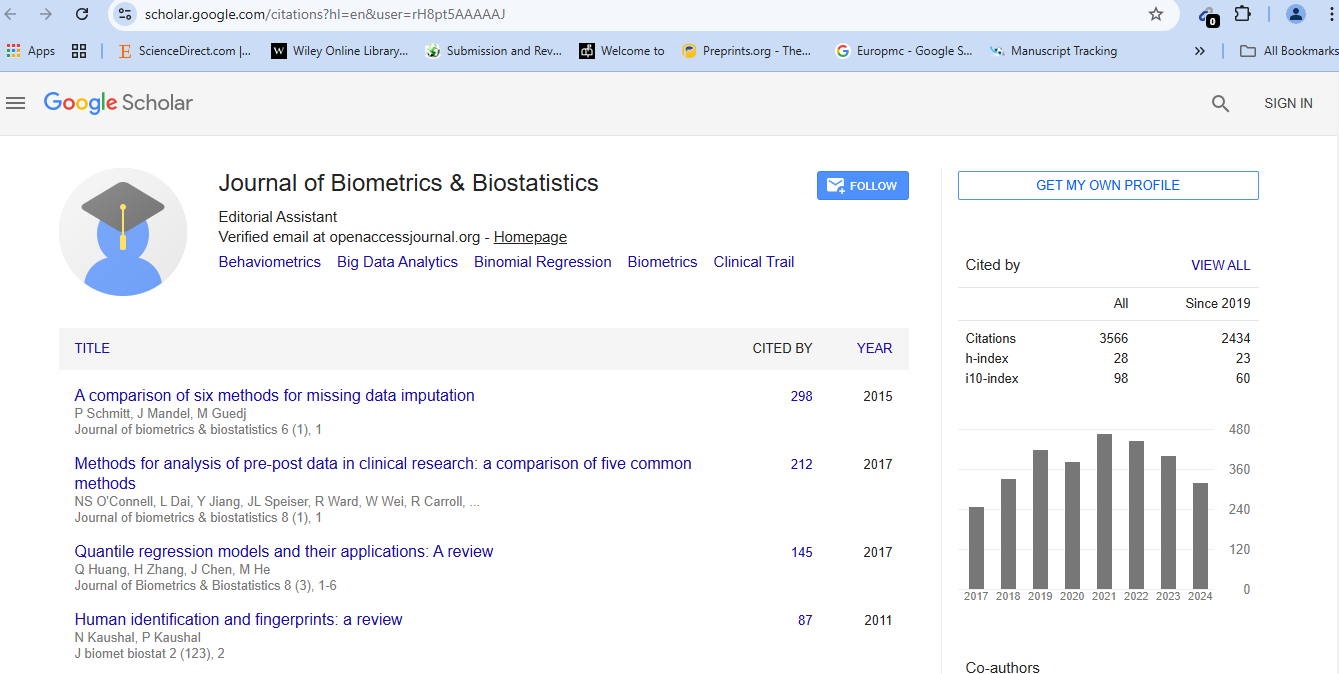
Journal of Biometrics & Biostatistics received 3496 citations as per Google Scholar report