Short Communication - (2025) Volume 16, Issue 4
Received: 02-Jul-2025, Manuscript No. jch-26-178777;
Editor assigned: 04-Jul-2025, Pre QC No. P-178777;
Reviewed: 17-Jul-2025, QC No. Q-178777;
Revised: 23-Jul-2025, Manuscript No. R-178777;
Published:
30-Jul-2025
, DOI: 10.37421/2157-7099.2025.16.810
Citation: Delgado, Rosa M.. ”Biomarkers Revolutionize Cancer Diagnostics and Treatment.” J Cytol Histol 16 (2025):810.
Copyright: © 2025 Delgado M. Rosa This is an open-access article distributed under the terms of the Creative Commons Attribution License, which permits unrestricted use, distribution and reproduction in any medium, provided the original author and source are credited.
Biomarkers have become indispensable tools in modern cytological and histological diagnostics, offering objective data that significantly enhances the precision of morphological assessments. They play a crucial role in improving diagnostic accuracy, predicting patient responses to various treatments, and establishing prognoses for a wide range of diseases, particularly in the field of oncology. This article aims to explore the extensive applications of biomarkers, encompassing both molecular markers and protein expression profiles, in the identification and classification of diverse pathological conditions. The integration of comprehensive biomarker analysis into routine clinical practice is poised to revolutionize patient management, paving the way for more personalized and precise therapeutic strategies. [1] Molecular biomarkers, including specific gene mutations and amplifications, are fundamentally reshaping the landscape of cancer diagnosis and the selection of optimal treatment regimens. Within cytological specimens, these critical molecular alterations can be effectively detected through methods such as liquid biopsies or direct sample analysis, thereby guiding therapeutic decisions in prevalent cancers like lung cancer, breast cancer, and lymphomas. Histological analysis also benefits immensely from techniques like immunohistochemistry and in situ hybridization, which facilitate the identification of specific protein expression patterns and genetic alterations, ultimately leading to the development and application of more targeted therapies. [2] The burgeoning field of artificial intelligence (AI) is demonstrating remarkable synergy with biomarker analysis, leading to significant advancements in the interpretation of cytological and histological images. Sophisticated AI algorithms possess the capability to discern subtle patterns within these images and precisely quantify biomarker expression with exceptional accuracy. This enhanced analytical power assists pathologists in making more consistent and reliable diagnostic decisions. The collaborative integration of AI and biomarker analysis holds exceptional promise for achieving earlier disease detection and improving prognostic outcomes. [3] Immunohistochemistry (IHC) continues to stand as a fundamental technique for the evaluation of protein biomarkers within histological sections. The accurate application and meticulous interpretation of IHC markers are critical for precise tumor subtyping, predicting responses to targeted therapeutic agents, and effectively differentiating between benign and malignant lesions. Recent advancements in multiplex IHC technology now permit the simultaneous detection of multiple biomarkers, thereby providing a more holistic and comprehensive diagnostic picture. [4] Liquid biopsies, which leverage circulating tumor DNA (ctDNA), circulating tumor cells (CTCs), and extracellular vesicles (EVs), are rapidly emerging as powerful and indispensable tools in the realm of cytological diagnostics. These novel biomarker sources offer a less invasive means of cancer detection, therapeutic monitoring, and surveillance for disease recurrence. Their judicious integration with traditional cytological evaluations has the potential to yield a more comprehensive understanding of a patient's overall disease status. [5] The assessment of protein biomarkers within cytological samples, such as those obtained through fine-needle aspiration (FNA), can substantially elevate diagnostic precision. This is particularly evident when differentiating benign from malignant lesions in organs like the thyroid and breast. Assays designed to detect specific protein markers can furnish vital information that guides clinical management decisions and helps to avert the need for unnecessary invasive procedures. [6] Biomarker-driven therapeutic strategies have fundamentally transformed the management of cancer. Both histological and cytological specimens are of paramount importance for identifying those patients who are most likely to benefit from specific targeted agents or immunotherapies. The continuous discovery and rigorous validation of new biomarkers are indispensable for advancing the principles of personalized oncology and ultimately improving patient outcomes. [7] The critical validation and standardization of biomarker assays are of utmost importance for their reliable and consistent implementation in routine cytological and histological diagnostic workflows. Significant challenges remain, including ensuring the reproducibility of assays, establishing clear and unambiguous interpretation guidelines, and effectively integrating biomarker data into existing diagnostic processes. Collaborative efforts among researchers and clinicians are essential to surmount these hurdles and maximize the clinical utility of biomarkers. [8] Exosomes and other extracellular vesicles (EVs) are increasingly recognized as valuable sources of biomarkers for the early detection and monitoring of cancer through cytological analysis. The molecular cargo contained within these vesiclesâ??including proteins, RNA, and DNAâ??reflects the physiological state of their parent cells, thus providing a non-invasive avenue for observing disease progression. Ongoing research is actively exploring their utility in conjunction with conventional cytological evaluations. [9] The application of cutting-edge spatial transcriptomics and proteomics technologies in histological samples is unlocking unprecedented insights into the intricate tumor microenvironment and complex cellular interactions. These advanced methodologies facilitate the simultaneous assessment of multiple biomarkers within their native spatial context, leading to a profound understanding of disease mechanisms and the identification of novel therapeutic targets. [10]
Biomarkers are playing an increasingly pivotal role in cytological and histological diagnostics, providing objective data that complements traditional morphological assessments. Their ability to enhance diagnostic accuracy, predict treatment responses, and aid in prognosis makes them invaluable in patient care. This article delves into the diverse applications of biomarkers, specifically focusing on molecular markers and protein expression, for the identification and classification of various pathologies, with a particular emphasis on oncology. The seamless integration of biomarker analysis into everyday clinical practice holds the promise of enabling more personalized and precise management of patients. [1] Molecular biomarkers, such as specific gene mutations and amplifications, are revolutionizing the diagnosis of cancer and the selection of appropriate treatments. In cytological specimens, these markers can be detected through methods like liquid biopsies or direct analysis, providing crucial guidance for therapy in conditions such as lung cancer, breast cancer, and lymphomas. Histological analysis also benefits significantly from techniques like immunohistochemistry and in situ hybridization, which are used to identify specific protein expressions and genetic alterations, thereby facilitating the development of more targeted therapeutic approaches. [2] The integration of artificial intelligence (AI) with biomarker analysis is significantly improving the interpretation of cytological and histological images. AI algorithms are capable of identifying subtle patterns and quantifying biomarker expression with high levels of accuracy, assisting pathologists in making more consistent and reliable diagnoses. This powerful synergy between AI and biomarkers is proving particularly promising for achieving earlier disease detection and enhancing prognostication. [3] Immunohistochemistry (IHC) remains a fundamental technique for evaluating protein biomarkers in histological sections. The precise application and interpretation of IHC markers are critical for accurate tumor subtyping, predicting responses to targeted therapies, and differentiating benign from malignant lesions. Advances in multiplex IHC technology now allow for the simultaneous detection of multiple markers, offering a more comprehensive diagnostic picture. [4] Liquid biopsies, which analyze circulating tumor DNA (ctDNA), circulating tumor cells (CTCs), and extracellular vesicles (EVs), are emerging as potent tools in cytological diagnostics. These novel biomarkers offer a less invasive approach for cancer detection, treatment monitoring, and surveillance for recurrence. Their integration with traditional cytology methods can provide a more complete view of a patient's disease status. [5] The analysis of protein biomarkers in cytological samples, particularly those obtained via fine-needle aspiration (FNA), can considerably improve diagnostic precision, especially in distinguishing benign from malignant lesions in organs like the thyroid and breast. Assays for specific protein markers can deliver essential information that guides clinical management and helps avoid unnecessary invasive procedures. [6] Biomarker-driven therapies have profoundly altered the management of cancer. Histological and cytological specimens are indispensable for identifying patients who will benefit from specific targeted agents or immunotherapies. The ongoing discovery and validation of new biomarkers are crucial for advancing personalized oncology and improving patient outcomes. [7] The validation and standardization of biomarker assays are essential for their reliable implementation in routine cytological and histological diagnostic practices. Challenges include ensuring assay reproducibility, establishing clear interpretation guidelines, and integrating biomarker data into existing diagnostic workflows. Collaborative efforts are necessary to overcome these obstacles and maximize the clinical utility of biomarkers. [8] Exosomes and other extracellular vesicles (EVs) are emerging as promising sources of biomarkers for early cancer detection and monitoring through cytological analysis. The molecular content of these vesiclesâ??proteins, RNA, and DNAâ??reflects the physiological state of the parent cell, offering a non-invasive insight into disease progression. Current research is actively investigating their utility in conjunction with standard cytological evaluations. [9] The application of spatial transcriptomics and proteomics technologies to histological samples offers unprecedented insights into the tumor microenvironment and cellular interactions. These advanced techniques enable the simultaneous evaluation of multiple biomarkers within their native spatial context, leading to a deeper understanding of disease mechanisms and the identification of novel therapeutic targets. [10]
Biomarkers are revolutionizing cytological and histological diagnostics by providing objective data that enhances accuracy, predicts treatment response, and aids prognosis, especially in oncology. Molecular biomarkers, such as gene mutations, are guiding cancer therapy. Artificial intelligence is improving image interpretation and biomarker quantification. Immunohistochemistry remains vital for protein biomarker evaluation, while liquid biopsies offer a less invasive diagnostic approach. Protein biomarkers in cytological aspirates improve diagnostic precision for solid tumors. Biomarker-driven therapies are transforming cancer treatment. Validation and standardization of biomarker assays are crucial for reliable clinical use. Extracellular vesicles and spatial omics technologies are emerging as powerful tools for biomarker discovery and understanding the tumor microenvironment. These advancements collectively promise more personalized and precise patient management.
None
None
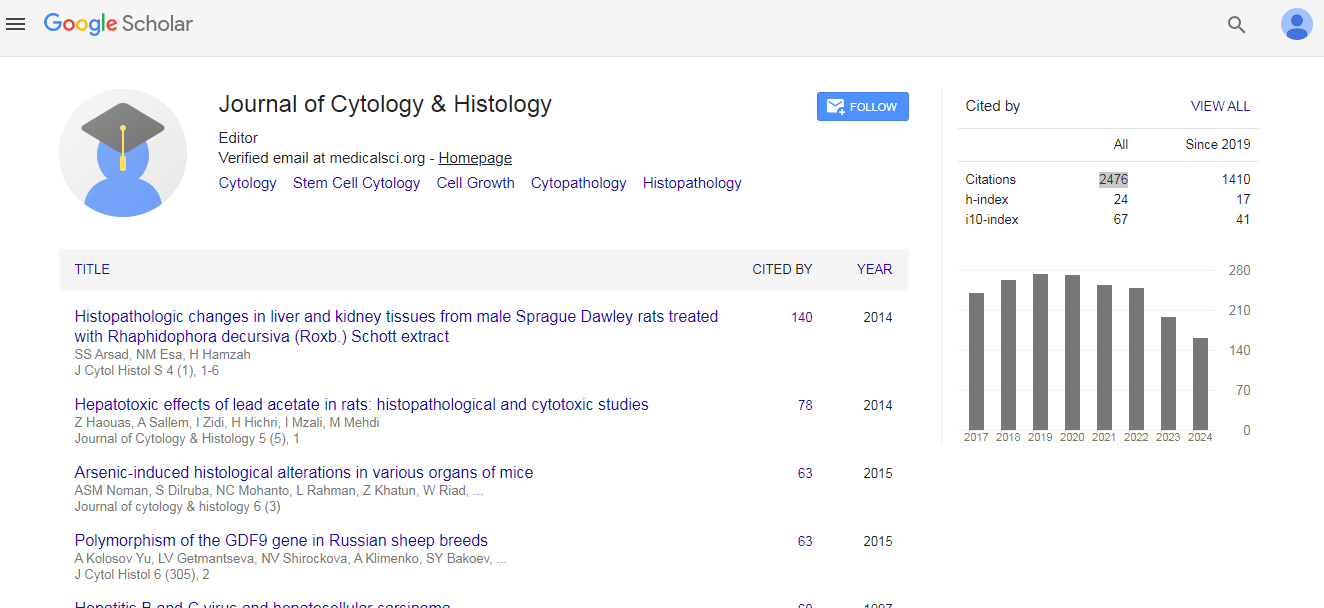
Journal of Cytology & Histology received 2476 citations as per Google Scholar report