Perspective - (2025) Volume 16, Issue 5
Received: 01-Oct-2025, Manuscript No. jbsbe-26-183321;
Editor assigned: 03-Oct-2025, Pre QC No. P-183321;
Reviewed: 17-Oct-2025, QC No. Q-183321;
Revised: 22-Oct-2025, Manuscript No. R-183321;
Published:
29-Oct-2025
, DOI: 10.37421/2165-6210.2025.16.527
Citation: Vries, Jan de. ”Bioelectronic Devices For Closed-Loop Chronic Disease Management.” J Biosens Bioelectron 16 (2025):527.
Copyright: © 2025 Vries d. Jan This is an open-access article distributed under the terms of the Creative Commons Attribution License, which permits unrestricted use, distribution and reproduction in any medium, provided the original author and source are credited.
The field of bioelectronic devices for closed-loop therapeutic systems represents a significant advancement in chronic disease management, offering precise and personalized treatment strategies. These systems integrate biosensors with actuating elements to continuously monitor biological parameters and deliver timely interventions, thereby revolutionizing care for conditions such as diabetes and epilepsy. Critical design considerations for effective chronic implantation include miniaturization, biocompatibility, and long-term stability to ensure patient safety and device efficacy [1].
Advancements in flexible and stretchable electronics are enabling the development of novel implantable sensors that conform to the body's natural contours. This adaptability minimizes immune responses and optimizes signal transduction, which are essential for uninterrupted physiological monitoring integral to closed-loop therapies [2].
The development of implantable neural interfaces is crucial for modulating neural activity, a key component in treating neurological disorders. These interfaces must reliably record neural signals with high fidelity and deliver targeted stimulation for therapeutic outcomes, particularly for conditions like Parkinson's disease and epilepsy within closed-loop architectures [3].
Wireless power transfer and data communication are paramount for the long-term functionality and minimal invasiveness of implantable bioelectronic devices. Robust wireless operation allows for untethered monitoring and stimulation, circumventing the need for frequent surgical interventions and enhancing patient quality of life in closed-loop therapeutic systems [4].
Ensuring the biocompatibility and long-term stability of implanted bioelectronic materials is a critical challenge. Advanced materials and surface modification techniques are being employed to minimize foreign body responses and guarantee the consistent performance of devices essential for chronic closed-loop therapeutic applications [5].
Electrochemical biosensors play a vital role in continuous physiological monitoring, particularly for glucose monitoring in closed-loop artificial pancreas systems. Innovations in sensor design focus on achieving high sensitivity, selectivity, and stability in complex biological environments to enable accurate therapeutic delivery [6].
The integration of microfluidic systems with bioelectronic sensors offers enhanced capabilities for point-of-care diagnostics and therapeutic delivery. Microfluidics provides precise control over sample handling and reagent delivery, thereby improving the functionality of closed-loop systems through rapid, on-demand analysis and intervention [7].
Sophisticated algorithms and signal processing techniques are indispensable for the effective operation of closed-loop therapeutic systems. These algorithms are required to interpret complex biological signals from bioelectronic sensors and to precisely control therapeutic actuators in real-time for personalized and effective patient treatment [8].
Implantable optical biosensors are being explored for real-time physiological monitoring, offering a promising avenue for non-invasive or minimally invasive sensing. These sensors can be integrated into closed-loop systems to provide continuous health data, enabling dynamic adjustments to personalized treatment plans [9].
Efficient energy harvesting and management are crucial for the long-term sustainability of implantable bioelectronic devices. Various energy harvesting techniques are being investigated to provide reliable power sources for closed-loop systems, thereby reducing the reliance on conventional batteries and minimizing surgical interventions for replacements [10].
Bioelectronic devices for closed-loop therapeutic systems are at the forefront of personalized medicine, offering continuous monitoring and automated interventions for chronic diseases. The intricate design of these systems, focusing on miniaturization, biocompatibility, and long-term stability, is essential for successful chronic implantation and therapeutic efficacy [1].
Flexible and stretchable bioelectronic devices are emerging as a promising platform for implantable sensors. Their ability to conform to biological tissues not only enhances comfort and reduces potential tissue damage but also improves the quality of physiological signals acquired for closed-loop therapies [2].
Neural interfaces are a key component for closed-loop neurological therapies, enabling precise modulation of neural circuits. Research in this area focuses on developing devices capable of both high-fidelity neural signal recording and targeted stimulation, addressing the complex needs of conditions like epilepsy and Parkinson's disease [3].
Untethered operation is a critical aspect of implantable bioelectronic devices, achieved through advanced wireless power transfer and data communication. This technology ensures the long-term functionality of closed-loop systems without the limitations of wired connections, enhancing patient mobility and reducing the risk of infection associated with percutaneous leads [4].
The selection and development of biocompatible and stable materials are paramount for the longevity and safety of implanted bioelectronic devices. Minimizing the foreign body response and ensuring the sustained performance of sensors and actuators are key priorities for chronic closed-loop applications [5].
Electrochemical biosensors are instrumental in providing real-time physiological data, such as glucose levels, which are vital for closed-loop systems like artificial pancreases. Ongoing research aims to enhance sensor sensitivity, selectivity, and stability in complex biological environments to ensure accurate and reliable therapeutic responses [6].
Microfluidic technology offers a sophisticated approach to integrating sensing and delivery functions in bioelectronic devices. By enabling precise control over fluid flow and reagent handling, microfluidics enhances the precision and responsiveness of closed-loop systems for diagnostics and targeted therapy [7].
The intelligence behind closed-loop therapeutic systems lies in their algorithms and signal processing capabilities. These advanced computational methods are essential for translating raw biosensor data into actionable therapeutic commands, ensuring personalized and adaptive treatment delivery [8].
Optical biosensors represent a non-invasive or minimally invasive sensing modality with significant potential for integration into closed-loop systems. Their ability to detect physiological parameters in real-time can provide valuable data for continuous health monitoring and dynamic treatment adjustments [9].
Powering implantable bioelectronic devices sustainably is a major focus, with energy harvesting and management technologies offering a solution to prolonged device operation. These advancements aim to eliminate the need for frequent battery replacements, thereby reducing the invasiveness and cost associated with long-term therapeutic interventions [10].
This compilation explores the multifaceted advancements in bioelectronic devices designed for closed-loop therapeutic systems. Key areas of focus include the integration of biosensors with actuators for continuous monitoring and precise intervention, critical for managing chronic diseases like diabetes and epilepsy. Research highlights the importance of miniaturization, biocompatibility, and long-term stability for implanted devices. Developments in flexible electronics, neural interfaces, wireless power transfer, and microfluidic integration are enabling more sophisticated and less invasive therapeutic solutions. The role of advanced algorithms in processing biological signals and controlling therapeutic delivery is also emphasized, alongside progress in optical biosensors and sustainable energy harvesting for long-term device functionality. The overarching goal is to achieve personalized, effective, and minimally invasive chronic disease management.
None
None
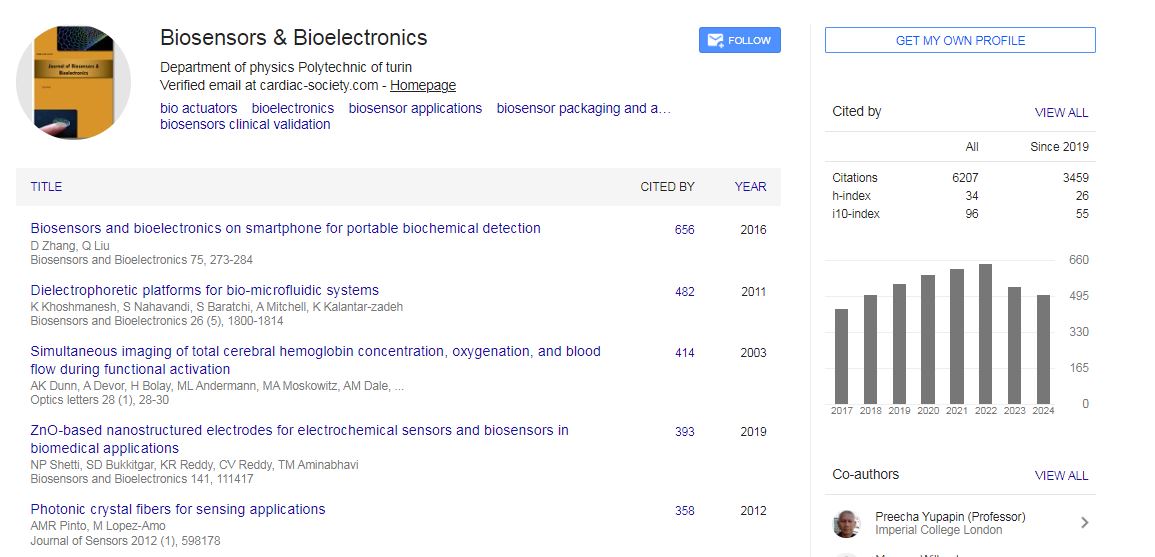
Biosensors & Bioelectronics received 6207 citations as per Google Scholar report