Perspective - (2025) Volume 17, Issue 6
Received: 01-Dec-2025, Manuscript No. jbabm-26-182369;
Editor assigned: 03-Dec-2025, Pre QC No. P-182369;
Reviewed: 17-Dec-2025, QC No. Q-182369;
Revised: 22-Dec-2025, Manuscript No. R-182369;
Published:
29-Dec-2025
, DOI: 10.37421/1948-593X.2025.17.527
Citation: Zulu, Lunghi M.. ”Bioanalytical Techniques: Unlocking Nutraceutical and Functional Food Insights.” J Bioanal Biomed 17 (2025):527.
Copyright: © 2025 Zulu M. Lunghi This is an open-access article distributed under the terms of the Creative Commons Attribution License, which permits unrestricted use, distribution and reproduction in any medium, provided the original author and source are credited.
The field of bioanalysis has emerged as a cornerstone in the comprehensive understanding of nutraceuticals and functional foods, providing critical insights into their bioavailability, metabolism, and efficacy. Advanced analytical techniques, particularly liquid chromatography-mass spectrometry (LC-MS) and gas chromatography-mass spectrometry (GC-MS), are instrumental in the precise quantification of bioactive compounds within complex biological matrices. These sophisticated analytical approaches are indispensable for ensuring product quality control, adhering to stringent regulatory requirements, and substantiating the health benefits claimed by these products, thereby fostering evidence-based product development and marketing [1].
Investigating the impact of various processing methods on the stability and bioavailability of polyphenols in functional foods is a critical area of research. Employing techniques like LC-MS/MS allows for meticulous tracking of the degradation and transformation pathways of key polyphenols during storage and simulated digestive processes. Such investigations reveal how processing techniques significantly influence the chemical structure of these compounds, ultimately affecting their absorption and biological activity, which is vital for optimizing food formulation strategies [2].
The development of novel bioanalytical methodologies is paramount for advancing our understanding of nutrient uptake. A prime example is the creation of a sensitive method for the simultaneous quantification of carotenoids in both serum and liver tissues. Utilizing ultra-high-performance liquid chromatography coupled with diode-array detection (UHPLC-DAD) enables high specificity and sensitivity, facilitating accurate measurements of compounds like beta-carotene and lutein. The application of such methods in studies assessing carotenoid absorption from diverse dietary sources provides crucial data on nutrient utilization and individual variability [3].
The metabolic fate of phytosterols, compounds recognized for their role in functional foods, is increasingly being elucidated through advanced bioanalytical techniques. Studies employing LC-MS/MS analysis of human plasma provide detailed insights into the major metabolites formed after the consumption of phytosterol-enriched foods. By investigating factors that influence plasma concentrations, researchers can gain a deeper understanding of the bioactivity and potential health benefits, particularly in areas like cardiovascular health [4].
Evaluating the bioaccumulation and pharmacokinetic profiles of essential nutrients, such as omega-3 fatty acids, from different dietary sources is crucial for assessing their efficacy. Techniques like gas chromatography coupled with flame ionization detection (GC-FID) and mass spectrometry (GC-MS) are employed to quantify fatty acids like EPA and DHA in biological samples. These methods reveal significant differences in absorption rates and tissue distribution, underscoring the importance of bioanalytical approaches in evaluating the effectiveness of dietary interventions [5].
The development of highly sensitive and selective bioanalytical methods is essential for accurately assessing the status of vital micronutrients, especially in vulnerable populations. For instance, the quantification of vitamin D metabolites in infant serum using LC-MS/MS addresses the challenges posed by low analyte concentrations and intricate biological matrices. Such validated methods are vital for understanding the impact of functional foods and supplements on infant health and development [6].
Assessing the bioavailability of specific bioactive compounds from functional foods requires robust bioanalytical techniques. A study focusing on flavonoids from a cocoa-based functional food utilized LC-MS/MS to quantify plasma levels of epicatechin and its metabolites. This approach provided essential data on how the food matrix affects absorption, contributing to the scientific substantiation of health claims, particularly those related to cardiovascular benefits [7].
Metabolic fingerprinting, powered by advanced analytical instrumentation like high-resolution mass spectrometry (HRMS), offers a comprehensive approach to understanding the fate of phenolic compounds from functional beverages. This technique allows for the identification of a wide array of metabolites in biological samples, providing a holistic view of their absorption, distribution, metabolism, and excretion (ADME) profiles. HRMS is proving to be a powerful tool in nutraceutical research for deciphering mechanisms of action [8].
The development and application of bioanalytical methods are also critical for understanding the impact of dietary peptides. Research has focused on determining bioactive peptides in human urine using LC-MS/MS, investigating excretion profiles of peptides derived from functional food proteins. These findings contribute to knowledge regarding peptide stability, absorption, and their potential physiological effects, guiding the development of novel peptide-based functional ingredients [9].
Beyond traditional bioanalysis, advanced spectroscopic techniques are being integrated for the rapid authentication and quality assessment of nutraceuticals. Methods such as Raman spectroscopy, when combined with chemometrics, can provide rapid insights into the composition and authenticity of botanical extracts and functional food ingredients. This is vital for ensuring product integrity and preventing adulteration, complementing bioanalytical approaches in quality assurance [10].
The critical role of bioanalysis in understanding the bioavailability, metabolism, and efficacy of nutraceuticals and functional foods is prominently highlighted, showcasing the indispensable nature of advanced analytical techniques like LC-MS and GC-MS for precise quantification of bioactive compounds in biological matrices. The significance of these analyses in quality control, regulatory compliance, and substantiating health benefits is emphasized, paving the way for evidence-based claims and robust product development [1].
The impact of processing on the stability and bioavailability of polyphenols within functional foods is a significant research focus, with LC-MS/MS being a key methodology for tracking degradation and transformation during storage and digestion. Findings from such studies demonstrate how processing alterations influence the chemical forms of polyphenols, directly impacting their absorption and biological activity, thus informing crucial food formulation strategies [2].
Novel bioanalytical methods are continually being developed to enhance our understanding of nutrient absorption. The development of a method for simultaneous quantification of carotenoids in serum and liver tissues using UHPLC-DAD offers high sensitivity and specificity. The application of this method in studies evaluating carotenoid absorption from various dietary sources provides valuable data on nutrient uptake and inter-individual variability [3].
The metabolic journey of phytosterols, important functional food constituents, is being meticulously mapped using advanced LC-MS/MS in human plasma. This research elucidates major metabolites formed post-consumption of enriched foods and investigates factors influencing their plasma concentrations, offering profound insights into the bioactivity and potential health benefits, especially regarding cardiovascular health [4].
Bioaccumulation and pharmacokinetic profiles of essential nutrients like omega-3 fatty acids are being thoroughly investigated from diverse dietary sources using techniques such as GC-FID and GC-MS. Quantifying EPA and DHA in red blood cells and plasma reveals significant differences in absorption and tissue distribution, reinforcing the critical role of bioanalytical methods in assessing the efficacy of omega-3 interventions [5].
The development of sensitive and selective LC-MS/MS methods for detecting vitamin D metabolites in infant serum is crucial for assessing nutritional status in vulnerable populations. Addressing challenges of low analyte levels and complex matrices, these validated methods are vital for understanding the influence of functional foods and supplements on infant health and development [6].
Assessing the bioavailability of flavonoids from functional foods, such as a cocoa-based product, is effectively achieved through bioanalytical techniques like LC-MS/MS. This approach quantifies plasma levels of epicatechin and its metabolites, providing essential data on how food matrix effects influence absorption and supporting health claims, particularly for cardiovascular well-being [7].
Metabolic fingerprinting of phenolic compounds from functional beverages using high-resolution mass spectrometry (HRMS) offers a comprehensive perspective on their absorption, distribution, metabolism, and excretion (ADME) profiles. This advanced approach provides a detailed understanding of the systemic fate of these compounds, underscoring the utility of HRMS in elucidating mechanisms of action in nutraceutical research [8].
The determination of bioactive peptides in human urine through bioanalytical methods, specifically LC-MS/MS, allows for the investigation of excretion profiles derived from functional food proteins. This research contributes to understanding peptide stability, absorption characteristics, and their physiological impacts, guiding the development of functional peptide-based ingredients [9].
Advanced spectroscopic techniques, exemplified by Raman spectroscopy coupled with chemometrics, are being integrated for rapid authentication and quality assessment of nutraceuticals. These methods provide crucial information regarding the composition and authenticity of botanical extracts and functional food ingredients, serving as vital tools for ensuring product quality and preventing adulteration [10].
This collection of research highlights the critical role of bioanalytical techniques in understanding nutraceuticals and functional foods. Advanced methods like LC-MS, GC-MS, and UHPLC-DAD are employed for precise quantification of bioactive compounds in biological samples, crucial for quality control and regulatory compliance. Studies investigate the stability and bioavailability of compounds like polyphenols and omega-3 fatty acids, assess nutrient absorption, and elucidate metabolic fates of compounds such as phytosterols. Development of sensitive methods is vital for assessing micronutrient status, particularly in vulnerable groups. Metabolic fingerprinting and spectroscopic techniques offer comprehensive insights into compound behavior and product authenticity, collectively supporting evidence-based health claims and product development in the functional food and nutraceutical sectors.
None
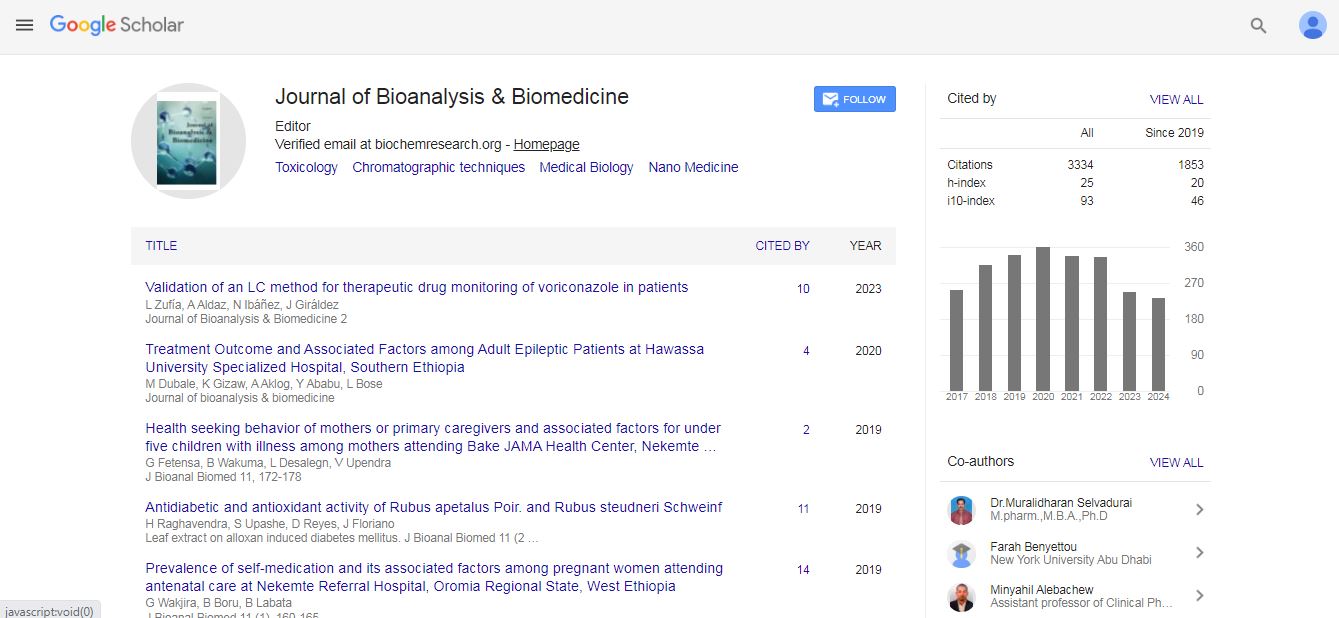
Journal of Bioanalysis & Biomedicine received 3099 citations as per Google Scholar report