Perspective - (2025) Volume 16, Issue 5
Received: 01-Oct-2025, Manuscript No. jbmbs-26-183411;
Editor assigned: 03-Oct-2025, Pre QC No. P-183411;
Reviewed: 17-Oct-2025, QC No. Q-183411;
Revised: 22-Oct-2025, Manuscript No. R-183411;
Published:
29-Oct-2025
, DOI: 10.37421/2155-6180.2025.16.296
Citation: Weber, Michael. ”Big Data Revolutionizes Biometrics, Biostatistics, and Healthcare.” J Biom Biosta 16 (2025):296.
Copyright: © 2025 Weber M. This is an open-access article distributed under the terms of the Creative Commons Attribution License, which permits unrestricted use, distribution and reproduction in any medium, provided the original author and source are credited.
Big data analytics is profoundly reshaping the landscapes of biometrics and biostatistics, offering unprecedented capabilities for analyzing vast datasets to discern intricate patterns and enhance predictive models in healthcare. This integration is pivotal for advancing personalized medicine, streamlining clinical trials, and fortifying biometric systems against fraud by enabling sophisticated interpretation of extensive biological and statistical information [1].
The application of big data analytics within biostatistics is initiating a revolution in the design and execution of clinical trials. Researchers can now more accurately identify specific patient subgroups, optimize therapeutic protocols, and forecast trial outcomes with enhanced precision, thereby accelerating and improving drug development processes. The feasibility of real-time data monitoring and adaptive trial designs promises to reduce costs and expedite medical innovation [2].
Biometric systems, particularly those leveraging physiological characteristics, are increasingly being integrated with big data analytics to bolster security and enrich personalized user experiences. The analysis of massive volumes of biometric data facilitates the development of more accurate and resilient identification algorithms, alongside the capability to detect advanced spoofing techniques, which is crucial for diverse applications from access control to consumer electronics [3].
The synergy between big data analytics and biostatistics is proving instrumental in deepening the understanding of disease progression and in formulating personalized treatment strategies. By analyzing large-scale genomic, proteomic, and clinical data, researchers can pinpoint biomarkers for early diagnosis, predict patient responses to various therapies, and engineer precision medicine interventions, thereby moving healthcare away from a one-size-fits-all approach towards tailored solutions [4].
Biometrics, especially when incorporated into wearable technology and Internet of Things (IoT) devices, generates colossal streams of data. Big data analytics are indispensable for processing this information for health monitoring, activity tracking, and the early detection of health anomalies. This continuous flow of physiological data supports longitudinal studies and the creation of predictive health models that were previously unattainable [5].
The confluence of big data and biostatistics plays a critical role in public health surveillance and epidemiology. Analyzing extensive and varied datasets enables real-time tracking of infectious disease outbreaks, identification of associated risk factors, and rigorous evaluation of public health interventions, which is vital for rapid response and efficient resource allocation during health crises [6].
Advanced statistical methodologies are essential for deciphering the complex, high-dimensional data prevalent in contemporary biometrics and biostatistics. Machine learning and artificial intelligence techniques, supported by big data infrastructure, are enabling the discovery of subtle relationships, effective feature extraction, and the development of predictive models for biological phenomena and population health trends [7].
The ethical considerations and privacy concerns surrounding the collection and analysis of extensive biometric and biostatistical datasets are of utmost importance. Big data analytics must be implemented with stringent security measures and transparent data governance policies to ensure responsible usage and safeguard individual privacy, particularly in sensitive domains such as healthcare and personal identification [8].
Big data analytics are empowering novel approaches to comprehend intricate biological systems and human health through the integration of diverse data types. In biometrics, this translates to more robust identification systems, while in biostatistics, it contributes to improved disease modeling and risk assessment, ultimately fostering more informed decision-making in both research and clinical practice [9].
Substantial statistical challenges arise from the volume, velocity, and variety of big data in biometrics and biostatistics, necessitating the development of scalable algorithms and reliable validation techniques. Creating methods capable of effectively handling these datasets is paramount for extracting trustworthy insights and constructing dependable predictive models for biological and health-related applications [10].
Big data analytics is revolutionizing biometrics and biostatistics by enabling the comprehensive analysis of massive datasets. This allows for the identification of complex patterns, the enhancement of predictive models, and the improvement of diagnostic accuracy in healthcare settings. Consequently, this integration fosters the advancement of personalized medicine, increases the efficiency of clinical trials, and strengthens fraud detection capabilities in biometric systems. The effective processing and interpretation of large volumes of biological and statistical data are fundamental to progress in research and practical applications within these fields [1].
The deployment of big data analytics in biostatistics is significantly transforming the methodologies for designing and executing clinical trials. It empowers researchers to precisely identify distinct patient subgroups, refine treatment protocols, and predict trial outcomes with a higher degree of accuracy, ultimately leading to more efficient and impactful drug development. The capacity for real-time data monitoring and the adoption of adaptive trial designs are becoming increasingly feasible, contributing to reduced costs and an accelerated pace of medical innovation [2].
Biometric systems, especially those that rely on physiological traits, are witnessing a growing integration with big data analytics. This fusion aims to enhance security measures and deliver more personalized user experiences. The extensive analysis of biometric data enables the creation of more accurate and robust identification algorithms, as well as the development of sophisticated methods for detecting spoofing attempts, which is critical for a wide array of applications, from access control to consumer electronics [3].
The collaborative relationship between big data analytics and biostatistics is a critical driver for understanding disease progression and for developing tailored treatment strategies. Through the analysis of large-scale genomic, proteomic, and clinical datasets, researchers are able to identify key biomarkers for early diagnosis, predict individual patient responses to therapies, and design precision medicine interventions. This paradigm shift moves healthcare beyond generalized approaches towards highly individualized solutions [4].
Biometrics, particularly within the context of wearable technology and the Internet of Things (IoT), generates an immense volume of continuous data. Big data analytics are essential for processing this data to facilitate health monitoring, track physical activity, and enable the early detection of health anomalies. The constant influx of physiological data allows for the undertaking of longitudinal studies and the development of predictive health models that were previously beyond reach [5].
At the intersection of big data and biostatistics lies a crucial capability for public health surveillance and epidemiology. The analysis of large and diverse datasets permits the real-time tracking of infectious disease outbreaks, the identification of risk factors contributing to public health issues, and the comprehensive evaluation of public health interventions. This analytical power is vital for enabling rapid responses and ensuring effective resource allocation during public health crises [6].
Advanced statistical methodologies are indispensable for the accurate interpretation of the complex and high-dimensional data generated within modern biometrics and biostatistics. Machine learning and artificial intelligence techniques, empowered by big data infrastructure, facilitate the discovery of subtle relationships, effective feature extraction, and the construction of predictive models for biological phenomena and population health trends [7].
The ethical considerations and privacy implications associated with the collection and analysis of large biometric and biostatistical datasets are of paramount importance. It is imperative that big data analytics are implemented with robust security measures and transparent data governance policies to guarantee responsible data usage and protect individual privacy, especially in sensitive areas such as healthcare and personal identification [8].
Big data analytics are enabling innovative methodologies for understanding complex biological systems and human health through the integration of diverse data types. In the realm of biometrics, this leads to the development of more robust identification systems, while in biostatistics, it enhances disease modeling and risk assessment capabilities. These advancements collectively drive more informed decision-making in both research endeavors and clinical practice [9].
The statistical challenges presented by big data in biometrics and biostatistics are considerable, demanding the creation of scalable algorithms and rigorous validation techniques. The development of methods that can effectively manage the volume, velocity, and variety inherent in these datasets is essential for extracting reliable insights and for building trustworthy predictive models applicable to a wide range of biological and health-related applications [10].
Big data analytics is revolutionizing biometrics and biostatistics by enabling the analysis of massive datasets to uncover complex patterns, enhance predictive models, and improve diagnostic accuracy in healthcare. This integration supports personalized medicine, efficient clinical trials, and advanced fraud detection in biometric systems. The application of big data in biostatistics is optimizing clinical trial design, allowing for better patient subgroup identification and outcome prediction, accelerating drug development. Biometric systems are leveraging big data for enhanced security and personalized experiences, while also benefiting from wearable technology data for health monitoring and anomaly detection. Furthermore, big data analytics plays a crucial role in public health surveillance, disease outbreak tracking, and risk factor identification. Advanced statistical methods, including machine learning, are vital for interpreting complex data and developing predictive models. Ethical considerations and privacy protection are paramount in handling these large datasets. Ultimately, the synergy between big data and biostatistics drives informed decision-making in research and clinical practice, despite significant statistical challenges that require scalable algorithms and robust validation.
None
None
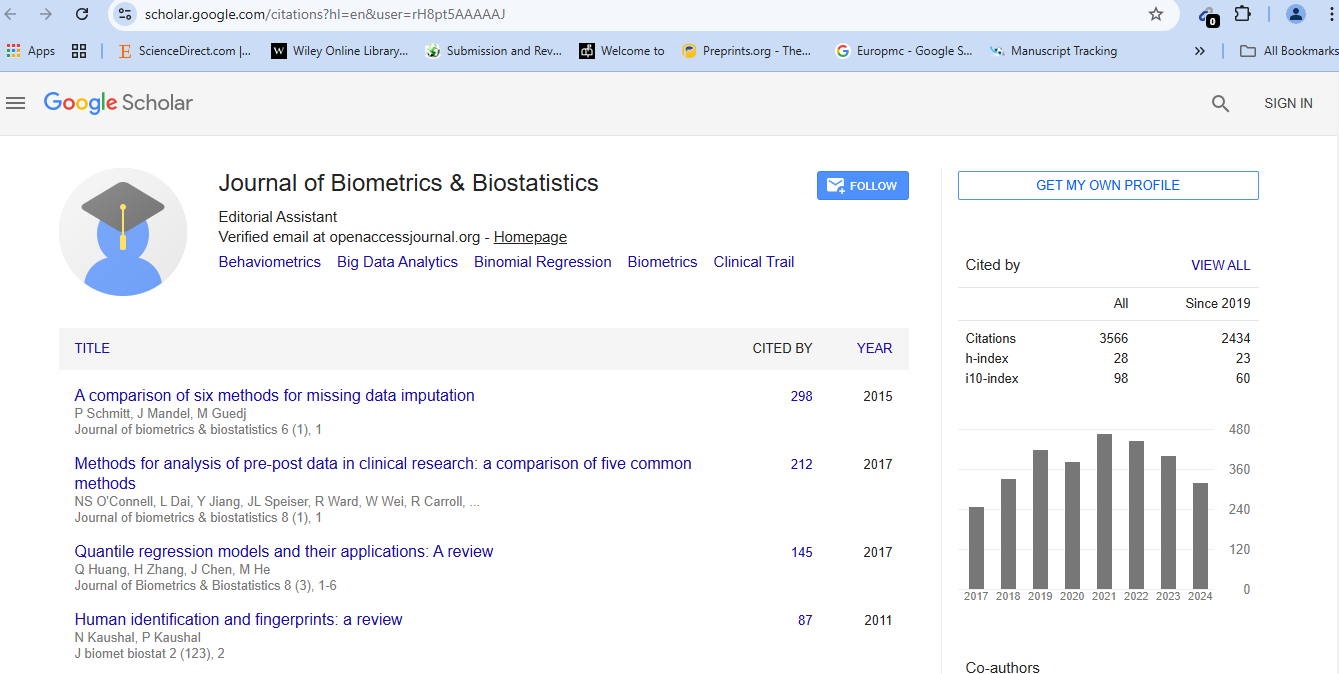
Journal of Biometrics & Biostatistics received 3496 citations as per Google Scholar report