Short Communication - (2025) Volume 12, Issue 6
Received: 01-Dec-2025, Manuscript No. jreac-26-185813;
Editor assigned: 03-Dec-2025, Pre QC No. P-185813;
Reviewed: 17-Dec-2025, QC No. Q-185813;
Revised: 22-Dec-2025, Manuscript No. R-185813;
Published:
29-Dec-2025
, DOI: 10.37421/2380-2391.2025.12.459
Citation: Okafor, Nneka. ”Big Data: Powering Global Environmental Sustainability.” J Environ Anal Chem 12 (2025):459.
Copyright: © 2025 Okafor N. This is an open-access article distributed under the terms of the Creative Commons Attribution License, which permits unrestricted use,
distribution and reproduction in any medium, provided the original author and source are credited.
The integration of big data analytics has emerged as a transformative force in the realm of environmental monitoring, offering unprecedented capabilities for understanding and managing our planet's complex systems. This pivotal shift is driven by the exponential growth of data generated from a multitude of sources, necessitating advanced analytical approaches to glean meaningful insights. The ability to process and interpret these vast datasets in real-time is crucial for informed decision-making across a spectrum of environmental challenges. This article delves into the critical role of big data integration in fostering sustainable environmental monitoring, highlighting how diverse data streams can be harnessed for comprehensive analysis. We will explore frameworks and methodologies designed to effectively manage and interpret this data, thereby facilitating robust decision-making processes in key areas such as pollution tracking, biodiversity assessment, and climate change adaptation, with a particular emphasis on the unique contexts of developing regions [1].
The burgeoning field of big data analytics is proving indispensable for monitoring and predicting environmental risks, especially within ecosystems that are particularly vulnerable to degradation. The inherent heterogeneity of environmental data streams presents both challenges and opportunities, demanding sophisticated strategies for integration. Research in this area focuses on developing early warning systems that can proactively alert us to natural disasters and gradual environmental deterioration. The imperative for robust analytical models and scalable infrastructure is underscored as foundational to achieving truly sustainable environmental management [2].
The Internet of Things (IoT) is revolutionizing environmental quality monitoring by enabling seamless integration with big data platforms for real-time assessments. This technological convergence allows for the systematic collection, processing, and analysis of sensor data to provide accurate evaluations of air and water quality, as well as soil conditions. Such integrated systems are instrumental in empowering communities and policymakers with timely, actionable information, thereby promoting the adoption of sustainable environmental practices [3].
Advancements in ecological modeling for biodiversity conservation are being significantly propelled by the synergistic application of machine learning and big data. The capacity to leverage large-scale datasets, encompassing genetic information, species distribution records, and detailed habitat data, allows for the creation of highly accurate predictive models. These enhanced models are vital for refining strategies related to habitat restoration, species management, and the critical assessment of environmental impacts on biodiversity [4].
The global challenge of climate change is being addressed with renewed vigor through the application of big data analytics. By integrating diverse data sources, ranging from sophisticated climate models to meticulous ground-based observations and extensive satellite data, researchers can significantly improve the accuracy of climate projections. This enhanced understanding is essential for informing effective mitigation and adaptation strategies, with a growing recognition of the importance of data governance and interoperability for successful climate action [5].
Sustainable urban environmental management is witnessing a paradigm shift with the application of big data analytics. Integrating data from comprehensive smart city infrastructure, including traffic sensors, energy consumption meters, and waste management systems, enables optimized resource utilization and a significant reduction in environmental footprints. The research highlights the tangible benefits for improving urban air quality, strategically managing urban sprawl, and fostering the development of essential green infrastructure [6].
The agricultural sector is increasingly leveraging big data analytics to foster sustainability, with a specific focus on optimizing resource management and conducting thorough environmental impact assessments. The integration of data from precision agriculture techniques, soil sensors, weather stations, and remote sensing technologies allows for the refinement of irrigation, fertilization, and pest control strategies. This leads to substantial reductions in water usage, chemical runoff, and greenhouse gas emissions, contributing to more environmentally responsible farming practices [7].
Water resource management for environmental sustainability is being significantly enhanced by the application of big data analytics. The integration of hydrological data, satellite imagery, and climate information provides a comprehensive framework for monitoring water quality, predicting water availability, and effectively managing the risks associated with floods and droughts. The development of data-driven solutions is paramount for achieving efficient water allocation and promoting crucial conservation efforts [8].
Environmental monitoring networks are increasingly relying on the integration of big data to support robust policy-making and foster meaningful public engagement. Real-time data on crucial environmental indicators, such as air pollution levels, noise intensity, and resource consumption, can be effectively visualized and communicated to stakeholders. This transparency empowers informed policy development and highlights the critical importance of data accessibility and user-friendly interfaces for broader societal benefit [9].
The assessment and mitigation of environmental impacts stemming from industrial activities are being significantly improved through big data analytics. Methodologies are being developed to integrate diverse industrial datasets, including emissions records, waste generation logs, and energy consumption data, with broader environmental information. This integrated approach is crucial for identifying pollution hotspots and rigorously evaluating the effectiveness of implemented mitigation measures, thereby supporting the evolution towards more sustainable industrial practices [10].
The critical role of big data integration in advancing sustainable environmental monitoring is profoundly explored, emphasizing the processing and analysis of vast datasets from diverse sources like sensors, satellite imagery, and citizen science to yield real-time environmental insights. The research focuses on developing robust frameworks and methodologies for effective data management and interpretation, facilitating informed decision-making in vital areas such as pollution tracking, biodiversity assessment, and climate change adaptation, particularly within the context of developing regions [1].
This research thoroughly examines the application of big data analytics for the monitoring and prediction of environmental risks within vulnerable ecosystems. It articulates the complexities and prospects associated with integrating heterogeneous environmental data streams, including those from sensor networks and remote sensing technologies, to establish effective early warning systems for natural disasters and environmental degradation. The paper strongly advocates for the necessity of resilient analytical models and scalable infrastructure to underpin sustainable environmental management [2].
This study meticulously concentrates on the integration of Internet of Things (IoT) devices with big data platforms to enable real-time environmental quality monitoring. It delineates a comprehensive architecture for the collection, processing, and analysis of sensor data, aiming to accurately assess air and water quality, as well as soil conditions. The work emphatically underscores how such integrated systems can equip communities and policymakers with timely and actionable information, thereby actively promoting environmental sustainability [3].
A significant focus of this paper is placed on the utilization of machine learning and big data techniques to enhance ecological modeling, specifically for the crucial objective of biodiversity conservation. It addresses the methodologies by which large-scale datasets, encompassing genetic information, species distribution records, and detailed habitat data, can be effectively leveraged to construct more precise predictive models. The overarching aim is to substantially improve strategies for habitat restoration, species management, and the comprehensive assessment of environmental impacts on biodiversity [4].
This article undertakes a detailed examination of the challenges and the significant potential that big data analytics offers in addressing the multifaceted global issue of climate change. It explores how the integration of a wide array of data sources, from sophisticated climate models to meticulous ground-based observations and extensive satellite data, can lead to marked improvements in climate projections and provide essential guidance for mitigation and adaptation strategies. Furthermore, the importance of robust data governance and interoperability is critically discussed as a prerequisite for effective climate action [5].
This paper introduces a conceptual framework for the application of big data analytics with the explicit goal of enhancing sustainable urban environmental management. It elaborates on the integration of data derived from smart city infrastructure, such as traffic sensors, energy consumption meters, and waste management systems, to achieve optimized resource utilization and a tangible reduction in overall environmental footprints. The research highlights significant benefits for improving urban air quality, effectively managing urban sprawl, and actively promoting the development of essential green infrastructure [6].
This research provides an in-depth investigation into the application of big data analytics for monitoring agricultural sustainability, with a pronounced emphasis on resource management and the critical assessment of environmental impacts. It meticulously details how the integration of data from precision agriculture, soil sensors, weather stations, and remote sensing can facilitate optimized irrigation, fertilization, and pest control practices, thereby leading to substantial reductions in water usage, chemical runoff, and greenhouse gas emissions [7].
This article critically explores the immense potential of big data analytics to significantly improve the management of vital water resources, thereby contributing to overall environmental sustainability. It discusses the integration of hydrological data, satellite imagery, and climate information to facilitate comprehensive monitoring of water quality, accurate prediction of water availability, and effective management of flood and drought risks. The central emphasis is on developing data-driven solutions that promote efficient water allocation and conservation [8].
This paper concentrates on the integration of big data derived from environmental monitoring networks to provide essential support for policy-making and to enhance public engagement. It outlines how real-time data concerning air pollution, noise levels, and resource consumption can be effectively visualized and communicated to various stakeholders, thereby fostering greater transparency and enabling the development of more informed policies. The article underscores the fundamental importance of data accessibility and the provision of user-friendly interfaces for widespread adoption and impact [9].
This research undertakes an examination of the role that big data analytics plays in the assessment and mitigation of the environmental impacts specifically associated with industrial activities. It lays out methodologies for integrating diverse industrial datasets, including emissions data, waste generation records, and energy consumption information, with broader environmental data. This integrated approach is designed to pinpoint pollution hotspots and rigorously evaluate the effectiveness of mitigation measures, ultimately supporting the development and implementation of more sustainable industrial practices [10].
This collection of research highlights the transformative power of big data analytics and integration in addressing critical environmental challenges. Studies explore its application in sustainable environmental monitoring, risk prediction in vulnerable ecosystems, and real-time quality assessment through IoT integration. Big data is also shown to enhance biodiversity conservation via ecological modeling, improve climate change mitigation and adaptation strategies, and optimize urban environmental management through smart city data. Furthermore, its role in promoting agricultural sustainability, managing water resources, supporting environmental policy-making with accessible data, and assessing/mitigating industrial environmental impacts is detailed. The overarching theme emphasizes the need for robust analytical frameworks, scalable infrastructure, and effective data integration to drive informed decision-making and promote global environmental sustainability.
None
None
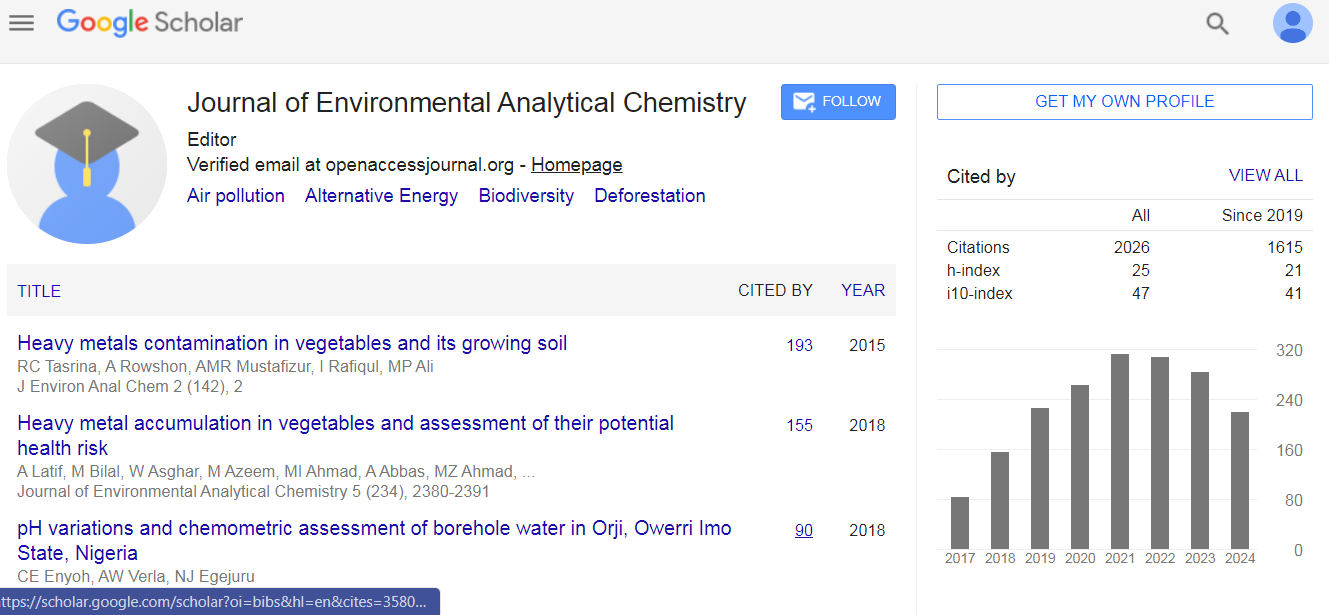
Journal of Environmental Analytical Chemistry received 1781 citations as per Google Scholar report