Perspective - (2025) Volume 9, Issue 5
Received: 01-Sep-2025, Manuscript No. hps-26-184485;
Editor assigned: 03-Sep-2025, Pre QC No. P-184485;
Reviewed: 17-Sep-2025, QC No. Q-184485;
Revised: 22-Sep-2025, Manuscript No. R-184485;
Published:
29-Sep-2025
, DOI: 10.37421/2573-4563.2025.9.367
Citation: Herrera, Luis A.. ”Autophagy’s Role in Liver Disease and Therapy.” J Hepatol Pancreat Sci 09 (2025):367.
Copyright: © 2025 Herrera A. Luis This is an open-access article distributed under the terms of the Creative Commons Attribution License, which permits unrestricted use, distribution and reproduction in any medium, provided the original author and source are credited.
Autophagy, a fundamental cellular catabolic process involving the degradation of damaged organelles and misfolded proteins, plays a crucial and multifaceted role in the pathogenesis and progression of a wide spectrum of liver diseases. Its intricate involvement spans conditions such as non-alcoholic fatty liver disease (NAFLD), alcoholic liver disease (ALD), viral hepatitis, and hepatocellular carcinoma (HCC), underscoring its significance in hepatic health and disease [1].
In the context of NAFLD, the review highlights how impaired autophagic flux significantly contributes to the development and exacerbation of steatosis, inflammation, and fibrosis. This dysfunction impedes the cell's ability to clear accumulated lipids and damaged mitochondria, thereby promoting a pro-inflammatory environment and fibrotic remodeling within the liver. Consequently, therapeutic strategies aimed at restoring or enhancing autophagic activity are being explored to ameliorate NAFLD [2].
For alcoholic liver disease (ALD), research indicates that chronic alcohol consumption profoundly disrupts autophagic pathways. This disruption leads to the accumulation of cellular debris, including damaged organelles, and cellular stress, ultimately contributing to liver injury and fibrosis. The findings suggest that bolstering autophagy could offer a protective effect against these alcohol-induced pathologies, positioning autophagy activators as potential therapeutic agents [3].
Viral hepatitis, encompassing infections like Hepatitis B virus (HBV) and Hepatitis C virus (HCV), presents a complex scenario where autophagy acts as a double-edged sword. While viral replication can hijack cellular autophagy for its own benefit, autophagy also functions as a critical host defense mechanism. The article explores the potential for therapeutic interventions targeting autophagy to effectively control viral load and mitigate liver pathology [4].
The intricate relationship between autophagy and hepatocellular carcinoma (HCC) is characterized by its dual nature, where autophagy can both suppress and promote tumor development depending on the specific stage and cellular context. This research delves into strategies for manipulating autophagy to enhance the efficacy of chemotherapy and prevent recurrence in HCC patients, highlighting its therapeutic potential [5].
Liver fibrosis, a common endpoint for many chronic liver diseases, is significantly influenced by autophagy. Impaired autophagy contributes to the activation of hepatic stellate cells, the primary collagen-producing cells in the liver, leading to excessive deposition of extracellular matrix. The authors discuss the potential of pharmacological agents that can modulate autophagy to effectively reduce liver fibrosis [6].
Furthermore, the role of autophagy in drug-induced liver injury (DILI) is being investigated, suggesting that modulating this pathway could serve as a strategy to protect the liver from toxic insults. The research explores how certain drugs disrupt autophagic flux and how interventions aimed at restoring this process might mitigate DILI [7].
Beyond NAFLD, autophagy is also implicated in other metabolic liver diseases, including steatohepatitis associated with metabolic syndrome. Dysregulated autophagy in these conditions contributes to their progression, and the therapeutic potential of autophagy modulation is being actively explored, offering new avenues for treatment [8].
Liver regeneration, a remarkable capacity of the liver to repair itself, relies heavily on autophagy. This study investigates the specific autophagy-related genes (ATGs) involved in this process, highlighting autophagy's crucial role in clearing damaged cellular components during regeneration and suggesting that its modulation could enhance liver repair mechanisms [9].
Developing effective autophagy-modulating drugs for liver diseases presents both challenges and opportunities. Current research focuses on preclinical and clinical advancements, emphasizing the identification of reliable biomarkers for autophagy activity and patient stratification to optimize therapeutic outcomes, thereby paving the way for more personalized and effective treatments [10].
Autophagy, a cellular self-degradation process, is increasingly recognized as a critical modulator in the pathogenesis and progression of various liver diseases, including non-alcoholic fatty liver disease (NAFLD), alcoholic liver disease (ALD), viral hepatitis, and hepatocellular carcinoma (HCC). Dysregulation of autophagy contributes to liver injury, inflammation, fibrosis, and tumorigenesis. Consequently, targeting autophagy pathways presents a promising therapeutic strategy for managing these conditions. Modulating autophagy can be achieved through activators or inhibitors, depending on the specific disease context. For instance, autophagy activation may be beneficial in early stages of NAFLD and ALD to clear damaged organelles and misfolded proteins, while its inhibition might be useful in later stages of fibrosis or in certain types of HCC where cancer cells exploit autophagy for survival. Further research is needed to precisely define the role of specific autophagy pathways in different liver diseases and to develop safe and effective autophagy-modulating drugs [1].
This review delves into the complex role of autophagy in NAFLD, highlighting how impaired autophagic flux contributes to steatosis, inflammation, and fibrosis. It discusses potential therapeutic strategies that aim to restore or enhance autophagic activity to ameliorate NAFLD. The authors emphasize the need for a nuanced understanding of how autophagy modulation impacts different cellular processes within the liver to develop effective treatments [2].
Focusing on alcoholic liver disease (ALD), this study investigates how chronic alcohol consumption disrupts autophagic pathways, leading to the accumulation of damaged organelles and cellular stress. The findings suggest that enhancing autophagy could offer a protective effect against alcohol-induced liver injury and fibrosis, pointing towards autophagy activators as potential therapeutic agents [3].
This article explores the dual role of autophagy in viral hepatitis, particularly in the context of Hepatitis B virus (HBV) and Hepatitis C virus (HCV) infections. It examines how viral replication can manipulate cellular autophagy for its benefit, but also how autophagy can act as a host defense mechanism. The potential for therapeutic interventions targeting autophagy to control viral load and liver pathology is discussed [4].
The intricate relationship between autophagy and hepatocellular carcinoma (HCC) is dissected in this research. It highlights how autophagy can both suppress and promote tumor development, depending on the stage and context. The authors investigate strategies for manipulating autophagy to enhance chemotherapy efficacy and prevent recurrence in HCC patients [5].
This study provides a comprehensive overview of the molecular mechanisms underlying autophagy in liver fibrosis. It explains how impaired autophagy leads to the activation of hepatic stellate cells and the excessive deposition of extracellular matrix. The authors discuss the potential of pharmacological agents that can modulate autophagy to reduce liver fibrosis [6].
Examining the role of autophagy in drug-induced liver injury (DILI), this research suggests that modulating autophagy can be a strategy to protect the liver from toxic insults. The authors explore how certain drugs disrupt autophagy and how interventions to restore autophagic flux might mitigate DILI [7].
This paper reviews the emerging role of autophagy in metabolic liver diseases beyond NAFLD, including steatohepatitis associated with metabolic syndrome. It discusses how dysregulated autophagy contributes to the progression of these conditions and explores the therapeutic potential of autophagy modulation [8].
This study investigates the specific autophagy-related genes (ATGs) involved in liver regeneration. It highlights how autophagy plays a crucial role in clearing damaged cellular components during the regenerative process and how its modulation could potentially enhance liver repair mechanisms [9].
This article discusses the challenges and opportunities in developing autophagy-modulating drugs for liver diseases. It reviews current preclinical and clinical advancements, focusing on identifying reliable biomarkers for autophagy activity and patient stratification to optimize therapeutic outcomes [10].
Autophagy is a critical cellular process implicated in various liver diseases, including NAFLD, ALD, viral hepatitis, and HCC. Dysregulation of autophagy contributes to liver injury, inflammation, fibrosis, and tumorigenesis. Therapeutic strategies targeting autophagy pathways, either through activation or inhibition, show promise for managing these conditions. For NAFLD and ALD, autophagy activation may clear damaged components, while inhibition might be useful in later fibrosis stages or HCC. Autophagy's role in viral hepatitis is complex, acting as both a viral tool and a host defense. In HCC, autophagy's impact is context-dependent, with modulation strategies explored to enhance chemotherapy. Autophagy is also central to liver fibrosis and DILI, with modulation offering protective effects. Its role in other metabolic liver diseases and liver regeneration is also significant. Developing autophagy-modulating drugs faces challenges, necessitating advancements in biomarker identification and patient stratification for optimal therapeutic outcomes.
None
None
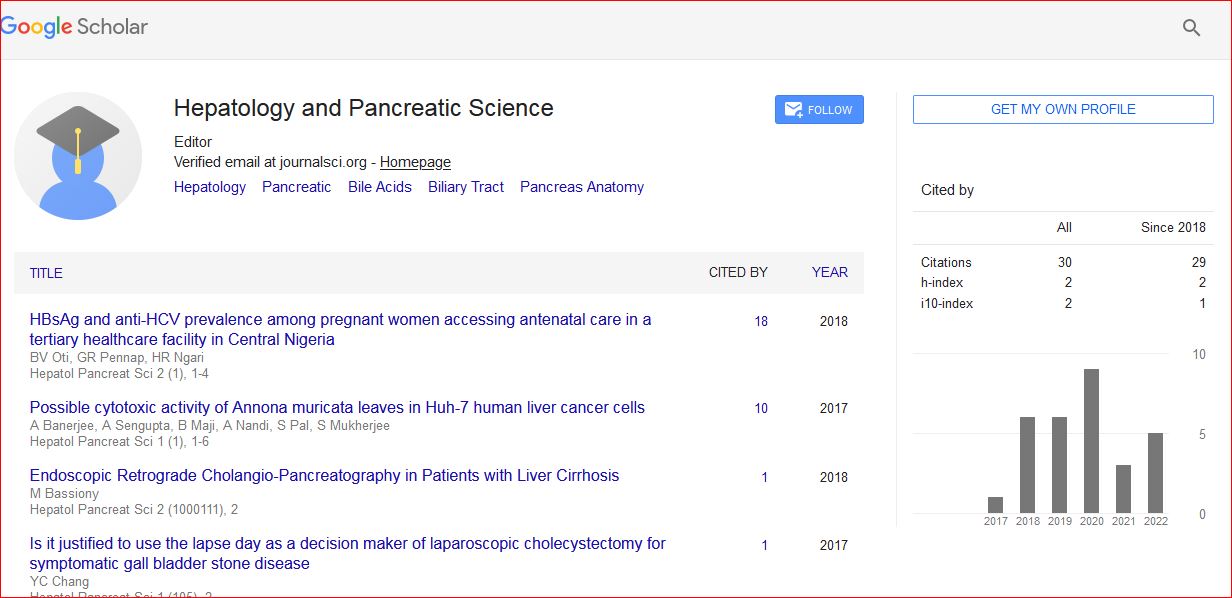
Hepatology and Pancreatic Science received 34 citations as per Google Scholar report