Commentary - (2025) Volume 13, Issue 2
Received: 01-Apr-2025, Manuscript No. jaat-26-183144;
Editor assigned: 03-Apr-2025, Pre QC No. P-183144;
Reviewed: 17-Apr-2025, QC No. Q-183144;
Revised: 22-Apr-2025, Manuscript No. R-183144;
Published:
29-Apr-2025
, DOI: 10.37421/2329-6542.2025.13.343
Citation: Thompson, James R.. ”Astrophysical Particle Acceleration: Cosmic Rays and Beyond.” J Astrophys Aerospace Technol 13 (2025):343.
Copyright: © 2025 Thompson R. James This is an open-access article distributed under the terms of the Creative Commons Attribution License, which permits unrestricted use, distribution and reproduction in any medium, provided the original author and source are credited.
The acceleration of charged particles to extremely high energies is a fundamental process in high-energy astrophysics, driving phenomena across the cosmos. This review delves into the intricate mechanisms responsible for this energization, examining established models and exploring more exotic scenarios. We will investigate how particles acquire the immense energies observed in various astrophysical environments. The current understanding is built upon decades of theoretical development and observational advancements. One key area of focus is the study of particle acceleration at the termination shocks of astrophysical jets. These shocks are thought to be crucial for accelerating cosmic rays up to the 'knee' energy region, around 10^15 eV. Detailed magnetohydrodynamic (MHD) simulations have demonstrated how particles can be efficiently energized through repeated crossings of the shock front. The role of magnetosonic waves in particle acceleration within turbulent astrophysical plasmas, such as those found in galaxy clusters, is another significant avenue of research. A novel acceleration mechanism driven by the nonlinear interaction of particles with these waves can lead to enhanced energy gains beyond standard diffusive shock acceleration (DSA). Particle acceleration in pulsar magnetospheres is a critical topic, particularly concerning the mechanisms that produce the observed high-energy gamma-ray emission. The efficiency of DSA and magnetic reconnection as potential energy sources for relativistic particles within these extreme environments is a subject of ongoing investigation. The acceleration of particles in turbulent relativistic jets is another area of intense study, with a particular emphasis on the contribution to ultra-high-energy cosmic rays (UHECRs). Advanced numerical simulations are employed to explore how turbulence, magnetic fields, and shocks interact to energize charged particles to petaelectronvolt energies and beyond. Investigating particle acceleration at the heliospheric termination shock provides insights into the origin of galactic cosmic rays that enter our solar system. The analysis of observational data from spacecraft and theoretical models helps to understand the efficiency and mechanisms of DSA in this region, addressing questions about the source of low-energy cosmic rays. Particle acceleration in supernova remnant shocks stands as a prime candidate for producing galactic cosmic rays up to PeV energies. Detailed modeling of the shock structure and particle diffusion processes aims to explain the observed nonthermal emission from these objects, with considerations for the role of magnetic field amplification. The process of magnetic reconnection is explored as a powerful mechanism for accelerating particles in astrophysical environments like solar flares and pulsar magnetospheres. Theoretical frameworks and observational evidence support magnetic reconnection as a potent energy release and particle acceleration process capable of producing high-energy particles. Particle acceleration in the vicinity of black holes, specifically within active galactic nuclei (AGNs) and their relativistic jets, is examined. Processes such as DSA and magnetic reconnection within accretion disks and jet bases are discussed as potential sources of UHECRs, highlighting the importance of multi-messenger observations. Finally, the acceleration of UHECRs originating from extragalactic sources is a major focus, summarizing potential acceleration sites including blazars, radio galaxies, and intergalactic shocks. Challenges in identifying these sources and the role of particle propagation through the intergalactic medium are discussed.
The fundamental processes by which charged particles are accelerated to extremely high energies are central to understanding high-energy astrophysics. This field investigates phenomena ranging from the intragalactic to the extragalactic, with numerous astrophysical sites implicated. Established models like diffusive shock acceleration (DSA) are continually refined, while more exotic scenarios such as magnetic reconnection in astrophysical plasmas and the influence of turbulent environments are explored to account for the observed particle energies. The acceleration of cosmic rays up to the 'knee' energy region, approximately 10^15 eV, is a significant area of research, with particular attention paid to particle acceleration at the termination shocks of astrophysical jets. Detailed magnetohydrodynamic (MHD) simulations have been instrumental in demonstrating how particles can achieve high energies through repeated interactions with these shock fronts, contributing to the observed cosmic ray spectrum and anisotropy. Within turbulent astrophysical plasmas, such as those prevalent in galaxy clusters, magnetosonic waves play a crucial role in particle energization. A novel acceleration mechanism, driven by the nonlinear interaction of particles with these waves, has been proposed, offering a pathway for energy gains exceeding those predicted by standard DSA models and providing insights into the origin of ultra-high-energy cosmic rays (UHECRs). In the extreme environments of pulsar magnetospheres, particle acceleration is responsible for generating observed high-energy gamma-ray emission. The efficiency of both diffusive shock acceleration and magnetic reconnection as mechanisms for energizing relativistic particles within these magnetospheres is a key area of study, aiming to elucidate the workings of some of the universe's most potent particle accelerators. The acceleration of particles within turbulent relativistic jets is another critical area of investigation, with significant implications for the production of UHECRs. Sophisticated numerical simulations are employed to unravel the complex interplay of turbulence, magnetic fields, and shocks that leads to the energization of charged particles to petaelectronvolt energies and beyond, with consequences for the observed UHECR spectrum and composition. Particle acceleration at the heliospheric termination shock offers valuable insights into the origin of galactic cosmic rays that permeate our solar system. By integrating observational data from spacecraft with theoretical modeling, researchers aim to better understand the efficiency and specific mechanisms of DSA in this crucial region, addressing fundamental questions about the sources of lower-energy cosmic rays. Supernova remnant shocks are considered primary candidates for the acceleration of galactic cosmic rays to energies as high as PeV. This research involves detailed modeling of shock structures and particle diffusion processes to explain the observed nonthermal emission from these remnants, also considering the pivotal role that magnetic field amplification plays in these acceleration processes. Magnetic reconnection is recognized as a potent mechanism for accelerating particles in a variety of astrophysical settings, including solar flares and pulsar magnetospheres. A comprehensive review of both theoretical frameworks and observational evidence underscores magnetic reconnection's capacity for rapid energy release and the efficient acceleration of particles to high energies. The vicinity of black holes, particularly within active galactic nuclei (AGNs) and their associated relativistic jets, is another focal point for particle acceleration studies. The interplay of processes like DSA and magnetic reconnection in accretion disks and jet bases is explored for its contribution to the generation of UHECRs, emphasizing the value of multi-messenger observations for probing these energetic phenomena. The origins of ultra-high-energy cosmic rays (UHECRs) from extragalactic sources are a subject of intense research, with potential acceleration sites including blazars, radio galaxies, and intergalactic shocks. The challenges in pinpointing these sources and understanding how particle propagation through the intergalactic medium shapes the observed UHECR spectrum and composition are key aspects of this ongoing investigation.
This research explores the acceleration of charged particles to high energies in various astrophysical environments. Key mechanisms discussed include diffusive shock acceleration (DSA) in supernova remnants and pulsar magnetospheres, magnetic reconnection, and particle energization in turbulent relativistic jets. Studies utilize magnetohydrodynamic simulations and observational data to understand these processes, focusing on their contributions to cosmic ray spectra, including ultra-high-energy cosmic rays (UHECRs). The research also touches upon acceleration at the heliospheric termination shock and within active galactic nuclei. The ultimate goal is to identify the sources of these energetic particles and understand their propagation through the cosmos.
None
None
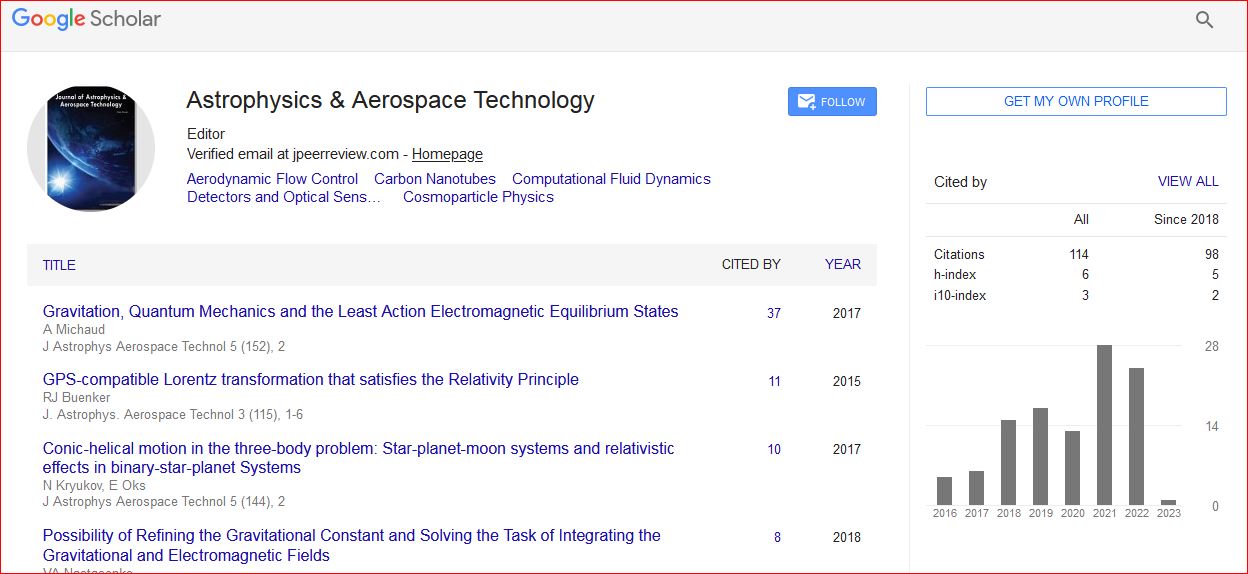
Astrophysics & Aerospace Technology received 114 citations as per Google Scholar report