Perspective - (2025) Volume 21, Issue 5
Received: 01-Sep-2025, Manuscript No. jos-26-185178;
Editor assigned: 03-Sep-2025, Pre QC No. P-185178;
Reviewed: 17-Sep-2025, QC No. Q-185178;
Revised: 22-Sep-2025, Manuscript No. R-185178;
Published:
29-Sep-2025
, DOI: 10.37421/1584-9341.2024.20.227
Citation: Rossi, Valentina. ”Antibiotic Timing: Crucial for Surgical
Site Infection Prevention.” J Surg 21 (2025):227.
Copyright: © 2025 Rossi V. This is an open-access article distributed under the terms of the Creative Commons Attribution License, which permits unrestricted use, distribution
and reproduction in any medium, provided the original author and source are credited.
Optimizing prophylactic antibiotic timing in clean-contaminated surgery is paramount for effectively preventing surgical site infections (SSIs). The crucial insight is that the antibiotic should be administered within the hour before incision to achieve adequate therapeutic concentrations at the operative site during the critical period of potential bacterial contamination [1].
Deviations from this established window, particularly delayed administration, have been shown to significantly increase the risk of SSIs [2].
While timing is a critical factor, other influences such as the specific antibiotic type, the complexity of the surgical procedure, and patient-specific characteristics also play a role in determining optimal prophylaxis, necessitating individualized approaches guided by evidence-based protocols [3].
The adherence to established guidelines for timely antibiotic administration is a cornerstone of effective SSI prophylaxis in clean-contaminated settings, as demonstrated by real-world evidence from multi-center studies [4].
Research has also begun to explore how patient factors, such as body mass index (BMI) and altered pharmacokinetics in obese patients, may necessitate adjustments to standard timing and dosing protocols to ensure adequate tissue concentrations [5].
Beyond timing, the selection of an appropriate antibiotic with an adequate spectrum of activity is also a critical component of effective prophylaxis, complementing the importance of correct administration time [6].
Studies specifically examining colorectal surgery, a common type of clean-contaminated procedure, further support the established practice of pre-incision antibiotic administration for SSI prevention [7].
The evolution of antibiotic prophylaxis guidelines consistently emphasizes the enduring importance of correct timing, while also acknowledging the challenges of implementation in busy surgical settings and the ongoing need for education and audit [8].
Even in procedures that can be considered clean-contaminated depending on intraoperative findings, such as appendectomy, delayed antibiotic administration has been associated with negative outcomes, reinforcing the general principle of timely prophylaxis for infection prevention [9].
Overall, a systematic review and meta-analysis critically evaluating current guidelines confirms that administration within the hour before incision is consistently associated with the lowest risk of SSIs in clean-contaminated surgery [10].
The critical window for prophylactic antibiotic administration in clean-contaminated surgery is generally accepted to be within the hour preceding incision. This timing ensures that peak serum and tissue antibiotic concentrations coincide with the period of greatest risk for bacterial contamination during the surgical procedure [1].
Delays in administration beyond this hour have been clearly correlated with an increased incidence of surgical site infections (SSIs) [2].
Factors such as the duration of the operative procedure can influence the effectiveness of a single prophylactic dose, suggesting that prolonged surgeries may require redosing to maintain therapeutic levels and prevent SSIs [3].
Real-world data from multicenter studies reinforce the principle that strict adherence to prophylactic antibiotic timing guidelines is a fundamental aspect of effective SSI prevention in clean-contaminated surgical settings [4].
For specific patient populations, such as those with a high body mass index, altered pharmacokinetics may necessitate adjustments to standard timing and dosing strategies to achieve adequate drug concentrations [5].
While timing is a paramount consideration, the choice of antibiotic and its spectrum of activity are also vital components of a comprehensive SSI prevention strategy in clean-contaminated surgery [6].
Retrospective analyses of procedures like colorectal surgery further validate the practice of administering prophylactic antibiotics prior to incision as a means to reduce SSI development [7].
The ongoing discussion and evolution of antibiotic prophylaxis guidelines consistently highlight the significance of correct administration timing, alongside addressing challenges in practical implementation and the necessity of continuous education and monitoring [8].
Studies investigating procedures like appendectomy, which can be classified as clean-contaminated, also demonstrate that delayed antibiotic administration negatively impacts outcomes, underscoring the importance of timely prophylaxis [9].
Comprehensive systematic reviews and meta-analyses have critically evaluated the evidence base, confirming that administering prophylactic antibiotics within the hour before incision is consistently linked to the lowest SSI rates in clean-contaminated surgical procedures [10].
The timely administration of prophylactic antibiotics, specifically within one hour before incision, is crucial for preventing surgical site infections (SSIs) in clean-contaminated surgery. Deviations from this timeframe, particularly delays, increase SSI risk. Factors such as antibiotic type, surgical complexity, and patient characteristics like obesity can influence optimal prophylaxis, requiring individualized approaches. Prolonged surgeries may necessitate redosing. Adherence to timing guidelines is a cornerstone of SSI prevention, supported by multicenter studies and specific procedure analyses. The selection of an appropriate antibiotic also plays a vital role. Ongoing research and evolving guidelines emphasize the enduring importance of correct timing, alongside considerations for practical implementation and education.
None
None
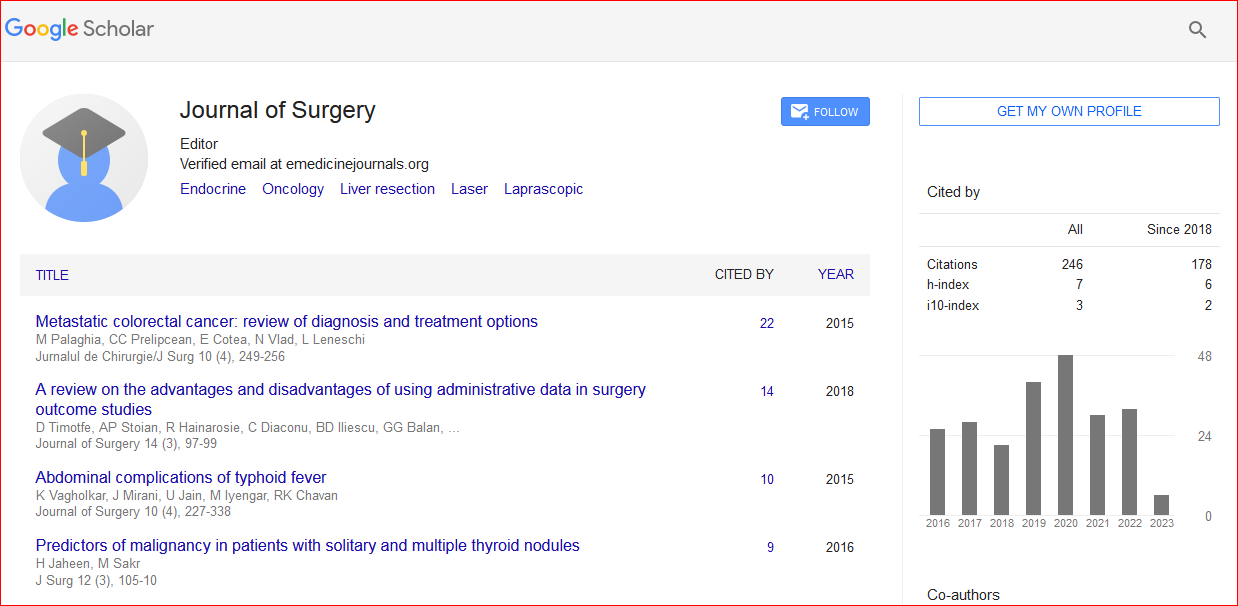
Journal of Surgery received 288 citations as per Google Scholar report