Perspective - (2025) Volume 9, Issue 5
Received: 01-Oct-2025, Manuscript No. ahbs-26-182540;
Editor assigned: 03-Oct-2025, Pre QC No. P-182540;
Reviewed: 17-Oct-2025, QC No. Q-182540;
Revised: 22-Oct-2025, Manuscript No. R-182540;
Published:
29-Oct-2025
, DOI: 10.37421/2952-8097.2025.9.339
Citation: Chang, Yen-Ling. ”Animal Behavior And Physiology:
Diverse Species Studies.” J Anim Health Behav Sci 09 (2025):339.
Copyright: © 2025 Chang Y. This is an open-access article distributed under the terms of the Creative Commons Attribution License, which permits unrestricted use, distribution
and reproduction in any medium, provided the original author and source are credited.
This document synthesizes recent advancements in comparative animal behavior and physiology, drawing from a range of studies that explore diverse species and their unique adaptations. The investigation into early life stress in companion animals, specifically dogs and cats, reveals commonalities in the long-term impacts on the hypothalamic-pituitary-adrenal (HPA) axis and emotional regulation, suggesting potential therapeutic avenues for stress-related disorders in these species [1].
Further exploration into social learning strategies compares primates and canids, examining how juvenile animals acquire foraging skills through observation and imitation. While both groups demonstrate social learning, the underlying cognitive mechanisms and efficiency of skill transfer appear to differ, likely reflecting evolutionary divergence in social structures and ecological pressures [2].
Research on environmental enrichment in captive ungulates, including zebras and giraffes, highlights significant variations in glucocorticoid levels and immune cell counts that correlate with enclosure design, social grouping, and enrichment activities. This underscores the critical importance of optimizing welfare conditions in zoological settings to maintain robust health [3].
In the realm of avian communication, a comparative study of territorial defense calls and mating songs in two sympatric forest bird species reveals distinct spectral and temporal characteristics in their vocalizations. These adaptations are crucial for minimizing acoustic interference and facilitating species recognition, which are vital for reproductive success and habitat partitioning [4].
The impact of parasite load on antipredator behavior is examined in small mammals, comparing responses between a rodent species and a shrew species. Infected individuals from both groups exhibit reduced vigilance and slower escape responses, indicating a significant compromise in predator detection and evasion due to parasitic manipulation of behavior [5].
Parental care strategies in aquatic vertebrates are analyzed through a comparative study of oviparous and viviparous fish. The research investigates the time and energy invested in offspring protection and provisioning, demonstrating how reproductive strategy directly influences the nature and duration of parental investment and, consequently, offspring survival rates [6].
Dietary influences on cognitive performance and behavioral flexibility are explored in laboratory rats and mice. Findings indicate that nutrient-dense diets enhance problem-solving abilities and reduce repetitive behaviors in both species, though the magnitude of improvement varies, suggesting species-specific nutritional requirements for optimal brain function [7].
Stress responses to handling procedures in domesticated livestock, specifically dairy cows and pigs, are investigated using physiological and behavioral indicators. The study reveals that calmer, more predictable handling methods significantly reduce stress markers in both species, thereby promoting animal welfare [8].
Social dynamics and group cohesion in captive primate populations, including chimpanzees and bonobos, are examined through observations of affiliative behaviors and conflict resolution. While both species display complex social structures, bonobos tend to exhibit more egalitarian relationships and less intergroup aggression [9].
Finally, the role of olfaction in mate selection and social recognition is explored in two species of nocturnal rodents, hamsters and gerbils. Behavioral assays reveal differences in their sensitivity to conspecific and heterospecific odors, suggesting distinct evolutionary pathways in the development of their chemosensory systems that impact reproductive and social behaviors [10].
The study of early life stress in domestic dogs and cats, as detailed in one investigation, highlights the enduring effects on their hypothalamic-pituitary-adrenal (HPA) axis and emotional regulation. This comparative approach reveals shared vulnerabilities and potential therapeutic targets for stress-related disorders common to both companion species [1].
Another study contrasts social learning strategies in primates and canids, focusing on the acquisition of foraging skills by juveniles. The research elucidates the roles of observation and imitation, noting that while social learning is present in both groups, the underlying cognitive processes and the efficiency of skill transfer may differ, reflecting evolutionary trajectories shaped by social structures and ecological demands [2].
A significant contribution comes from research into environmental enrichment for captive ungulates, such as zebras and giraffes. This work quantifies the impact of enclosure design, social dynamics, and enrichment on immune function and stress hormone levels, emphasizing the critical link between well-managed captive environments and animal health [3].
Comparative analysis of avian communication patterns focuses on the acoustic divergence in territorial defense calls and mating songs of two sympatric forest bird species. The findings underscore the evolutionary adaptations in vocalizations that facilitate species recognition and minimize interference, which are essential for successful reproduction and coexistence within shared habitats [4].
The intricate relationship between parasite load and antipredator behavior is investigated in rodent and shrew species. The study demonstrates that parasitic infections impair crucial survival behaviors, leading to reduced vigilance and delayed escape responses, illustrating a clear behavioral deficit that compromises predator evasion [5].
Reproductive strategies significantly influence parental care, as shown by a comparative study of oviparous and viviparous fish. This research quantifies the investment in offspring care and its correlation with survival rates, providing insights into the diverse evolutionary pathways of parental investment in aquatic vertebrates [6].
The cognitive benefits of dietary interventions are explored in rodent models, specifically rats and mice. Nutrient-dense diets are found to improve cognitive functions and reduce maladaptive behaviors, with species-specific variations in response suggesting tailored nutritional needs for optimal brain health and behavioral regulation [7].
Animal welfare in agricultural settings is addressed through an examination of stress responses in dairy cows and pigs to different handling procedures. The evidence strongly supports the use of calm and predictable handling techniques to mitigate physiological and behavioral stress markers, enhancing overall animal well-being [8].
Social organization and behavior in captive primates, namely chimpanzees and bonobos, are analyzed to understand their complex social structures. The study highlights differences in relationship dynamics, with bonobos exhibiting more egalitarian social systems and reduced aggression compared to chimpanzees [9].
Lastly, the role of olfaction in the social and reproductive lives of nocturnal rodents, hamsters and gerbils, is investigated. Differences in their responses to olfactory cues point to distinct evolutionary paths in the development of their chemosensory systems, influencing crucial behaviors related to mate choice and social recognition [10].
This compilation of studies explores diverse aspects of animal behavior and physiology across various species. Key themes include the long-term effects of early life stress on companion animals, comparative social learning strategies in primates and canids, and the influence of environmental enrichment on captive ungulates. The research also delves into avian acoustic communication, parasite-induced behavioral changes in small mammals, parental care strategies in fish, dietary impacts on rodent cognition, stress responses in farm animals, social dynamics in primates, and the role of olfaction in nocturnal rodents. These investigations collectively enhance our understanding of evolutionary adaptations, welfare considerations, and species-specific behaviors.
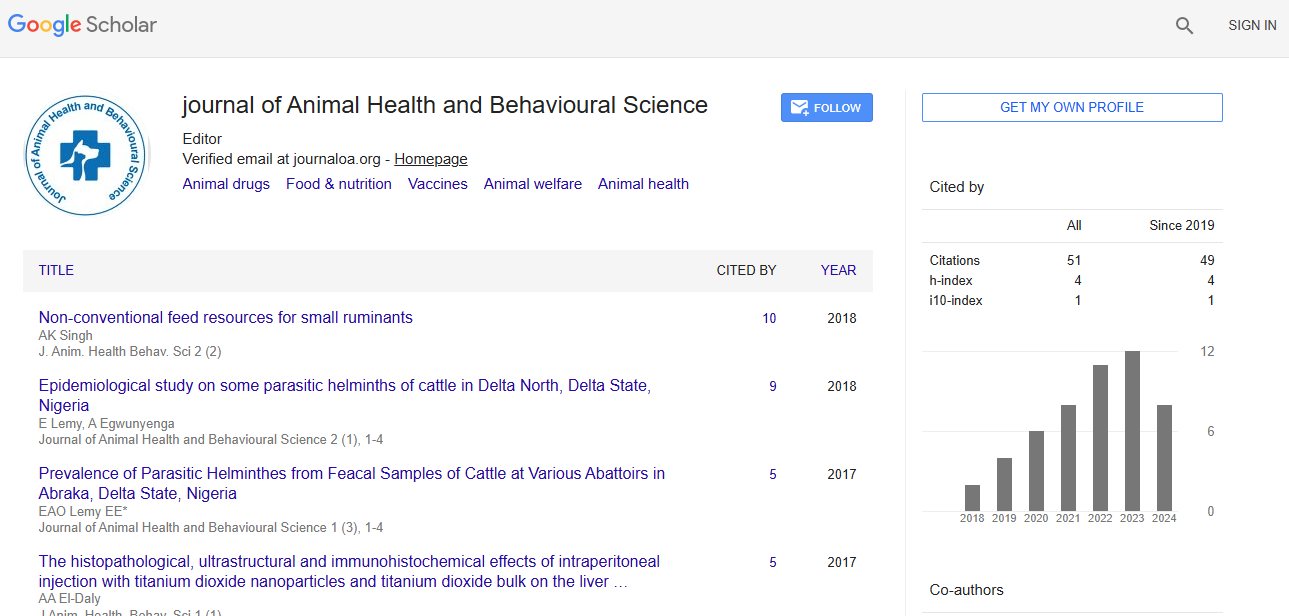
Journal of Animal Health and Behavioural Science received 38 citations as per Google Scholar report