Opinion - (2025) Volume 15, Issue 2
Received: 01-Apr-2025, Manuscript No. jeat-26-188599;
Editor assigned: 03-Apr-2025, Pre QC No. P-188599;
Reviewed: 17-Apr-2025, QC No. Q-188599;
Revised: 22-Apr-2025, Manuscript No. R-188599;
Published:
29-Apr-2025
, DOI: 10.37421/2161-0525.2025.15.840
Citation: Williams, Noah. ”Analytical Methods for Pharmaceutical
Residues in Wastewater.” J Environ Anal Toxicol 15 (2025):840.
Copyright: © 2025 Williams N. This is an open-access article distributed under the terms of the Creative Commons Attribution License, which permits unrestricted use,
distribution and reproduction in any medium, provided the original author and source are credited.
The pervasive presence of pharmaceutical residues in wastewater represents a significant and growing environmental concern, necessitating the development of highly sensitive and specific analytical methodologies for their detection and quantification [1].
This concern is amplified by the continuous release of a diverse array of pharmaceutical compounds into aquatic environments, often originating from domestic, industrial, and agricultural sources, underscoring the need for robust monitoring strategies [2].
Analyzing these residues presents considerable challenges, including their often extremely low concentrations, the complex matrices of wastewater, and the sheer number of different pharmaceutical compounds and their transformation products present [3].
Advanced analytical techniques, particularly mass spectrometry coupled with chromatography, such as LC-MS/MS and GC-MS/MS, have become indispensable tools due to their exceptional sensitivity and specificity in identifying and quantifying these trace contaminants [4].
Method validation is a critical step in ensuring the reliability of analytical data, which is essential for accurate environmental risk assessments, regulatory compliance, and understanding the ecological impacts of emerging pharmaceutical contaminants [5].
Passive sampling techniques offer a valuable alternative for in-situ monitoring, providing time-weighted average concentrations with reduced labor and solvent consumption, thus enabling more comprehensive environmental surveillance of pharmaceuticals [6].
The scope of wastewater monitoring is expanding beyond traditional pharmaceuticals to include other emerging contaminants, such as per- and polyfluoroalkyl substances (PFAS) and microplastics, due to their co-occurrence and potential synergistic impacts on aquatic ecosystems [7].
Furthermore, the removal of specific classes of pharmaceuticals, such as endocrine-disrupting compounds (EDCs), from wastewater is a key focus, with comparative analytical studies of various treatment technologies informing infrastructure upgrades to mitigate their environmental effects [8].
Specialized analytical methods are also required for veterinary pharmaceuticals found in agricultural wastewater, where their entry into the environment through manure application and runoff poses risks to ecosystems and human health [9].
Finally, understanding the link between pharmaceutical residues and the development and spread of antimicrobial resistance genes (ARGs) in wastewater is crucial, necessitating integrated analytical approaches that combine the monitoring of both pharmaceuticals and ARGs to fully assess environmental risks [10].
The imperative for precise analytical determination of pharmaceutical residues in wastewater stems from their growing environmental prevalence and the challenges posed by low concentrations and complex matrices [1].
A significant challenge lies in understanding the occurrence and spatial distribution of specific pharmaceutical classes, such as antibiotics, within wastewater treatment plants and their receiving water bodies, requiring sensitive quantification methods [2].
The analysis of polar pharmaceutical compounds and their degradation products within complex environmental matrices like wastewater effluent necessitates novel sample preparation approaches coupled with advanced mass spectrometry techniques to achieve low detection limits and unambiguous identification [3].
Advanced oxidation processes (AOPs) are being investigated for their effectiveness in removing a broad spectrum of pharmaceutical residues, with analytical monitoring employing LC-MS/MS being crucial for tracking degradation and identifying potentially toxic byproducts [4].
Passive sampling offers a methodologically advantageous approach for the in-situ monitoring of pharmaceuticals in wastewater, providing time-weighted average concentrations and reducing laboratory workload through integrated sampling and extraction processes [5].
The application of wastewater-based epidemiology (WBE) for public health surveillance has expanded to include the determination of illicit drugs and their metabolites, utilizing sensitive GC-MS/MS methods for quantitative data on drug consumption patterns [6].
Integrated analytical strategies are being developed to address the increasing concern over the co-occurrence of diverse emerging contaminants in wastewater, including pharmaceuticals, PFAS, and microplastics, enabling comprehensive environmental risk assessments [7].
The comparative analytical study of wastewater treatment technologies for removing endocrine-disrupting compounds (EDCs) provides critical data on removal efficiencies, informing decisions on upgrading infrastructure to mitigate their significant environmental impact [8].
Targeted analytical methods, such as QuEChERS-based sample preparation coupled with LC-MS/MS, are vital for monitoring veterinary pharmaceuticals in agricultural wastewater, addressing the unique challenges of these residues entering the environment [9].
Complementary to pharmaceutical residue monitoring, analytical methodologies for antimicrobial resistance genes (ARGs) in wastewater are crucial for understanding the development and spread of resistance, emphasizing the need to integrate both pharmaceutical and ARG analysis for a complete risk assessment [10].
This compilation of research highlights the critical need for advanced analytical methods to detect and quantify pharmaceutical residues in wastewater, a growing environmental concern. Studies emphasize the use of sophisticated techniques like LC-MS/MS and GC-MS/MS due to their sensitivity and specificity in analyzing complex matrices and low concentrations. Method validation is crucial for reliable risk assessment and regulatory compliance. The research also explores the occurrence and distribution of specific pharmaceuticals, the challenges in analyzing polar compounds and their transformation products, and the effectiveness of various treatment technologies, including advanced oxidation processes, for their removal. The scope is expanding to include other emerging contaminants and the monitoring of illicit drugs through wastewater-based epidemiology. Specialized methods are needed for veterinary pharmaceuticals in agricultural settings. Furthermore, the link between pharmaceutical residues and antimicrobial resistance genes is a key area of study, emphasizing integrated analytical approaches for comprehensive environmental risk assessment.
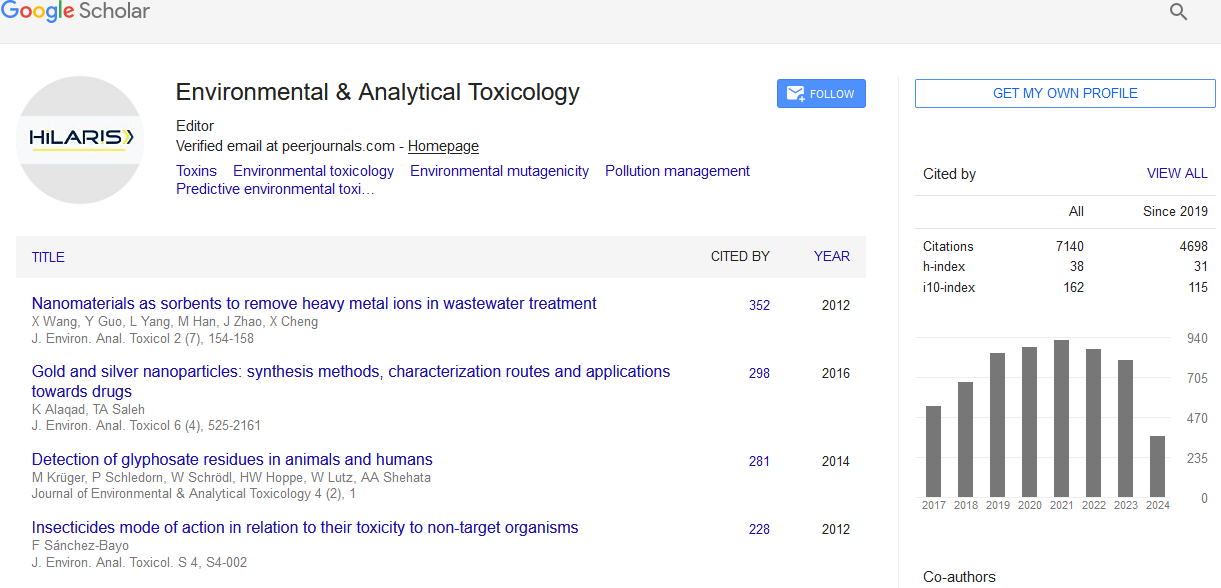
Environmental & Analytical Toxicology received 6818 citations as per Google Scholar report