Commentary - (2025) Volume 15, Issue 6
Received: 01-Dec-2025, Manuscript No. jbbs-25-178298;
Editor assigned: 03-Dec-2025, Pre QC No. P-178298;
Reviewed: 17-Dec-2025, QC No. Q-178298;
Revised: 22-Dec-2025, Manuscript No. R-178298;
Published:
29-Dec-2025
, DOI: 10.37421/2155-9538.2025.15.510
Citation: Rao, Ananya. ”AI-Driven Advances: Revolutionizing Medical Imaging.” J Bioengineer & Biomedical Sci 15 (2025):510.
Copyright: © 2025 Rao A. This is an open-access article distributed under the terms of the Creative Commons Attribution License, which permits unrestricted use, distribution and reproduction in any medium, provided the original author and source are credited.
Recent years have witnessed a remarkable acceleration in biomedical imaging, driven by technological innovations that promise to revolutionize diagnostics and therapeutics. AI-powered image reconstruction, novel contrast agents, and miniaturized sensors are at the forefront, significantly enhancing diagnostic accuracy and improving therapeutic guidance across a spectrum of medical applications. Early cancer detection, personalized treatment monitoring, and the development of less invasive surgical procedures are among the key areas benefiting from these advancements. The integration of multi-modal imaging and quantitative analysis is emerging as a critical trend, enabling a more comprehensive understanding of disease states. This progress is not confined to specific modalities; deep learning algorithms are transforming medical image analysis, automating complex tasks like segmentation and anomaly detection. Convolutional neural networks and other advanced architectures are demonstrating exceptional performance across MRI, CT, and ultrasound, addressing diverse disease areas. Ethical considerations and data privacy are paramount as AI becomes more integrated into clinical workflows, demanding careful attention to patient data security and algorithmic fairness. Concurrently, optical imaging techniques are advancing, offering unprecedented resolution for preclinical and clinical research. Innovations in super-resolution microscopy, optical coherence tomography, and photoacoustic imaging provide high-resolution structural and functional information, with significant applications in ophthalmology, dermatology, and neuroimaging. These developments are complemented by progress in advanced contrast agents, particularly for MRI and CT. Nanoparticle-based, targeted, and biodegradable agents are improving lesion detection and characterization, proving invaluable in oncology for monitoring treatment response. The field of ultrasound imaging is also experiencing substantial evolution, with advancements in high-frequency and contrast-enhanced ultrasound (CEUS) expanding its clinical utility. Its integration with other modalities and application in interventional procedures are growing, alongside exploration of AI for image interpretation. Molecular imaging, including PET and SPECT, continues to be refined for disease detection and therapy assessment. Advances in radiotracer development and instrumentation, such as PET/MRI and digital PET, are enhancing its role in oncology, neurology, and cardiology, underpinning personalized medicine initiatives. The drive towards accessibility and wider application is spurring the development of portable and miniaturized imaging devices. These innovations aim to bring advanced imaging to point-of-care settings and resource-limited regions, with handheld ultrasound and portable X-ray systems leading the way, though challenges in image quality and regulatory approval persist. Quantitative imaging biomarkers (QIBs) are gaining prominence for their ability to enhance objectivity and reproducibility in medical imaging assessments. The extraction and validation of QIBs from modalities like MRI, CT, and PET are crucial for disease phenotyping and treatment monitoring, with standardization efforts underway to facilitate their clinical adoption. Hybrid imaging systems, such as PET/CT and PET/MRI, represent another significant area of advancement, merging anatomical and functional information for improved diagnostic accuracy. These systems offer benefits in reduced scan times and enhanced patient comfort, with broad applications in oncology, neurology, and cardiology. Finally, the burgeoning field of radiomics and texture analysis offers novel ways to extract quantitative features from medical images, thereby improving disease characterization and prediction. Methodologies, clinical applications, and challenges related to standardization and validation are actively being addressed, paving the way for enhanced clinical decision-making. The synergy between these diverse imaging advancements holds immense potential for transforming healthcare. [1] The landscape of medical imaging is being profoundly reshaped by the rapid integration of artificial intelligence and novel technological approaches, ushering in an era of enhanced precision and efficacy. Innovations in AI-driven image reconstruction, the development of sophisticated novel contrast agents, and the creation of miniaturized sensors are collectively contributing to a significant uplift in diagnostic accuracy and the precision of therapeutic guidance. These advancements are finding critical applications in areas such as the early detection of cancers, the nuanced monitoring of personalized treatment regimens, and the engineering of less invasive surgical techniques. A notable trend is the increasing reliance on the integration of multi-modal imaging data combined with rigorous quantitative analysis, which together provide a more holistic and insightful view of pathological processes. This comprehensive approach is fundamental to unlocking the full potential of modern medical imaging. [2] Deep learning, particularly in the form of convolutional neural networks (CNNs) and other advanced architectures, is fundamentally transforming the analysis of medical images. The capability of these algorithms to automate intricate tasks such as image segmentation, precise classification, and the detection of subtle anomalies is proving invaluable across a wide range of imaging modalities, including magnetic resonance imaging (MRI), computed tomography (CT), and ultrasound. The application of deep learning extends to numerous disease areas, demonstrating its versatility and power. However, alongside these technological leaps, critical attention must be paid to the ethical considerations and the imperative of data privacy that arise with the widespread adoption of AI in medical imaging. Ensuring the secure and responsible handling of sensitive patient information is paramount as these technologies become more deeply embedded in clinical practice. [3] Advancements in optical imaging techniques are providing researchers and clinicians with unprecedented capabilities for both preclinical and clinical investigations. Innovations such as super-resolution microscopy, optical coherence tomography (OCT), and photoacoustic imaging are distinguished by their ability to deliver exceptionally high-resolution structural and functional information about biological tissues. These sophisticated techniques are finding diverse and impactful applications, notably within ophthalmology, dermatology, and neuroimaging, where detailed visualization is essential for diagnosis and treatment. The ability to visualize biological processes at such fine scales opens new avenues for understanding disease mechanisms and developing targeted interventions. [4] The development and clinical application of novel contrast agents have become a cornerstone of enhanced medical imaging, particularly for MRI and CT scans. Significant progress has been made in the creation of nanoparticle-based contrast agents, targeted agents designed to bind to specific molecular pathways, and biodegradable agents that offer improved safety profiles. The primary objective of these advancements is to improve the detection and characterization of lesions, thereby facilitating more effective monitoring of treatment response, especially in the field of oncology. The precision offered by these agents allows for earlier and more accurate diagnoses. [5] Ultrasound imaging is undergoing a period of significant innovation, with a growing emphasis on its integration with other imaging modalities and its expansion into novel clinical domains. Developments include the creation of high-frequency ultrasound systems that enable superior imaging of superficial structures and the refined use of contrast-enhanced ultrasound (CEUS) for detailed vascular assessments. Furthermore, ultrasound's role in guiding interventional procedures is expanding, offering real-time visualization for minimally invasive treatments. The potential for artificial intelligence to further enhance ultrasound image interpretation is also a key area of ongoing research and development, promising to improve diagnostic efficiency. [6] Molecular imaging, encompassing techniques like Positron Emission Tomography (PET) and Single-Photon Emission Computed Tomography (SPECT), remains a vital tool for disease detection and the assessment of therapeutic efficacy. Current advancements are focused on the development of novel radiotracers, improvements in imaging instrumentation such as combined PET/MRI and digital PET systems, and the broad application of these technologies in oncology, neurology, and cardiology. The pivotal role of molecular imaging in the advancement of personalized medicine is increasingly recognized, enabling tailored treatment strategies based on individual molecular profiles. [7] The increasing demand for accessible and advanced medical imaging capabilities is driving the development of portable and miniaturized imaging devices. These innovations are designed to extend sophisticated imaging tools to point-of-care settings and to regions with limited resources, thereby democratizing access to crucial diagnostic information. Examples include handheld ultrasound devices, portable X-ray systems, and smartphone-based imaging solutions. Despite these promising developments, significant challenges persist in achieving comparable image quality to established systems, managing costs, and navigating the complex landscape of regulatory approval. [8] Quantitative imaging biomarkers (QIBs) are emerging as essential tools for enhancing the objectivity and reproducibility of medical imaging evaluations. The methodologies for extracting and validating QIBs from various imaging modalities, including MRI, CT, and PET, are continually being refined. These biomarkers are crucial for precise disease phenotyping and for robust monitoring of treatment response. Efforts towards standardization of QIBs are underway to facilitate their seamless integration into clinical trials and routine clinical practice, promising a more data-driven approach to patient care. [9] Hybrid imaging systems, such as PET/CT, PET/MRI, and SPECT/CT, represent a significant leap forward in medical imaging by seamlessly combining anatomical detail with functional or molecular information. This integration leads to substantially improved diagnostic accuracy, potentially reduced examination times, and an enhanced overall patient experience. These advanced systems are finding widespread application in oncology, neurology, and cardiology, offering a more comprehensive diagnostic picture and guiding treatment decisions with greater confidence, while ongoing research addresses current limitations and future potential. [10] Radiomics and texture analysis are innovative approaches that leverage the extraction of quantitative features from medical images to enhance disease characterization and prediction capabilities. This rapidly evolving field involves reviewing methodologies, exploring potential clinical applications across various specialties, particularly in oncology, and addressing challenges related to feature selection, standardization, and rigorous clinical validation. The integration of radiomics with other data modalities, such as genomics and clinical information, holds significant promise for advancing personalized medicine and improving patient outcomes. [10]
The field of biomedical imaging is experiencing a period of rapid advancement, largely propelled by innovations in artificial intelligence, novel contrast agents, and miniaturized sensor technologies. These developments are directly translating into enhanced diagnostic accuracy and more precise therapeutic guidance. Key areas benefiting from these innovations include the early detection of cancers, the monitoring of personalized treatment responses, and the creation of less invasive surgical procedures. A significant emerging trend is the integration of multi-modal imaging, allowing for a more comprehensive understanding of disease, coupled with quantitative analysis to extract meaningful data. This integrated approach is poised to redefine diagnostic paradigms and treatment strategies. [1] The transformative impact of deep learning on medical image analysis cannot be overstated. Algorithms, particularly convolutional neural networks (CNNs), are automating complex tasks such as segmentation, classification, and anomaly detection with remarkable efficiency. This automation spans across various imaging modalities, including MRI, CT, and ultrasound, and is applicable to a wide spectrum of diseases. The review of these deep learning architectures highlights their performance across different applications. However, the increasing reliance on AI in this domain necessitates a concurrent focus on ethical considerations and the robust protection of patient data privacy. Ensuring the responsible and secure deployment of these powerful tools is paramount for building trust and maintaining patient confidentiality. [2] Optical imaging techniques are undergoing significant evolution, offering enhanced capabilities for both preclinical and clinical research. Innovations in super-resolution microscopy, optical coherence tomography (OCT), and photoacoustic imaging are enabling the acquisition of high-resolution structural and functional information. These advancements are particularly impactful in fields such as ophthalmology, dermatology, and neuroimaging, where detailed visualization is critical for diagnosis and treatment planning. The ability to visualize biological processes at microscopic levels opens new avenues for understanding disease mechanisms and developing targeted interventions with greater precision. [3] The development and clinical utility of novel contrast agents for MRI and CT imaging are rapidly expanding. Research is focused on creating advanced agents, including nanoparticle-based formulations, targeted agents that bind to specific molecular pathways, and biodegradable agents designed for improved safety. The primary goal of these contrast agents is to enhance the detection and characterization of lesions, which is crucial for accurately monitoring treatment response, especially in oncological applications. The precision offered by these agents allows for earlier and more accurate identification of disease. [4] Ultrasound imaging continues to evolve, with a particular focus on its integration with other modalities and its application in new clinical areas. High-frequency ultrasound is being developed for detailed imaging of superficial tissues, while contrast-enhanced ultrasound (CEUS) is becoming increasingly important for vascular assessments. The role of ultrasound in interventional procedures is also growing, providing real-time guidance for minimally invasive treatments. Furthermore, the potential for artificial intelligence to improve the interpretation of ultrasound images is an active area of research, promising to enhance diagnostic accuracy and efficiency. [5] Molecular imaging techniques, such as PET and SPECT, are essential for disease detection and assessing the effectiveness of therapies. Current research is focused on developing advanced radiotracers and improving imaging instrumentation, including PET/MRI and digital PET systems. These technologies are being applied across oncology, neurology, and cardiology, playing a crucial role in the paradigm shift towards personalized medicine. The ability to visualize molecular processes provides a deeper understanding of disease at its earliest stages. [6] The development of portable and miniaturized biomedical imaging devices is a key initiative aimed at bringing advanced imaging capabilities to point-of-care settings and resource-limited environments. This includes innovations in handheld ultrasound, portable X-ray systems, and smartphone-based imaging technologies. While these devices offer the promise of increased accessibility, challenges remain in achieving comparable image quality to established systems, ensuring cost-effectiveness, and navigating the complex regulatory approval processes required for medical devices. [7] Quantitative imaging biomarkers (QIBs) are gaining significant traction for their ability to bring objectivity and reproducibility to the assessment of medical images. The extraction and validation of QIBs from various imaging modalities, such as MRI, CT, and PET, are crucial for accurate disease phenotyping and for reliably monitoring treatment response. Standardization efforts are underway to ensure consistency and facilitate the integration of QIBs into clinical trials and everyday practice, paving the way for more data-driven medical decisions. [8] Hybrid imaging systems, including PET/CT, PET/MRI, and SPECT/CT, are revolutionizing medical diagnostics by combining anatomical imaging with functional or molecular information. This synergistic approach leads to improved diagnostic accuracy, reduced examination times, and a better patient experience. These systems are widely used in oncology, neurology, and cardiology, providing a more comprehensive view of disease processes and aiding in more informed treatment planning, while ongoing research addresses their limitations and future capabilities. [9] Radiomics and texture analysis represent a novel approach to medical image analysis, focusing on extracting quantitative features that can improve disease characterization and predictive capabilities. The ongoing review of methodologies, potential clinical applications, and challenges such as feature selection and standardization, are critical for advancing this field. The integration of radiomics with other data sources is essential for realizing its full potential in clinical decision-making and personalized medicine, offering a deeper insight into disease at the cellular level. [10]
This collection of research highlights the rapid evolution of biomedical imaging, driven by AI, novel contrast agents, and miniaturized sensors, enhancing diagnostic accuracy and therapeutic guidance. Deep learning is revolutionizing medical image analysis across modalities, while optical imaging provides high-resolution insights. Advanced contrast agents and improved ultrasound techniques are refining lesion detection and clinical applications. Molecular imaging and hybrid systems offer deeper insights into disease, supporting personalized medicine. The development of portable devices aims to increase accessibility, and quantitative imaging biomarkers are enhancing objectivity. Radiomics and texture analysis are emerging as powerful tools for disease characterization and prediction, underscoring a future of more precise and accessible medical imaging.
None
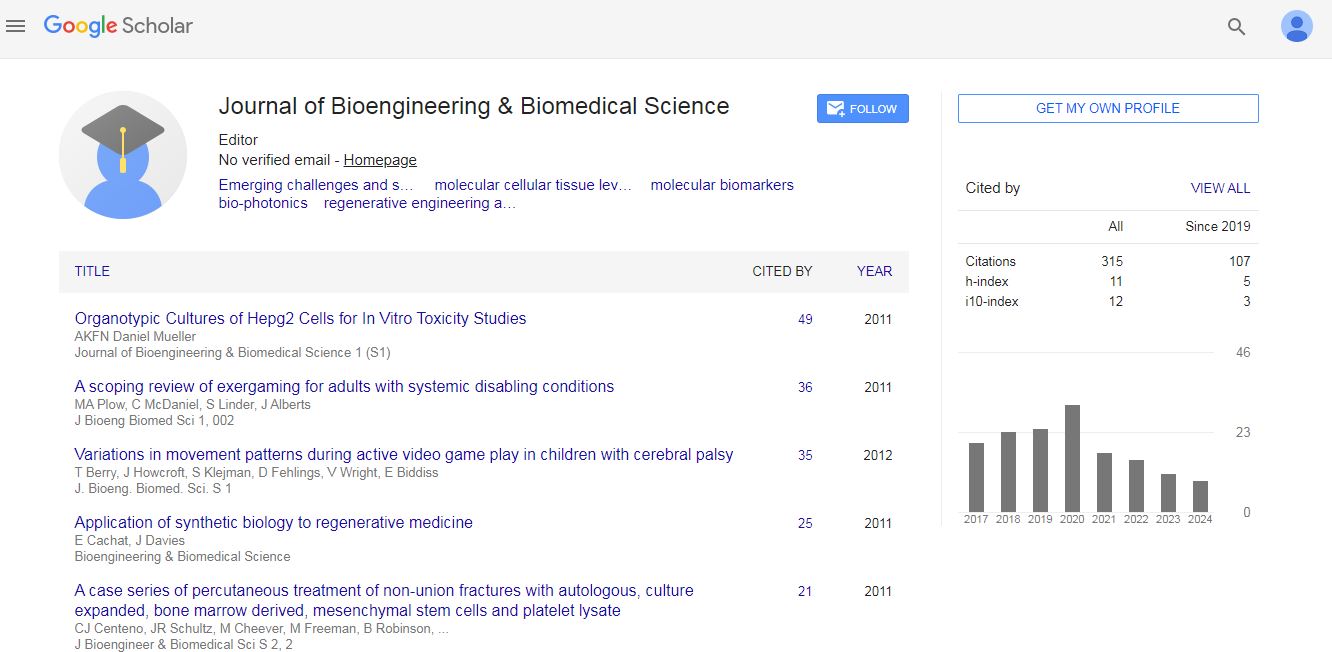
Journal of Bioengineering & Biomedical Science received 307 citations as per Google Scholar report