Perspective - (2025) Volume 15, Issue 6
Received: 01-Nov-2025, Manuscript No. jnt-26-178982;
Editor assigned: 03-Nov-2025, Pre QC No. P-178982;
Reviewed: 17-Nov-2025, QC No. Q-178982;
Revised: 24-Nov-2025, Manuscript No. R-178982;
Published:
29-Nov-2025
, DOI: 10.37421/2161-0959.2025.15.597
Citation: Rensburg, Jacob van. ”AI Revolutionizes Nephrology: Diagnosis, Treatment, Ethics.” J Nephrol Ther 15 (2025):597.
Copyright: © 2025 Rensburg v. Jacob This is an open-access article distributed under the terms of the Creative Commons Attribution License, which permits unrestricted use, distribution and reproduction in any medium, provided the original author and source are credited.
Artificial intelligence (AI) is set to revolutionize the field of nephrology by improving diagnostic precision, personalizing treatment approaches, and enhancing patient outcomes. AI algorithms possess the capability to analyze vast and complex datasets, encompassing electronic health records, medical imaging, and genomic information, thereby enabling the identification of early indicators of kidney disease, the prediction of disease progression trajectories, and the optimization of medication regimens. This transformative technology holds significant promise for streamlining clinical workflows and alleviating the workload faced by healthcare professionals in nephrology [1].
Machine learning models are demonstrating substantial potential in the early identification and risk stratification of chronic kidney disease (CKD). By analyzing routinely collected clinical data, these models can identify individuals at elevated risk of developing CKnditions before clinical signs become evident, thereby facilitating timely interventions and preventive measures. This proactive strategy has the capacity to profoundly alter the natural course of CKD progression [2].
The application of AI in the interpretation of renal histopathology images is emerging as a powerful diagnostic tool. Sophisticated deep learning algorithms are capable of accurately identifying and classifying kidney lesions, which could lead to a reduction in inter-observer variability and an overall improvement in diagnostic efficiency. This advancement promises more consistent and precise diagnoses, particularly in cases presenting with complex pathological features [3].
AI-driven tools are currently being developed with the specific aim of personalizing treatment strategies for patients suffering from kidney diseases. By meticulously analyzing individual patient data, including genetic predispositions and documented treatment responses, AI can assist clinicians in selecting the most effective therapeutic interventions and predicting the likelihood of adverse events. This personalized medical approach is designed to optimize treatment efficacy and minimize the occurrence of side effects [4].
Predicting the onset of acute kidney injury (AKI) represents a critical area where AI can exert a substantial positive impact. Machine learning models are adept at identifying patients who are at a high risk of developing AKI by analyzing various physiological and laboratory parameters, which allows for earlier intervention and potentially averting severe outcomes. The early detection of AKI is paramount for improving patient management and outcomes [5].
AI is actively being explored as a means to optimize fluid and electrolyte management in critically ill patients with kidney conditions. Advanced algorithms can process real-time patient data to provide guidance on fluid resuscitation and electrolyte correction, with the primary objective of preventing fluid overload and electrolyte imbalances, both of which are common and potentially dangerous complications in this vulnerable patient population [6].
The development and implementation of AI-powered decision support systems are poised to assist nephrologists in making more informed and evidence-based clinical decisions. These systems have the capacity to integrate comprehensive patient data with the most current medical literature and established clinical guidelines, thereby offering evidence-based recommendations for the diagnosis, treatment, and overall management of a wide spectrum of kidney conditions [7].
AI holds considerable potential for enhancing the efficiency of hemodialysis treatments. This can be achieved by optimizing treatment parameters and proactively predicting potential complications. Machine learning algorithms can analyze data generated during dialysis sessions to identify patterns associated with inadequate solute clearance or adverse events, enabling timely adjustments to treatment protocols and thereby improving patient safety and overall well-being [8].
The integration of AI into the practice of nephrology introduces a range of important ethical considerations that demand careful attention. These include issues related to data privacy, the potential for algorithmic bias, and the establishment of clear lines of accountability. It is imperative that AI tools are developed and deployed in a responsible, ethical manner, ensuring fairness, transparency, and patient safety, while actively addressing any inherent biases that could potentially exacerbate existing health disparities [9].
The utility of AI in the realm of remote patient monitoring for individuals with kidney disease is progressively expanding. Through the use of wearable devices and sophisticated AI algorithms, it is now possible to continuously track key physiological parameters, enabling timely alerts to healthcare providers regarding potential issues. This facilitates prompt interventions, thereby contributing to a reduction in hospitalizations and an overall improvement in the quality of life for patients managing chronic kidney conditions [10].
Artificial intelligence (AI) is poised to significantly transform the practice of nephrology by offering enhanced diagnostic accuracy, enabling personalized treatment strategies, and ultimately improving patient outcomes. AI algorithms are capable of analyzing complex datasets, including electronic health records, imaging modalities, and genomic information, to facilitate the early identification of kidney disease, predict its progression, and optimize medication plans. This technological advancement promises to streamline clinical workflows and reduce the burden on healthcare professionals [1].
Machine learning models are demonstrating considerable promise in the early detection and risk stratification of chronic kidney disease (CKD). By analyzing routinely collected clinical data, these models can identify individuals at high risk of developing CKD before clinical manifestations become apparent, allowing for timely interventions and preventive measures. This proactive approach has the potential to significantly alter the trajectory of CKD progression [2].
The application of AI in interpreting renal histopathology images is emerging as a powerful tool within diagnostic pathology. Deep learning algorithms have shown the ability to accurately identify and classify kidney lesions, potentially reducing inter-observer variability and improving diagnostic efficiency. This could lead to more consistent and precise diagnoses, particularly in challenging and complex cases [3].
AI-driven tools are being developed to enable the personalization of treatment for patients with kidney diseases. By analyzing individual patient data, including genetic predispositions and historical treatment responses, AI can assist clinicians in selecting the most effective therapies and predicting potential adverse events. This personalized approach aims to optimize treatment outcomes and minimize the incidence of side effects [4].
Predicting acute kidney injury (AKI) is a critical area where AI can make a substantial impact. Machine learning models are being developed to identify patients at high risk of developing AKI based on various physiological and laboratory parameters, allowing for earlier intervention and potentially preventing severe outcomes. Early detection is paramount for improving AKI management [5].
AI is being explored for its potential to optimize fluid and electrolyte management in critically ill patients with kidney disease. Algorithms can analyze real-time patient data to guide fluid resuscitation and electrolyte correction, with the goal of preventing fluid overload and electrolyte imbalances, which are common and dangerous complications in this patient population [6].
The development of AI-powered decision support systems can significantly assist nephrologists in making more informed clinical decisions. These systems are designed to integrate patient-specific data with the latest medical literature and clinical guidelines, providing evidence-based recommendations for the diagnosis, treatment, and management of various kidney conditions [7].
AI has the potential to improve the efficiency and safety of hemodialysis treatments by optimizing treatment parameters and predicting potential complications. Machine learning algorithms can analyze dialysis session data to identify patterns associated with inadequate clearance or adverse events, allowing for proactive adjustments to treatment protocols and enhancing patient safety and well-being [8].
The integration of AI in nephrology raises important ethical considerations that require careful consideration. These include concerns related to data privacy, the potential for algorithmic bias, and the establishment of accountability. It is crucial to develop and implement AI tools in a responsible manner, ensuring fairness, transparency, and patient safety, while actively addressing potential biases that could exacerbate health disparities [9].
The role of AI in remote patient monitoring for kidney disease is continuously expanding. Wearable devices coupled with AI algorithms can continuously track key physiological parameters, alerting healthcare providers to potential issues and enabling timely interventions. This approach can help reduce hospitalizations and improve the quality of life for patients managing chronic kidney conditions [10].
Artificial intelligence (AI) is poised to revolutionize nephrology by enhancing diagnostic accuracy, personalizing treatments, and improving patient outcomes through the analysis of complex datasets. Machine learning models are showing significant promise in the early detection and risk stratification of chronic kidney disease (CKD) and acute kidney injury (AKI), enabling proactive interventions. AI is also proving valuable in interpreting renal histopathology, optimizing fluid and electrolyte management, and improving hemodialysis efficiency. Decision support systems powered by AI can assist clinicians in making more informed decisions, while remote monitoring tools leverage AI to improve patient care and quality of life. However, the integration of AI also brings forth critical ethical considerations regarding data privacy, algorithmic bias, and accountability, necessitating responsible development and implementation to ensure fairness and patient safety.
None
None
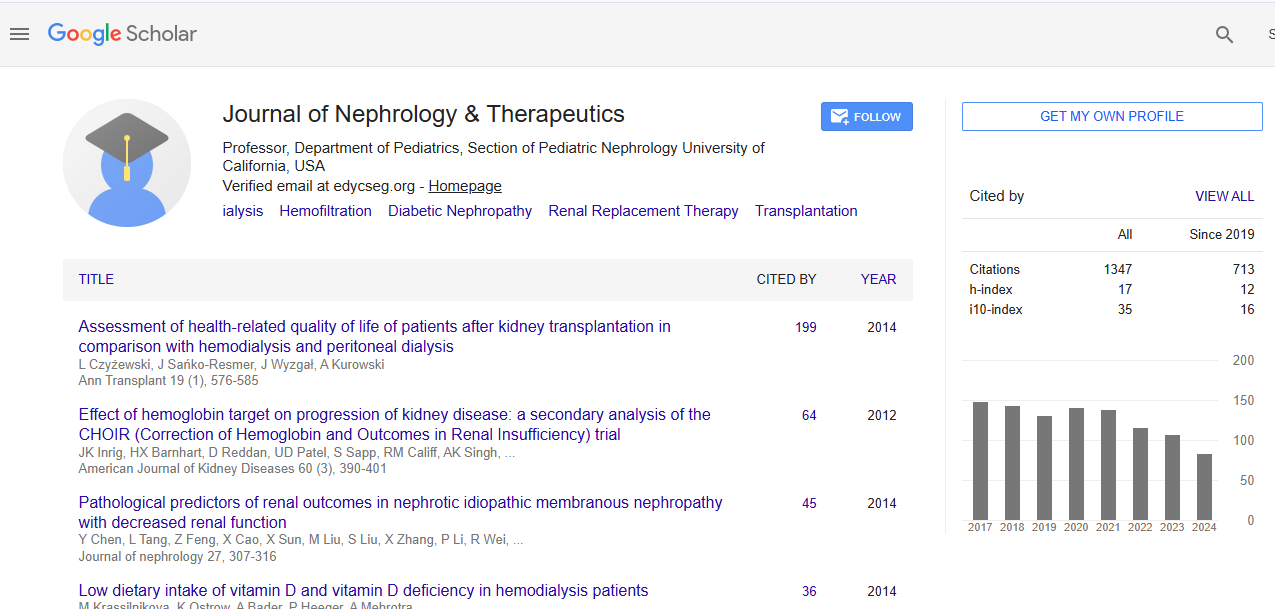
Journal of Nephrology & Therapeutics received 784 citations as per Google Scholar report