Brief Report - (2025) Volume 16, Issue 6
Received: 03-Nov-2025, Manuscript No. jnmrt-26-186395;
Editor assigned: 05-Nov-2025, Pre QC No. P-186395;
Reviewed: 19-Nov-2025, QC No. Q-186395;
Revised: 24-Nov-2025, Manuscript No. R-186395;
Published:
01-Dec-2025
, DOI: 10.37421/2155-9619.2025.16.676
Citation: Silva, Rodrigo. ”AI: Precision Radionuclide Therapy
Dosimetry Advancements.” J Nucl Med Radiat Ther 16 (2025):676.
Copyright: © 2025 Silva R. This is an open-access article distributed under the terms of the Creative Commons Attribution License, which permits unrestricted use, distribution
and reproduction in any medium, provided the original author and source are credited.
The field of radionuclide therapy has witnessed significant advancements, particularly with the integration of artificial intelligence (AI) to enhance precision and efficacy. One of the critical aspects of this therapy is the accurate dosimetry, which involves determining the radiation dose delivered to the tumor and surrounding healthy tissues. AI-driven models are emerging as powerful tools to optimize this process, offering more precise predictions and personalized treatment planning. This article explores the multifaceted applications of AI in improving tumor dosimetry for radionuclide therapy, highlighting its potential to revolutionize patient care. Artificial intelligence is being increasingly applied to optimize tumor dosimetry for radionuclide therapy. AI-driven models are adept at accurately predicting and mapping the distribution of radionuclides within tumors and adjacent healthy tissues. This capability allows for more precise dose calculations, leading to enhanced therapeutic efficacy while concurrently minimizing off-target toxicity. The primary focus lies in augmenting treatment planning by synergizing AI with imaging data to achieve personalized radionuclide delivery [1].
Machine learning algorithms are being investigated for their ability to predict the absorbed dose to organs at risk from radiopharmaceutical therapy. These AI models analyze patient-specific imaging and treatment data to provide more accurate dose estimations than traditional methods. This advancement in dosimetry can effectively guide treatment decisions, reduce unnecessary radiation exposure to healthy organs, and ultimately improve patient outcomes in targeted radionuclide therapy [2].
A novel approach to modeling radionuclide biodistribution utilizing deep learning, specifically convolutional neural networks (CNNs), has been presented. These models are trained on SPECT/CT imaging data to predict time-activity curves in both tumors and organs. This facilitates a more dynamic and patient-specific dosimetry calculation, which is paramount for optimizing therapeutic regimens and ensuring radiation safety in nuclear medicine [3].
The integration of quantitative imaging techniques with AI is a key focus for improving tumor response prediction in peptide receptor radionuclide therapy (PRRT). AI models analyze serial PET/CT scans to predict treatment response and guide dosimetry adjustments. This personalized approach aims to maximize therapeutic effect and minimize toxicity by adapting the radionuclide dose based on real-time tumor uptake and clearance [4].
The development of AI-powered software for automated tumor segmentation and dose calculation in radionuclide therapy is streamlining the dosimetry workflow. This automation reduces inter-observer variability and enhances the efficiency of treatment planning. AI models learn from extensive datasets to accurately delineate tumor volumes and estimate absorbed doses, contributing to more consistent and effective therapeutic outcomes [5].
Research is exploring the potential of AI in predicting patient-specific radionuclide uptake and retention in tumors, with the goal of optimizing treatment planning. By analyzing factors such as tumor biology, imaging characteristics, and patient physiology, AI models can provide more accurate predictions of absorbed dose distribution. This personalized dosimetry approach is essential for maximizing tumor control while minimizing toxicity to surrounding healthy tissues [6].
The role of AI in enhancing the accuracy of voxel-based dosimetry for radionuclide therapy is being examined. AI algorithms process complex 3D imaging data to generate more precise maps of radiation dose distribution at the voxel level. This granular approach to dosimetry allows for a more accurate assessment of the dose delivered to both the tumor and critical organs, facilitating a more refined optimization of treatment plans [7].
An AI framework is proposed to predict the impact of various radionuclide therapy regimens on tumor shrinkage and normal tissue complication probability. By simulating treatment outcomes based on predicted radionuclide distribution and dosimetry, AI can assist clinicians in selecting optimal treatment strategies for individual patients. The emphasis is on achieving a balance between tumor eradication and the minimization of long-term side effects [8].
Federated learning is being investigated for radionuclide dosimetry, enabling AI models to be trained across multiple institutions without sharing sensitive patient data. This approach improves the robustness and generalizability of AI-based dosimetry models. By aggregating insights from diverse datasets, these models can more accurately predict radionuclide distribution and optimize tumor targeting in radionuclide therapy [9].
An essential aspect of integrating AI into clinical practice is the validation of AI models for radionuclide biodistribution and dosimetry against clinical data. Rigorous validation ensures the reliability of AI-driven predictions, supporting their incorporation into clinical workflows for more precise tumor dosimetry and personalized treatment planning [10].
The application of artificial intelligence in optimizing tumor dosimetry for radionuclide therapy represents a significant leap forward in precision medicine. AI-driven models are proving instrumental in accurately predicting and mapping the distribution of radionuclides within tumors and surrounding healthy tissues. This advanced modeling capability enables more precise dose calculations, which is crucial for enhancing therapeutic efficacy while simultaneously mitigating off-target toxicity. The core objective is to elevate treatment planning by integrating AI with existing imaging data to achieve truly personalized radionuclide delivery strategies [1].
Machine learning algorithms are being extensively investigated for their potential to predict the absorbed dose delivered to organs at risk during radiopharmaceutical therapy. Through the analysis of patient-specific imaging and treatment data, these AI models aim to achieve greater accuracy in dose estimations compared to conventional methodologies. Such enhanced dosimetry precision can significantly guide treatment decisions, reduce cumulative radiation exposure to healthy organs, and ultimately lead to improved patient outcomes in the context of targeted radionuclide therapy [2].
A novel methodology employing deep learning, specifically convolutional neural networks (CNNs), has been developed for modeling radionuclide biodistribution in nuclear medicine. These sophisticated models are trained using SPECT/CT imaging data to accurately predict time-activity curves within tumors and critical organs. This advancement supports a more dynamic and patient-specific approach to dosimetry calculation, which is indispensable for optimizing therapeutic regimens and ensuring robust radiation safety protocols in nuclear medicine practices [3].
The synergistic integration of quantitative imaging techniques with artificial intelligence is a pivotal strategy for enhancing the prediction of tumor response in peptide receptor radionuclide therapy (PRRT). AI models are designed to analyze serial PET/CT scans, enabling them to predict treatment responses and inform necessary dosimetry adjustments. This personalized treatment paradigm seeks to maximize therapeutic benefits and minimize adverse effects by adapting the radionuclide dose in real-time based on tumor uptake and clearance dynamics [4].
The creation of AI-powered software dedicated to automated tumor segmentation and dose calculation in radionuclide therapy is significantly streamlining the clinical workflow. This automation effectively reduces inter-observer variability, a common challenge in medical imaging, and enhances the overall efficiency of treatment planning. The AI models are trained on extensive datasets, allowing them to accurately delineate tumor volumes and precisely estimate absorbed doses, thereby contributing to more consistent and impactful therapeutic outcomes [5].
Ongoing research is focused on harnessing the predictive power of AI to forecast patient-specific radionuclide uptake and retention within tumors, with the ultimate goal of optimizing treatment plans. By meticulously analyzing a range of factors, including tumor biology, intricate imaging characteristics, and individual patient physiology, AI models are capable of generating highly accurate predictions of absorbed dose distribution. This personalized dosimetry approach is fundamental to achieving maximal tumor control while effectively minimizing radiation-induced damage to surrounding healthy tissues [6].
The critical role of artificial intelligence in refining the accuracy of voxel-based dosimetry for radionuclide therapy is under thorough examination. AI algorithms are adept at processing complex three-dimensional imaging data to generate exceptionally precise maps of radiation dose distribution at the voxel level. This high-resolution approach to dosimetry enables a more detailed assessment of the radiation dose delivered to both the tumorous region and adjacent critical organs, thereby facilitating a more nuanced and effective optimization of treatment plans [7].
A comprehensive AI framework has been proposed to forecast the impact of diverse radionuclide therapy regimens on tumor shrinkage rates and the probability of normal tissue complications. By simulating potential treatment outcomes based on predicted radionuclide distribution and dosimetry, this AI framework can provide clinicians with valuable insights to select the most appropriate treatment strategy for each patient. The overarching goal is to strike an optimal balance between achieving complete tumor eradication and minimizing the occurrence of long-term adverse effects [8].
The application of federated learning in the realm of radionuclide dosimetry presents a promising solution for training AI models across multiple institutions while rigorously maintaining the privacy and security of sensitive patient data. This innovative approach enhances the robustness and generalizability of AI-based dosimetry models. By leveraging collective knowledge from diverse datasets, these models can achieve superior accuracy in predicting radionuclide distribution and optimizing tumor targeting within radionuclide therapy protocols [9].
A crucial step in the clinical adoption of AI tools for radionuclide therapy is the rigorous validation of AI models for radionuclide biodistribution and dosimetry against actual clinical data. Such validation is paramount for ensuring the reliability and trustworthiness of AI-driven predictions. Successful validation paves the way for the seamless integration of these AI tools into routine clinical practice, enabling more precise tumor dosimetry and facilitating truly personalized treatment planning [10].
Artificial intelligence (AI) is significantly advancing tumor dosimetry in radionuclide therapy by enabling more precise prediction and mapping of radionuclide distribution. AI-driven models enhance therapeutic efficacy and minimize toxicity through personalized treatment planning, integrating with imaging data to optimize radionuclide delivery. Machine learning algorithms are improving absorbed dose estimations to organs at risk, guiding treatment decisions and reducing radiation exposure. Deep learning, particularly CNNs, is used for dynamic, patient-specific dosimetry by modeling biodistribution. AI also aids in predicting tumor response in PRRT and automating tumor segmentation and dose calculation, reducing variability and increasing efficiency. Predictive AI models forecast patient-specific radionuclide uptake for optimized dosimetry, crucial for maximizing tumor control and minimizing damage to healthy tissues. Voxel-based dosimetry is enhanced by AI's ability to process 3D imaging data for precise dose distribution maps. AI frameworks simulate therapy outcomes to help select optimal treatment strategies, balancing tumor eradication with reduced side effects. Federated learning improves AI dosimetry models by enabling multi-institutional training without compromising data privacy. Rigorous validation of AI models against clinical data is essential for their reliable integration into practice, ensuring precise dosimetry and personalized treatment.
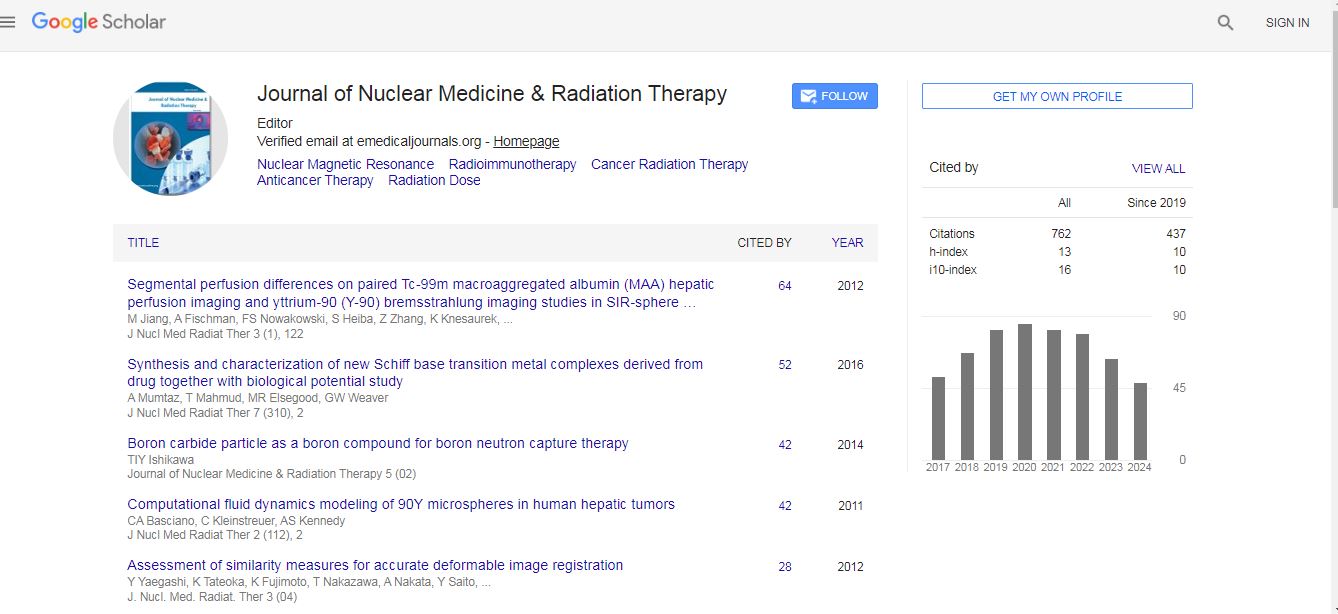
Nuclear Medicine & Radiation Therapy received 706 citations as per Google Scholar report