Short Communication - (2025) Volume 16, Issue 4
Received: 01-Aug-2025, Manuscript No. jbsbe-26-183313;
Editor assigned: 04-Aug-2025, Pre QC No. P-183313;
Reviewed: 18-Aug-2025, QC No. Q-183313;
Revised: 22-Aug-2025, Manuscript No. R-183313;
Published:
29-Aug-2025
, DOI: 10.37421/2165-6210.2025.16.519
Citation: Torres-Vega, Miguel. ”AI Enhancing Biosensor Data Interpretation for Diagnostics.” J Biosens Bioelectron 16 (2025):519.
Copyright: © 2025 Torres-Vega M. This is an open-access article distributed under the terms of the Creative Commons Attribution License, which permits unrestricted use, distribution and reproduction in any medium, provided the original author and source are credited.
Artificial Intelligence (AI) is revolutionizing the interpretation of complex signals generated by biosensors, offering enhanced accuracy and speed in analyzing biological data [1].
Machine learning algorithms are at the forefront of this transformation, enabling the detection of subtle patterns often missed by traditional methods, which is crucial for real-time diagnostics and personalized health monitoring [1].
The integration of AI with wearable biosensors is particularly promising for continuous health data streams, facilitating non-invasive health assessment systems [3].
Deep learning techniques, such as Convolutional Neural Networks (CNNs) and Recurrent Neural Networks (RNNs), are proving effective in decoding electrochemical biosensor data by learning intricate features from raw outputs [2].
This advancement leads to improved sensitivity and selectivity in identifying disease markers, paving the way for better point-of-care diagnostics [2].
AI is also vital for optimizing the performance of optical biosensors, where algorithms can calibrate sensors and compensate for environmental drifts, making them more robust for applications like food safety [5].
Furthermore, AI-driven interpretation of DNA hybridization signals in biosensors is enabling high-accuracy distinction between specific genetic sequences, a significant leap for rapid diagnostic tools [4].
The application of AI extends to processing complex protein-protein interaction data from biosensor arrays, accelerating the identification of binding patterns crucial for understanding cellular processes and drug development [6].
AI is also employed for signal preprocessing in microfluidic biosensors, effectively handling non-linearity and drift to improve measurement reliability in miniaturized devices [7].
In the realm of impedance spectroscopy, AI algorithms are identifying subtle electrical impedance changes for early disease detection, leading to more accurate diagnoses [8].
Surface Plasmon Resonance (SPR) biosensors benefit from AI in analyzing binding kinetics and affinity data, significantly streamlining drug screening processes by efficiently handling vast datasets [9].
Overall, AI's role in interpreting diverse biosensor signals is critical for improving sensitivity, selectivity, and enabling real-time analysis across various applications, heralding a future of more autonomous biosensing systems [10].
The transformative role of Artificial Intelligence (AI) in interpreting biosignals from biosensors is underscored by its ability to enhance accuracy and speed, particularly through machine learning algorithms that detect subtle patterns [1].
This technological advancement is pivotal for real-time diagnostics and personalized health monitoring, as AI can improve the signal-to-noise ratio and classify diverse bio-signals with high precision [1].
The integration of AI with wearable biosensors allows for continuous health data streams, supporting the development of sophisticated, non-invasive health assessment systems for chronic disease management [3].
Deep learning models, including CNNs and RNNs, are adept at decoding electrochemical biosensor data, learning complex features from raw sensor outputs to improve biomarker detection and enable advanced point-of-care diagnostics [2].
AI's utility extends to optimizing optical biosensors by facilitating sensor calibration and compensating for environmental variations, thereby increasing their robustness for applications in food safety and environmental monitoring [5].
In the context of DNA hybridization detection, machine learning models excel at accurately distinguishing specific genetic sequences within complex biological samples, offering a significant improvement for rapid and reliable diagnostic tools [4].
For protein-protein interaction analysis, AI algorithms are crucial for interpreting intricate binding patterns and affinities from biosensor arrays, accelerating research in cellular processes and targeted therapies [6].
Signal preprocessing in microfluidic biosensors is also significantly improved by AI, which effectively manages non-linearity and drift, thereby enhancing the reliability of measurements from miniaturized devices [7].
AI's capacity to interpret impedance spectroscopy data enables early disease detection by identifying subtle changes related to cellular responses or biomarker presence, leading to more precise diagnoses [8].
Furthermore, AI plays a key role in analyzing the extensive datasets generated by SPR biosensors during drug screening, efficiently identifying potential drug candidates by examining binding kinetics and affinity [9].
Collectively, these applications highlight AI's indispensable contribution to interpreting complex biosignals across a wide range of biosensor modalities, promising more sensitive, selective, and intelligent biosensing systems for diverse fields [10].
Artificial Intelligence (AI) is fundamentally changing how biosensor data is interpreted, enhancing accuracy, speed, and the detection of subtle patterns. Machine learning and deep learning algorithms, including CNNs and RNNs, are being applied across various biosensor types, such as electrochemical, optical, DNA hybridization, and SPR sensors. This integration facilitates real-time diagnostics, personalized health monitoring, and efficient drug discovery. AI helps in signal preprocessing, calibration, and noise filtering, improving the reliability and sensitivity of biosensing systems. Key applications include early disease detection, pathogen identification, and continuous health monitoring through wearable devices. The advancements promise more autonomous and intelligent biosensing solutions for healthcare, environmental monitoring, and food safety.
None
None
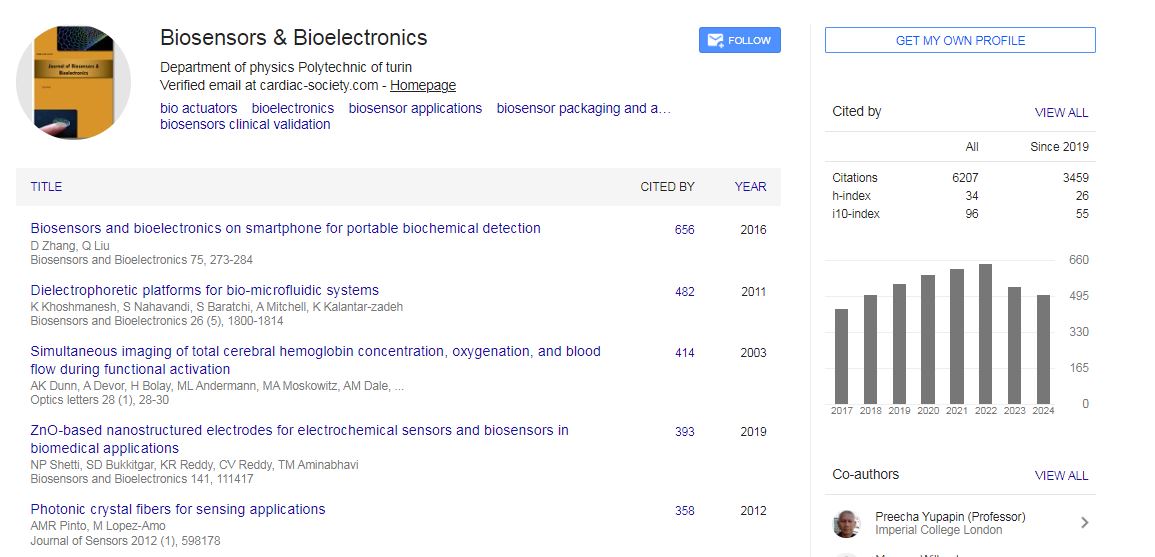
Biosensors & Bioelectronics received 6207 citations as per Google Scholar report