Commentary - (2025) Volume 15, Issue 5
Received: 02-Oct-2025, Manuscript No. jeat-26-188649;
Editor assigned: 06-Oct-2025, Pre QC No. P-188649;
Reviewed: 20-Oct-2025, QC No. Q-188649;
Revised: 23-Oct-2025, Manuscript No. R-188649;
Published:
30-Oct-2025
, DOI: 10.37421/2161-0525.2025.15.869
Citation: Costa, Isabella. ”Agricultural Runoff Pollutants: Detection,
Fate, and Mitigation.” J Environ Anal Toxicol 15 (2025):869.
Copyright: © 2025 Costa I. This is an open-access article distributed under the terms of the Creative Commons Attribution License, which permits unrestricted use, distribution
and reproduction in any medium, provided the original author and source are credited.
Agricultural runoff represents a significant conduit for the transport of various pollutants into aquatic ecosystems, posing substantial environmental and health risks. This research compilation delves into the complex landscape of contaminants found in agricultural drainage, exploring their sources, detection, impact, and mitigation strategies. One crucial aspect of this research is the investigation into the environmental fate and impact of specific toxic pollutants, such as pesticides and heavy metals, commonly found in agricultural runoff. It highlights the challenges in monitoring these contaminants, emphasizing the need for advanced analytical techniques to detect low concentrations and complex mixtures. The research underscores the significant threat these pollutants pose to aquatic ecosystems and human health, advocating for improved agricultural practices and regulatory frameworks to mitigate contamination [1].
Further contributing to the understanding of heavy metal contamination, a study presents a novel approach for the simultaneous determination of multiple heavy metals in agricultural runoff using inductively coupled plasma-mass spectrometry (ICP-MS). It details the sample preparation methods and analytical validation, demonstrating high sensitivity and accuracy. The findings reveal elevated levels of lead and cadmium in the studied regions, correlating with specific agricultural activities and raising concerns about their bioaccumulation potential [2].
The pervasive issue of pesticide contamination is addressed by a research focus on the occurrence and ecological impact of neonicotinoid pesticides in surface waters impacted by agricultural practices. Using liquid chromatography-tandem mass spectrometry (LC-MS/MS), the study quantifies various neonicotinoids and assesses their toxicity to non-target aquatic organisms. The results indicate widespread contamination and highlight the need for a re-evaluation of current pesticide use regulations [3].
Addressing the complexities of monitoring, an article explores the application of passive sampling techniques for long-term monitoring of organic pollutants in agricultural runoff. It compares the effectiveness of different passive samplers in capturing persistent organic pollutants (POPs) and evaluates the advantages over traditional grab sampling. The study emphasizes the value of passive sampling in understanding the temporal variability and bioavailability of pollutants [4].
The spatio-temporal dynamics of polycyclic aromatic hydrocarbons (PAHs) in agricultural runoff are examined in another paper, identifying key sources and transport pathways. It utilizes gas chromatography-mass spectrometry (GC-MS) for analysis and employs statistical methods to interpret the data. The findings highlight the contribution of both pyrogenic and petrogenic sources to PAH contamination [5].
Beyond identifying pollutants, research also evaluates the effectiveness of constructed wetlands in mitigating the pollution load of agricultural runoff, specifically focusing on nutrient and pesticide removal. It analyzes water quality parameters before and after treatment, demonstrating significant reductions in contaminant concentrations. The research supports the use of constructed wetlands as a sustainable and cost-effective solution [6].
The emergence of new contaminants in agricultural systems is a growing concern, prompting an investigation into the presence and characteristics of emerging contaminants, such as pharmaceuticals and personal care products (PPCPs), in agricultural drainage systems. Employing high-resolution mass spectrometry, the study identifies a range of PPCPs and discusses their potential ecological effects. It highlights the need for monitoring and managing these less-studied pollutants [7].
Innovative detection methods are also explored, with research exploring the use of biosensors for rapid and on-site detection of organophosphate pesticides in agricultural runoff. It details the development and validation of a biosensor based on enzyme inhibition. The study demonstrates the potential of biosensors for field monitoring, offering a cost-effective and user-friendly alternative to traditional laboratory methods [8].
Furthermore, the influence of atmospheric processes on agricultural water quality is investigated. An article examines the atmospheric deposition of heavy metals and its contribution to soil and water contamination in agricultural areas. It uses isotopic analysis and modeling to trace the sources of atmospheric deposition. The findings indicate that while agricultural practices are a major source of runoff pollution, atmospheric transport also plays a significant role in contaminant distribution [9].
Finally, remediation strategies for persistent pollutants are assessed. Research evaluates the efficacy of bioremediation strategies for removing organochlorine pesticides from agricultural runoff. It investigates the role of microbial communities in degrading these persistent pollutants and assesses the impact of different environmental conditions on the remediation process. The study suggests that targeted bioremediation approaches can be a sustainable way to address organochlorine contamination [10].
The pervasive issue of agricultural runoff necessitates a comprehensive understanding of the pollutants it carries and their environmental ramifications. This collection of research addresses this need by examining various contaminants and their behaviors within agricultural water systems. One foundational study delves into the characterization and environmental risk assessment of pesticide residues in agricultural drainage water. This research highlights the intricate challenges associated with monitoring these substances, emphasizing the critical role of advanced analytical techniques in detecting low concentrations and complex mixtures. The findings underscore the substantial risks posed by these pollutants to aquatic life and human well-being, advocating for policy changes and improved farming methods to curb contamination [1].
Complementing the understanding of chemical contaminants, a separate study focuses on the analytical challenges of heavy metals. It introduces a novel methodology for the simultaneous detection of multiple heavy metals in agricultural runoff, utilizing inductively coupled plasma-mass spectrometry (ICP-MS). The detailed sample preparation and validation confirm the method's high sensitivity and accuracy, revealing concerning levels of lead and cadmium in specific agricultural zones, which are linked to farming activities and raise alarms regarding bioaccumulation potential [2].
Addressing a specific class of pesticides, another research effort concentrates on the presence and ecological consequences of neonicotinoid insecticides within surface waters affected by agriculture. Through the application of liquid chromatography-tandem mass spectrometry (LC-MS/MS), the study quantifies diverse neonicotinoids and evaluates their toxic effects on non-target aquatic organisms. The widespread detection of these compounds indicates a significant need to reassess current regulations governing pesticide usage [3].
In the realm of environmental monitoring, a comparative study investigates the utility of passive sampling techniques for sustained observation of organic pollutants in agricultural runoff. This research evaluates the performance of different passive samplers for capturing persistent organic pollutants (POPs), noting their advantages over conventional grab sampling methods. The findings underscore the importance of passive sampling for discerning temporal variations and the bioavailable fractions of pollutants [4].
Furthermore, the spatio-temporal distribution and sources of polycyclic aromatic hydrocarbons (PAHs) in agricultural runoff are explored. Employing gas chromatography-mass spectrometry (GC-MS) and statistical analysis, the study identifies primary sources and transport mechanisms of PAHs, distinguishing between pyrogenic and petrogenic origins of contamination [5].
The practical application of ecological engineering for pollution control is demonstrated in research assessing the efficiency of constructed wetlands in treating agricultural runoff. The study focuses on the removal of nutrients and pesticides, providing data on water quality improvements before and after treatment. The results advocate for constructed wetlands as an economically viable and sustainable pollution management tool [6].
An emerging area of concern is the presence of novel contaminants in agricultural drainage systems, specifically pharmaceuticals and personal care products (PPCPs). Using high-resolution mass spectrometry, this research identifies various PPCPs and discusses their potential ecological impacts, highlighting the urgent necessity for monitoring and managing these often-overlooked pollutants [7].
Advancements in analytical technology are also highlighted through the development of biosensors for the rapid, on-site detection of organophosphate pesticides in agricultural runoff. The study details the creation and validation of an enzyme inhibition-based biosensor, presenting it as a cost-effective and user-friendly alternative to traditional laboratory analyses for field applications [8].
While agricultural practices are primary sources of runoff pollution, atmospheric deposition also contributes significantly to contaminant loads. Research examining the atmospheric deposition of heavy metals in agricultural watersheds utilizes isotopic analysis and modeling to trace sources and pathways, demonstrating its role in overall contamination distribution [9].
Finally, the potential of bioremediation for tackling persistent pollutants is explored. A study evaluates the effectiveness of microbial communities in degrading organochlorine pesticides found in agricultural runoff, assessing how different environmental conditions influence this process. The research supports bioremediation as a sustainable strategy for managing organochlorine contamination [10].
This compilation of research examines various pollutants found in agricultural runoff, including pesticides, heavy metals, and emerging contaminants like pharmaceuticals. Studies explore advanced analytical techniques such as ICP-MS, LC-MS/MS, and GC-MS for contaminant detection and quantification. The environmental fate, ecological risks, and spatio-temporal distribution of these pollutants are investigated. Additionally, the research highlights innovative monitoring methods like passive sampling and biosensors, as well as mitigation strategies such as constructed wetlands and bioremediation. The findings underscore the need for improved agricultural practices, regulatory frameworks, and continued research to address the complex challenges posed by agricultural runoff.
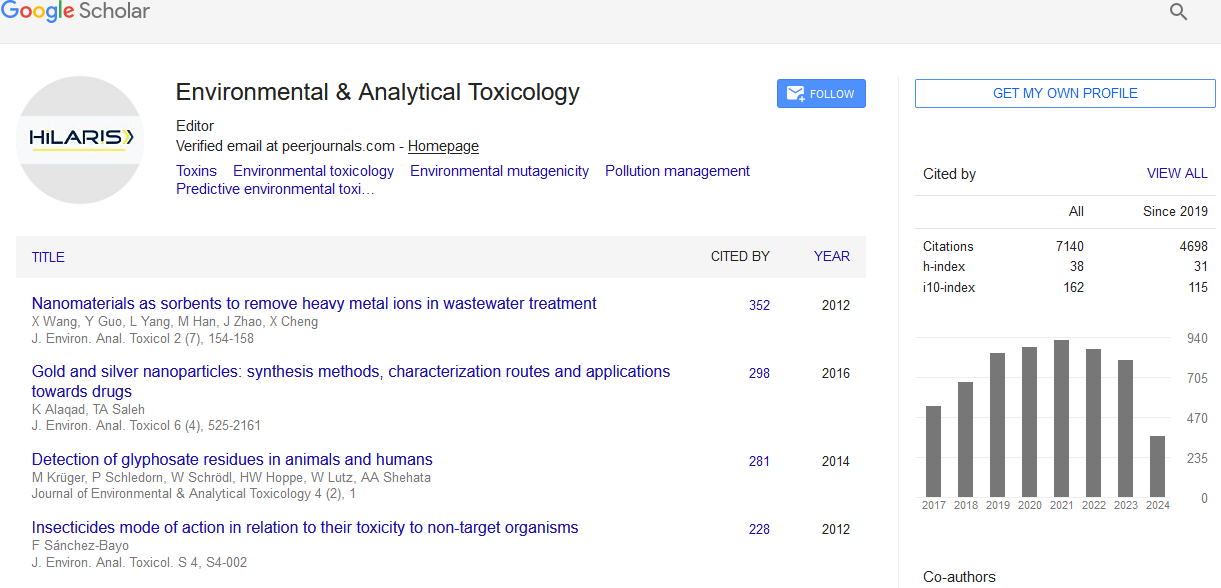
Environmental & Analytical Toxicology received 6818 citations as per Google Scholar report