Brief Report - (2025) Volume 14, Issue 6
Received: 01-Dec-2025, Manuscript No. jsp-26-182285;
Editor assigned: 03-Dec-2025, Pre QC No. P-182285;
Reviewed: 17-Dec-2025, QC No. Q-182285;
Revised: 22-Dec-2025, Manuscript No. R-182285;
Published:
29-Dec-2025
, DOI: 10.37421/2165-7939.2025.14.751
Citation: Novak, Tomáš V.. ”Aging Spine: Causes, Management, and Impact.” J Spine 14 (2025):751.
Copyright: © 2025 Novak V. Tomáš This is an open-access article distributed under the terms of the Creative Commons Attribution License, which permits unrestricted use, distribution and reproduction in any medium, provided the original author and source are credited.
Degenerative spine disease is an intrinsic aspect of the aging process, characterized by the gradual breakdown of vital spinal structures such as intervertebral discs and facet joints. This degenerative cascade can precipitate a range of conditions, including herniated discs, spinal stenosis, and osteoarthritis, often manifesting as debilitating pain, significant stiffness, and a pronounced reduction in overall mobility. While the inexorable march of aging serves as a primary driver for these changes, a complex interplay of genetic predispositions, individual lifestyle choices, and the cumulative impact of prior injuries can significantly influence both the severity and the progression rate of these spinal alterations. Consequently, contemporary management strategies are increasingly evolving to prioritize non-operative treatment modalities, encompassing comprehensive physical therapy, targeted pain management interventions, and the application of minimally invasive procedures, with surgical interventions being reserved for highly specific and recalcitrant cases. Delving deeper into the cellular and molecular underpinnings of disc degeneration in older adults, current research highlights the critical role of chondrocyte senescence and dysregulated matrix production. These age-related cellular changes are intrinsically linked to inflammatory processes and oxidative stress, both of which contribute substantially to the progressive breakdown of the extracellular matrix within the intervertebral discs. This matrix degradation ultimately leads to a significant loss of disc height and impaired spinal function, presenting a complex challenge for maintaining mobility and comfort. The exploration of therapeutic avenues that specifically target these identified cellular pathways is thus emerging as a promising frontier for potential interventions aimed at mitigating or reversing disc degeneration. Examining the multifaceted impact of aging on the development and progression of spinal stenosis, current literature provides a comprehensive review of contemporary diagnostic approaches and established treatment paradigms. The multifactorial etiology of spinal stenosis, particularly in the elderly demographic, is emphasized, frequently involving a confluence of degenerative changes affecting the intervertebral discs, facet joints, and supporting ligaments. Conservative management strategies, which typically include tailored exercise regimens and judicious pharmacotherapy, are thoroughly discussed alongside surgical options that are generally considered for cases exhibiting severe symptomatology or significant functional impairment. This significant body of research actively investigates the intricate relationship between modifiable lifestyle factors and the incidence of degenerative spine disease, particularly within an aging population. A consistent theme emerging from these studies is the detrimental influence of sedentary behavior, obesity, and suboptimal nutrition in accelerating the degenerative processes within the spine. Conversely, the adoption of regular physical activity and a commitment to a healthy dietary pattern appear to confer protective effects, potentially slowing the rate of degeneration. The findings strongly advocate for the implementation of comprehensive lifestyle interventions as a crucial component of preventative care and disease management. Advancements in medical imaging technologies represent a cornerstone in the accurate diagnosis of degenerative spine disease, especially in the context of the aging population. Significant focus is placed on sophisticated modalities such as Magnetic Resonance Imaging (MRI) and Computed Tomography (CT) scans. These powerful diagnostic tools enable clinicians to precisely visualize the specific degenerative changes occurring within the spinal structures, thereby facilitating more informed and targeted treatment decisions. The continuous evolution of these imaging techniques promises earlier and more precise diagnoses, ultimately contributing to improved patient outcomes and management strategies. The pivotal role of physical therapy and comprehensive rehabilitation programs in the effective management of degenerative spine disease associated with the aging process is thoroughly explored. This literature outlines a range of evidence-based exercise protocols and manual therapy techniques meticulously designed to enhance muscular strength, improve joint flexibility, and augment overall functional capacity. A critical emphasis is placed on the necessity of developing and implementing individualized rehabilitation plans tailored to the unique needs and capabilities of older patients, recognizing that a one-size-fits-all approach is rarely optimal. Pharmacological interventions form a critical component of managing the pain and inflammation frequently associated with degenerative spine disease in aging individuals. This body of work meticulously discusses various classes of medications, including Non-Steroidal Anti-Inflammatory Drugs (NSAIDs), potent analgesics, and agents used for treating neuropathic pain. Crucially, the potential benefits and inherent side effects of these medications in the elderly population are carefully considered, underscoring the importance of a cautious, individualized, and closely monitored approach to pharmacotherapy to optimize efficacy while minimizing risks. Exploration into the realm of minimally invasive surgical techniques offers a promising avenue for treating degenerative spine conditions in the elderly population. This advanced surgical approach highlights procedures such as minimally invasive spinal decompression and fusion, emphasizing their significant advantages over traditional open surgeries. These benefits include a marked reduction in patient morbidity, shorter hospital stays, and accelerated recovery times, allowing individuals to return to daily activities more quickly. Furthermore, the critical patient selection criteria for these advanced procedures are meticulously detailed to ensure optimal outcomes. This area of research rigorously investigates the potential genetic predispositions that may significantly influence both the rate of onset and the ultimate severity of degenerative spine disease as individuals age. The studies explore the complex interplay between inherited genetic factors and various environmental influences, positing that individuals possessing specific genetic profiles may exhibit a heightened susceptibility to the development of age-related spinal degeneration. Understanding these genetic underpinnings could pave the way for personalized risk assessment and targeted preventative strategies. Finally, the profound psychosocial impact of degenerative spine disease on the overall quality of life experienced by older adults is a critical area of examination. This includes a detailed assessment of how chronic pain, persistent functional limitations, and the emotional toll of the condition affect mental health, social engagement, and an individual's general sense of well-being. The discussion also presents and evaluates various strategies aimed at enhancing psychosocial support systems and bolstering patient coping mechanisms to improve their resilience and life satisfaction.
Degenerative spine disease represents an inherent consequence of the aging process, marked by the progressive deterioration of spinal components like intervertebral discs and facet joints. This breakdown can lead to conditions such as herniated discs, spinal stenosis, and osteoarthritis, which clinically present as pain, stiffness, and diminished mobility. While aging is the primary factor, genetic makeup, lifestyle habits, and prior injuries also play a role in the disease's severity and progression. Current management focuses on non-surgical approaches like physical therapy, pain management, and minimally invasive procedures, reserving surgery for select cases [1].
Research into the cellular and molecular mechanisms of disc degeneration in the elderly highlights chondrocyte senescence and altered matrix production. Age-related inflammation and oxidative stress significantly contribute to extracellular matrix breakdown, resulting in reduced disc height and function. Therapeutic strategies targeting these cellular pathways are being investigated as potential interventions [2].
The impact of aging on spinal stenosis is a key focus, with reviews covering diagnostic methods and treatment strategies. Spinal stenosis in the elderly is often multifactorial, involving degenerative changes in discs, facet joints, and ligaments. Conservative treatments like exercise and medication are discussed alongside surgical options for severe cases [3].
Studies are examining the connection between lifestyle and degenerative spine disease in older adults. Sedentary behavior, obesity, and poor nutrition accelerate degeneration, while regular exercise and a healthy diet may offer protection. The research advocates for comprehensive lifestyle interventions [4].
Advancements in imaging techniques, specifically MRI and CT scans, are crucial for diagnosing degenerative spine disease in the aging population. These technologies help visualize degenerative changes and guide treatment decisions, leading to earlier and more precise diagnoses for better patient outcomes [5].
Physical therapy and rehabilitation are vital for managing age-related degenerative spine disease. Evidence-based exercise programs and manual therapy aim to improve strength, flexibility, and function. Individualized rehabilitation plans are emphasized for older patients [6].
Pharmacological management of pain and inflammation in degenerative spine disease among the elderly is explored. Various drug classes, including NSAIDs, analgesics, and neuropathic pain agents, are discussed concerning their benefits and side effects in this population. A cautious and personalized approach to medication is stressed [7].
Minimally invasive surgical techniques for degenerative spine disease in the elderly are gaining prominence. Procedures like minimally invasive decompression and fusion offer benefits such as reduced morbidity and faster recovery compared to traditional open surgeries. Patient selection criteria are also detailed [8].
Genetic factors influencing the rate and severity of age-related degenerative spine disease are under investigation. The interplay between genetics and environmental factors suggests that certain genetic profiles may increase susceptibility to spinal degeneration with aging [9].
The psychosocial effects of degenerative spine disease on the quality of life in older adults are examined. This includes the impact of chronic pain and functional limitations on mental health and social engagement. Strategies for improving psychosocial support and coping mechanisms are presented [10].
Degenerative spine disease is a natural part of aging, affecting spinal structures like discs and joints, leading to pain and mobility issues. Factors like genetics and lifestyle influence its progression. Management typically involves non-surgical treatments such as physical therapy and pain management, with surgery reserved for severe cases. Research highlights cellular mechanisms, the role of inflammation, and the impact of lifestyle choices on spinal health. Advanced imaging aids diagnosis, while rehabilitation and pain management strategies are crucial for improving function and quality of life. Minimally invasive surgery offers an alternative for specific conditions, and genetic factors may play a role in susceptibility. The psychosocial impact on older adults is also a significant consideration, with strategies focused on support and coping mechanisms.
None
None
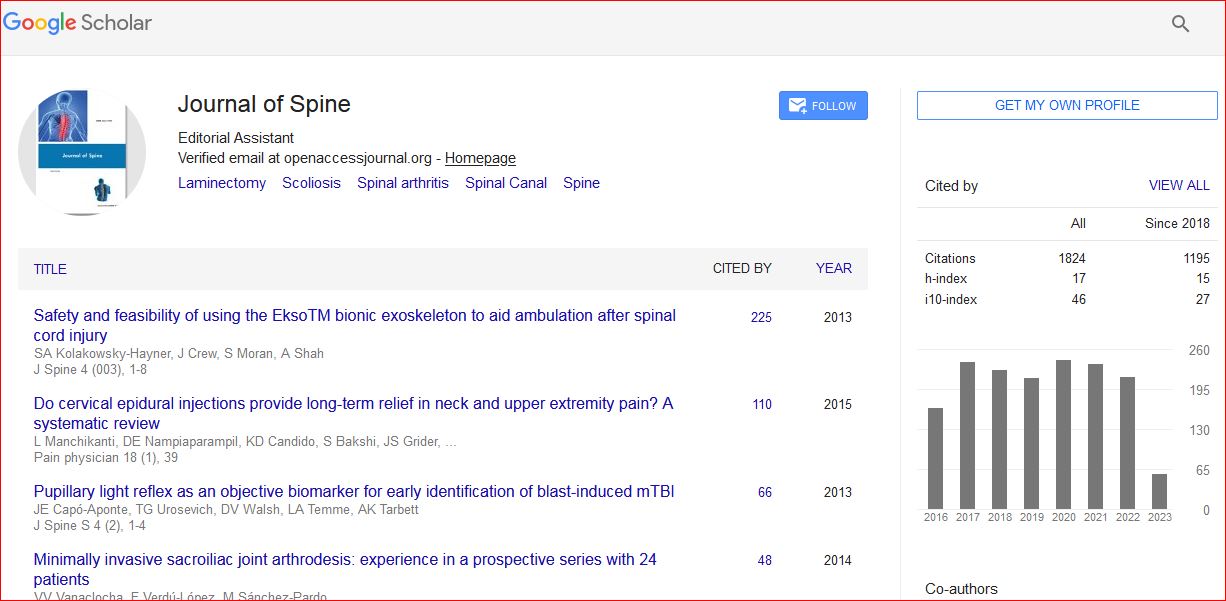
Journal of Spine received 2022 citations as per Google Scholar report