Short Communication - (2025) Volume 11, Issue 5
Received: 01-Oct-2025, Manuscript No. elj-25-174934;
Editor assigned: 03-Oct-2025, Pre QC No. P-174934;
Reviewed: 17-Oct-2025, QC No. Q-174934;
Revised: 17-Oct-2025, Manuscript No. R-174934;
Published:
29-Oct-2025
, DOI: 10.37421/2472-0895.2025.11.340
Citation: Wei, Chen. ”Advancing Symptomatic Epilepsy: Precision Patient Care.” Epilepsy J 11 (2025):340.
Copyright: © 2025 Wei C. This is an open-access article distributed under the terms of the Creative Commons Attribution License, which permits unrestricted use, distribution and reproduction in any medium, provided the original author and source are credited.
Quantitative Magnetic Resonance Imaging (qMRI) techniques are emerging as powerful tools for identifying biomarkers in symptomatic epilepsy. These methods are crucial for revealing subtle pathological changes, tracking disease progression, and forecasting treatment outcomes, offering a path to more precise diagnosis and personalized management strategies that move beyond traditional qualitative assessments [1].
Epilepsy surgery offers significant and lasting relief for individuals with symptomatic focal epilepsy. A comprehensive systematic review and meta-analysis confirms that, for carefully selected patients, surgical intervention leads to substantial improvements in seizure control over the long term, enhancing overall quality of life, highlighting surgery's role as an effective treatment for specific cases [2].
The field of pharmacological treatment for epilepsy, including its symptomatic forms, is under constant evolution. Research continues to shed light on novel anticonvulsant medications and innovative therapeutic targets. The primary goal is to improve seizure management and minimize side effects, especially for patients resistant to current treatments, underscoring a clear shift towards more individualized pharmacological strategies [3].
Cognitive challenges frequently accompany symptomatic epilepsy, significantly impacting daily life for many patients. Recent updates highlight the importance of thorough and early neuropsychological evaluation. This helps pinpoint specific areas of difficulty, making effective management, which encompasses both medication and non-drug therapies, essential for lessening the burden of these cognitive issues and improving functional outcomes [4].
New neuroimaging methods are transforming how clinicians diagnose symptomatic epilepsy and plan for surgical interventions. Breakthroughs like advanced Magnetic Resonance Imaging sequences, Positron Emission Tomography, and Magnetoencephalography provide critical views into where seizures originate. These technologies enable more precise mapping of seizure zones, aiding in the selection of appropriate patients for surgery and ultimately improving their results [5].
Uncovering the genetic roots of symptomatic epilepsy is key for accurate diagnosis and the development of effective treatments. Overviews explore the growing number of genetic factors now linked to common epilepsy syndromes. Genetic testing is increasingly becoming indispensable for identifying specific causes, which paves the way for truly personalized medicine and offers better guidance for patients and their families [6].
The ketogenic diet is now a recognized non-pharmacological treatment option, especially for adults facing challenging symptomatic epilepsy. Reviews cover the diet's mechanisms, how well it works, and practical implementation strategies. While adhering to the diet can be difficult, it significantly reduces seizures for some individuals, providing a valuable alternative when other treatments prove insufficient [7].
Growing evidence points to neuroinflammation as a key player in how symptomatic epilepsy develops and progresses. Articles explore the specific molecular and cellular pathways linking inflammation to seizure activity. Identifying these connections opens up new possibilities for therapies that could modify the disease itself, going beyond simply controlling symptoms [8].
Improving the quality of life for individuals living with symptomatic epilepsy is a critical goal that extends beyond just managing seizures. This includes understanding the many factors that influence patient well-being, such as mental health issues, social stigma, and side effects from treatment. There is a strong emphasis on patient-centered care that addresses both medical and psychosocial aspects for better overall outcomes [9].
Precision medicine is becoming increasingly vital for symptomatic epilepsy, aiming to tailor treatments to each patient's unique genetic, molecular, and clinical makeup. Reviews explain how combining genomic sequencing, advanced biomarkers, and neuroimaging can lead to more effective, personalized therapies. This approach ultimately improves patient outcomes and reduces unwanted side effects by delivering highly targeted care [10].
The diagnostic landscape for symptomatic epilepsy is undergoing significant advancements, moving towards more precise and personalized approaches. Quantitative MRI techniques are revolutionizing the identification of biomarkers, offering a deeper insight into subtle pathological changes, disease progression, and even predicting treatment efficacy [1]. Complementing this, other advanced neuroimaging methods such as Positron Emission Tomography and Magnetoencephalography are crucial for accurately mapping seizure origins, which is essential for effective surgical planning and patient selection [5]. Furthermore, understanding the genetic underpinnings of symptomatic epilepsy is key. Researchers are continually uncovering genetic factors linked to various syndromes, making genetic testing an indispensable tool for identifying specific causes and guiding personalized medicine strategies for patients and their families [6]. This push towards highly individualized care is central to precision medicine, which seeks to integrate genomic sequencing, advanced biomarkers, and comprehensive neuroimaging to tailor therapies, thereby improving outcomes and minimizing adverse effects [10].
Regarding therapeutic interventions, a range of options are available, from established methods to novel approaches. For carefully selected patients with symptomatic focal epilepsy, surgical intervention remains a highly effective option, providing significant and lasting relief by improving seizure control and enhancing quality of life over the long term [2]. Pharmacological treatments are also continuously evolving, with ongoing research into new anticonvulsant medications and innovative therapeutic targets. The aim here is to optimize seizure management and reduce side effects, particularly for those patients who are resistant to current treatment regimens, signifying a broader move towards individualized pharmacological strategies [3]. Beyond medication and surgery, non-pharmacological treatments like the ketogenic diet have gained recognition, especially for adults with challenging symptomatic epilepsy. While adherence can be difficult, the diet can offer a valuable alternative for reducing seizures when other treatments prove insufficient [7].
Current research is also deepening our understanding of the fundamental biological processes involved in symptomatic epilepsy. A notable area of focus is neuroinflammation, which is increasingly recognized as a key player in the development and progression of the condition. Exploring the molecular and cellular pathways that link inflammation to seizure activity is opening up exciting possibilities for therapies designed to modify the disease itself, rather than just controlling its symptoms [8]. This mechanistic insight is crucial for developing future disease-modifying treatments.
Beyond seizure control, addressing the broader impact of symptomatic epilepsy on a patientâ??s life is paramount. Cognitive challenges are a frequent accompaniment to symptomatic epilepsy and can significantly impair daily functioning. Therefore, early and thorough neuropsychological evaluation is vital for identifying specific areas of difficulty, allowing for comprehensive management plans that combine medication with non-drug therapies to alleviate cognitive burdens and improve functional outcomes [4]. Improving the overall quality of life for individuals with symptomatic epilepsy is a critical objective, encompassing not just seizure management but also mental health issues, social stigma, and the side effects of treatments. A patient-centered approach that integrates both medical and psychosocial aspects is essential for achieving better overall well-being and outcomes [9].
The collective body of research underscores a dynamic and multi-faceted approach to symptomatic epilepsy. From advanced diagnostic tools and genetic insights to diverse therapeutic strategies and a focus on underlying biological mechanisms, the field is actively working towards more effective, personalized, and holistic care. This ultimately aims to enhance seizure control, mitigate comorbidities, and significantly improve the daily lives and long-term prospects for individuals affected by this complex condition.
Current research in symptomatic epilepsy is actively reshaping how we approach diagnosis, treatment, and long-term patient care. New quantitative MRI techniques are proving to be powerful tools for identifying specific biomarkers, enabling more precise diagnoses, tracking disease progression, and even forecasting treatment success. This moves beyond traditional qualitative assessments, leading to more personalized management strategies. Alongside this, advanced neuroimaging methods like PET and MEG are transforming surgical planning by providing critical views into seizure origins, which helps select appropriate candidates for surgery and improve overall results. Genetics plays an increasingly vital role, with a growing understanding of factors linked to common epilepsy syndromes. Genetic testing is becoming indispensable for identifying specific causes, paving the way for truly personalized medicine. Pharmacological treatments are also evolving rapidly, with novel anticonvulsant medications and innovative therapeutic targets aiming to improve seizure management and reduce side effects, especially for those resistant to current options. For patients where medication isn't enough, epilepsy surgery offers significant and lasting relief, particularly for symptomatic focal epilepsy, improving seizure control and overall quality of life. Furthermore, non-pharmacological approaches like the ketogenic diet are recognized for adults with challenging symptomatic epilepsy, providing a valuable alternative. The field is also expanding to address broader aspects of the condition. There's growing evidence for neuroinflammation as a key player in disease development, opening possibilities for disease-modifying therapies. Cognitive challenges, which frequently accompany symptomatic epilepsy, are being managed more effectively through early neuropsychological evaluation and comprehensive therapies. Ultimately, improving the quality of life, considering mental health, social stigma, and treatment side effects, remains a critical goal, advocating for patient-centered care and precision medicine that tailors treatments to each individual's unique makeup.
None
None
Indexed at, Google Scholar, Crossref
Indexed at, Google Scholar, Crossref
Indexed at, Google Scholar, Crossref
Indexed at, Google Scholar, Crossref
Indexed at, Google Scholar, Crossref
Indexed at, Google Scholar, Crossref
Indexed at, Google Scholar, Crossref
Indexed at, Google Scholar, Crossref
Indexed at, Google Scholar, Crossref
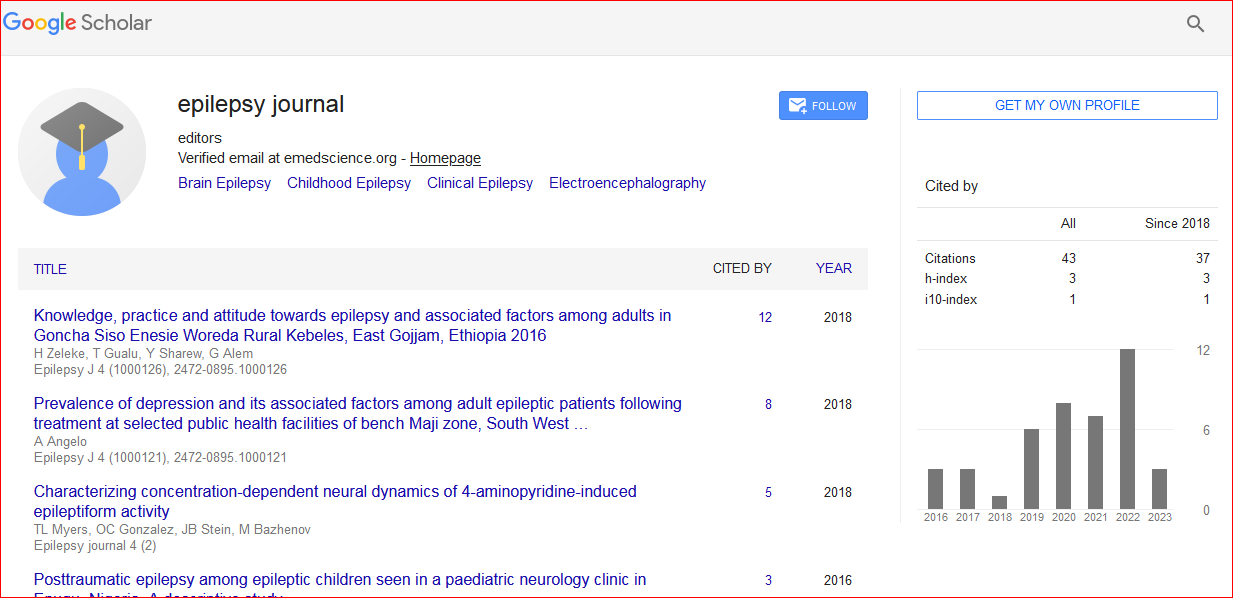
Epilepsy Journal received 41 citations as per Google Scholar report