Awoke Seyoum Tegegne*, Denekew Bitew Belay and Yirga Mekonnen
Background: Epilepsy seizure is one of the most common and serious brain disorders and affects more than 50 million people in the world, approximately 10 million people annually in sub-Saharan Africa. In Ethiopia, it affected about 29.5 per 1000 population. It has major physical, psychological and economic effects by reducing patients’ quality of life. The main objective of this study was to identify risk factors associated with seizure attacks for epileptic patients in North-West Ethiopia.
Method: A retrospective cohort study design was conducted from 131 randomly selected epileptic patients in the Neurologic clinic at Felege Hiwot Referral Hospital, Bahir Dar, Ethiopia. Both primary and secondary data sources were used. The data were collected using interview methods for primary source and patient’s chart under the follow-up period between 1st November 2014 up to 31 December 2019 for the secondary source. A general linear mixed effects model was used for data analysis.
Result: The majority of the participants (61.8%) were male epileptic patients. The increasing of both follow-up time and age at seizure onset and epileptic patients who believed to cure at the start of taking antiepileptic drugs were reduced the expected average of seizure attacks. Higher difference of age at diagnosis, age at seizure onset or duration of seizure medication, intellectual disability/retardation, and history of febrile convulsion statistically affected the average seizure in epileptic patients. Patients with low adherence and those of them having family disease history, highly affected by seizure attacks. Based on the lowest AIC and BIC values, the appropriate linear mixed model for the collected epileptic data was random intercept and random slope.
Conclusion: One way to improve medication adherence is free access of antiepileptic drugs. Attention should be given for patients with history of head injury, patients who came lately after the commencement of seizure onset, having more seizure at the beginning of diagnosis, mental disability and having history of febrile seizure.
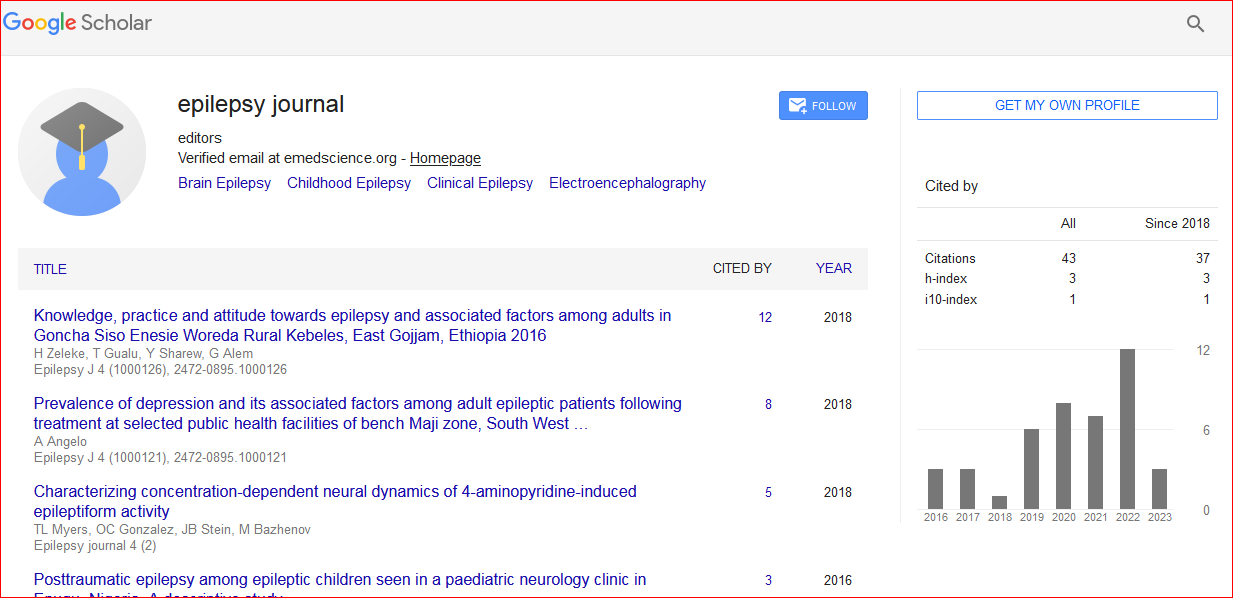
Epilepsy Journal received 41 citations as per Google Scholar report
 Spanish
  Chinese
  Russian
  German
  French
  Japanese
  Portuguese
  Hindi
Hindi 