Short Communication - (2025) Volume 9, Issue 4
Received: 01-Aug-2025, Manuscript No. jgge-25-174613;
Editor assigned: 04-Aug-2025, Pre QC No. P-174613;
Reviewed: 18-Aug-2025, QC No. Q-174613;
Revised: 22-Aug-2025, Manuscript No. R-174613;
Published:
29-Aug-2025
, DOI: 10.37421/2684-4567.2025.9.178
Citation: Greenwood, Naomi L.. ”Advancing Precision Oncology: A Multi-faceted Approach.” J Genet Genom 09 (2025):178.
Copyright: © 2025 Greenwood L. Naomi This is an open-access article distributed under the terms of the Creative Commons Attribution License, which permits unrestricted
use, distribution and reproduction in any medium, provided the original author and source are credited.
This review delves into the cutting edge of precision oncology, highlighting how genomic profiling is revolutionizing personalized cancer treatment. We are leveraging next-generation sequencing to scrutinize patient genes, aiming for targeted therapies and enhanced immunotherapy responses, despite challenges in data interpretation and clinical application [1].
Understanding tumor heterogeneity is critical, and single-cell multi-omics offers a fascinating lens into how individual cancer cells behave. These advanced techniques are poised to refine diagnostic and therapeutic strategies by providing an unprecedented resolution of cancer biology [2].
Liquid biopsy is significantly transforming lung cancer management, particularly in early diagnosis and monitoring recurrence. By analyzing circulating tumor DNA and other blood biomarkers, this less invasive method offers crucial genomic insights for detecting cancer sooner and tracking treatment efficacy [3].
Artificial Intelligence (AI) is rapidly becoming an indispensable asset in cancer genomics. Machine learning algorithms are analyzing complex genomic data, leading to more precise diagnoses and customized treatments. AI's potential to unearth new insights from vast datasets promises to advance precision medicine and improve patient outcomes [4].
Spatial transcriptomics marks an exciting leap, allowing researchers to visualize gene expression within a tumor's physical architecture. These technologies are enhancing our comprehension of tumor microenvironments and cell-to-cell interactions in situ, thereby illuminating tumor development and treatment responses [5].
Immunogenomics explores the intricate interplay between a patientâ??s immune system and their cancerâ??s genomic makeup. Tracing this field from fundamental discoveries to clinical applications, this understanding is vital for predicting immunotherapy responses and developing innovative immune-based treatments [6].
Beyond BRCA mutations, numerous other germline variants contribute to inherited cancer risk. A growing understanding of these genetic changes is crucial for genetic counseling and for developing personalized screening and prevention strategies [7].
Epigenomics plays a substantial role in cancer, influencing gene expression without altering the underlying DNA sequence. This review emphasizes how epigenetic modifications are key to colorectal cancer development and progression, suggesting new avenues for diagnosis and therapy [8].
Pan-cancer genomic studies offer a broad perspective, analyzing data across various cancer types to reveal shared genetic alterations and molecular classifications. This approach uncovers commonalities that could lead to treatments effective against multiple cancers [9].
CRISPR-Cas9 gene editing has profoundly advanced our capability to precisely modify genomes, holding immense promise for cancer therapy. Significant strides have been made in employing CRISPR-Cas9 for cancer treatment, from engineering immune cells to targeting oncogenes, though translating these powerful tools into safe and effective clinical applications remains a challenge [10].
Cancer research is undergoing a profound transformation, driven by innovative genomic and molecular techniques. We are seeing a move towards deeply personalized medicine, where treatment strategies are finely tuned to an individual's unique genetic profile [1]. This involves deciphering vast amounts of genomic information, a task made more manageable by next-generation sequencing, though integrating this data into routine clinical practice still presents a hurdle [1]. The goal is clearer: identify specific targets for therapies and enhance the effectiveness of immunotherapies, ultimately improving patient outcomes [1].
A deeper understanding of tumor biology is emerging through advanced methods like single-cell multi-omics, which allows us to peer into the distinct behaviors of individual cells within a tumor. This high-resolution view is critical for grasping tumor heterogeneity and is expected to refine diagnostic and therapeutic approaches significantly [2]. Complementing this, less invasive techniques such as liquid biopsy are revolutionizing the management of cancers like lung cancer. By analyzing biomarkers in blood, clinicians can detect cancer earlier and monitor treatment efficacy with greater ease and less patient burden [3]. This method is rapidly becoming indispensable for obtaining vital genomic insights without the need for tissue samples [3].
The sheer volume and complexity of genomic data necessitate sophisticated analytical tools, and here's the thing: Artificial Intelligence (AI) and machine learning are stepping up. These technologies are proving to be powerful allies in interpreting genomic data, leading to more precise diagnoses and tailored treatment plans. AI's ability to extract new patterns and insights from large datasets is pivotal in advancing precision medicine and truly personalizing patient care [4]. Moreover, the spatial context of gene expression within a tumor is no longer a mystery, thanks to spatial transcriptomics. These technologies allow us to visualize where gene expression occurs, offering a clearer picture of tumor microenvironments and cell-to-cell interactions, which is invaluable for understanding how tumors develop and respond to treatment [5].
The immune system's role in cancer is another critical area being illuminated by immunogenomics. This field explores the complex interaction between a patient's immune system and the genomic landscape of their cancer, paving the way for predicting responses to immunotherapy and developing novel immune-based treatments [6]. Beyond the well-known BRCA mutations, researchers are uncovering a broader spectrum of germline variants that increase inherited cancer susceptibility. This expanding knowledge is fundamental for accurate genetic counseling and for crafting personalized screening and prevention strategies that look beyond traditional markers [7]. Epigenomic modifications, which influence gene expression without altering the DNA sequence, are also proving to be crucial in cancer progression, particularly in colorectal cancer, offering potential new diagnostic and therapeutic targets [8]. Finally, pan-cancer genomic studies are revealing shared genetic alterations and molecular classes across different cancer types, which helps us see commonalities that might lead to broader, more effective treatments [9]. And let's not forget CRISPR-Cas9 gene editing; it's a revolutionary tool with immense promise for cancer therapy, from engineering immune cells to directly targeting oncogenes, though its clinical translation still presents challenges [10].
Recent advancements in cancer research are propelling us towards a new era of precision oncology, characterized by highly personalized diagnostic and therapeutic strategies. Genomic profiling, including next-generation sequencing, is fundamental to tailoring cancer treatments, though data interpretation and clinical implementation remain areas of active development. Complementary approaches like single-cell multi-omics offer unprecedented insights into tumor heterogeneity, allowing for a finer resolution of cancer biology and informing future diagnostic and therapeutic improvements. Less invasive methods such as liquid biopsy are transforming early diagnosis and recurrence monitoring, particularly in lung cancer, by providing crucial genomic information from blood samples. The integration of Artificial Intelligence (AI) and machine learning algorithms is proving indispensable for analyzing complex genomic data, leading to more precise diagnoses and guiding precision medicine strategies. Spatial transcriptomics adds another layer by mapping gene expression within the tumor's physical context, enhancing our understanding of tumor microenvironments and response to therapy. Further broadening the scope, immunogenomics explores the intricate interplay between the immune system and cancer's genomic makeup, informing immunotherapy development. The understanding of inherited cancer risk extends beyond BRCA mutations to other germline variants, impacting genetic counseling and prevention. Epigenomics reveals how epigenetic modifications drive cancer progression, offering new therapeutic avenues. Pan-cancer genomic studies identify shared alterations across various cancers, potentially leading to widely applicable treatments. Finally, CRISPR-Cas9 gene editing shows significant promise for targeted cancer therapy, despite ongoing challenges in clinical translation. This collective progress signifies a comprehensive, multi-faceted approach to combating cancer.
None
None
Jamal SR, Nicholas JH, Justin EM. "Genomic profiling for precision oncology: challenges and opportunities".Future Oncol 19 (2023):991-1002.
Indexed at, Google Scholar, Crossref
Yanan P, Donglei Y, Xiaodan W. "Single-cell multi-omics in cancer: current applications and future perspectives".Cell Death Dis 14 (2023):13.
Indexed at, Google Scholar, Crossref
Huan L, Peng L, Cheng Y. "Recent advances of liquid biopsy in early diagnosis and recurrence monitoring of lung cancer".Front Oncol 12 (2023):1109968.
Indexed at, Google Scholar, Crossref
Myung HP, Min SK. "Artificial Intelligence in Cancer Genomics and Precision Medicine".J Clin Med 12 (2023):2631.
Indexed at, Google Scholar, Crossref
Zhongyang J, Qiaoyun X, Yanwei D. "Spatial Transcriptomics in Cancer Research: Recent Advances and Future Perspectives".Cancers 15 (2023):3056.
Indexed at, Google Scholar, Crossref
Dan M, Yuan L, Wenhao Z. "The landscape of immunogenomics in cancer: from basic research to clinical application".Front Oncol 12 (2022):1082590.
Indexed at, Google Scholar, Crossref
Nazia R, Jinchun Y, Wenting M. "Germline variants beyond BRCA: implications for inherited cancer susceptibility".Precis Clin Med 5 (2022):pbac020.
Indexed at, Google Scholar, Crossref
Yuqian S, Yun Z, Jianlong M. "The role of epigenomics in colorectal cancer diagnosis and therapy".Front Oncol 12 (2022):1007820.
Indexed at, Google Scholar, Crossref
Hyerang K, You SP, Minsoo B. "Pan-cancer landscape of genetic alterations and their clinical implications".J Transl Med 20 (2022):396.
Indexed at, Google Scholar, Crossref
Jianshuang C, Shen S, Zhuanfang L. "CRISPR-Cas9-mediated genome editing: achievements and challenges in cancer therapy".Mol Cancer 21 (2022):100.
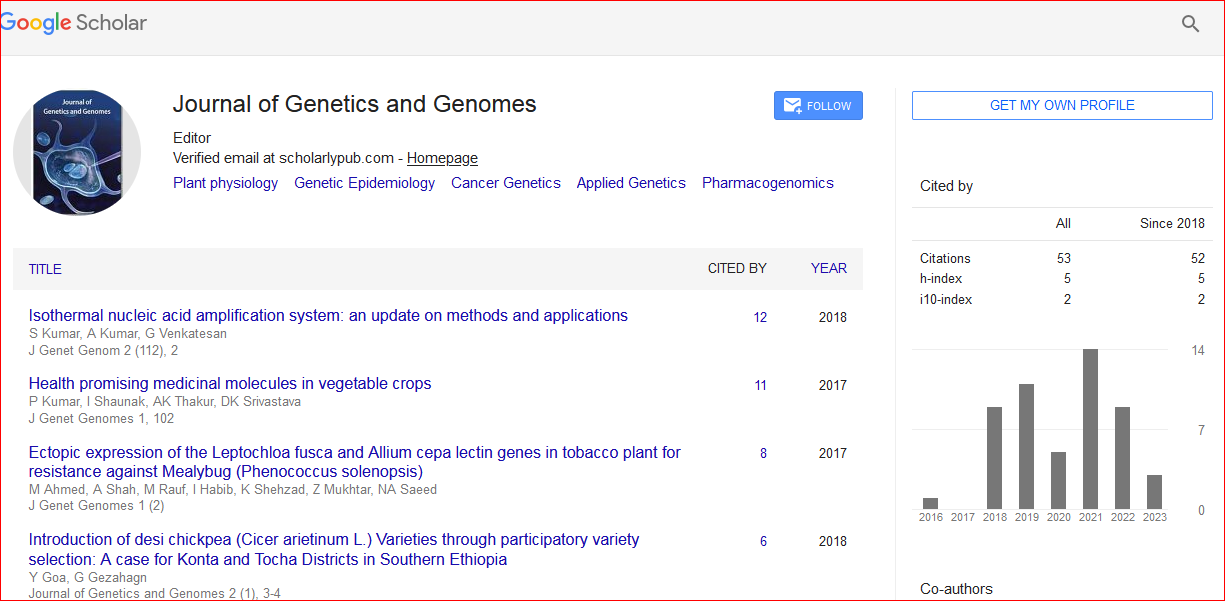
Journal of Genetics and Genomes received 65 citations as per Google Scholar report