Opinion - (2025) Volume 16, Issue 1
Received: 01-Jan-2025, Manuscript No. jnmrt-25-172721;
Editor assigned: 03-Jan-2025, Pre QC No. P-172721;
Reviewed: 18-Jan-2025, QC No. Q-172721;
Revised: 24-Jan-2025, Manuscript No. R-172721;
Published:
31-Jan-2025
, DOI: 10.37421/2155-9619.2025.16.629
Citation: El-Masry, Ahmed H.. ”Advancing Personalized Radionuclide Therapy for DTC.” J Nucl Med Radiat Ther 16 (2025):629.
Copyright: © 2025 El-Masry H. Ahmed This is an open-access article distributed under the terms of the Creative Commons Attribution License, which permits unrestricted use, distribution and reproduction in any medium, provided the original author and source are credited.
The management of differentiated thyroid cancer (DTC) has seen significant evolution, particularly in the realm of radionuclide therapy, reflecting a continuous effort to refine treatment strategies and improve patient outcomes. Recent updates highlight the persistent importance of radioiodine (I-131) therapy while also drawing attention to emerging therapeutic avenues and the increasing personalization of treatment decisions, which are now firmly rooted in risk stratification and distinct disease characteristics. This shift provides a contemporary perspective on the field, underlining more sophisticated treatment protocols [1].
For patients diagnosed with low-risk differentiated thyroid cancer, initial radioiodine therapy stands out for its capacity to deliver excellent long-term outcomes. Extensive cohort studies have rigorously confirmed that this treatment strategy is both effective and safe over the long run, particularly for those patients who fall into the low-risk category. This finding strongly reinforces existing clinical practices and offers assurance regarding the foundational role of radioiodine in this specific patient group [2].
A significant trend in the evolving landscape of DTC treatment is the movement towards personalized radioiodine therapy. This approach signifies a departure from a uniform, one-size-fits-all model. What this really means is that treatment doses and overall strategies are meticulously customized to individual patient profiles, with the dual aim of maximizing therapeutic effectiveness while simultaneously minimizing potential side effects. This reflects a deeper, more nuanced understanding of the disease's varied manifestations across different patients [3].
Beyond conventional radioiodine, the scope of targeted radionuclide therapy for advanced differentiated thyroid cancer is rapidly expanding. This area of research is actively exploring and discussing various new agents. For instance, novel somatostatin receptor or prostate-specific membrane antigen (PSMA) targeting agents are emerging. This expansion demonstrates how the field is creating more viable options for patients contending with advanced or refractory disease, offering hope where traditional treatments may be less effective [4].
One specific innovation in this space is the emerging role of Lutetium-177-DOTATATE, a distinct form of radionuclide therapy, for advanced differentiated thyroid cancer. A systematic review has diligently compiled existing evidence to evaluate its effectiveness and safety. This therapy is suggested as a potentially valuable alternative for particular patient cohorts, especially those presenting with somatostatin receptor-positive tumors, where the limitations of traditional radioiodine become apparent [5].
It is also critical to understand the outcomes of radioiodine therapy for DTC patients who exhibit distant metastases that do not readily absorb iodine. Such cases present a unique challenge. Studies are actively investigating clinical outcomes and identifying important prognostic factors, which are instrumental for clinicians. This work helps them discern which patients might still derive benefit from radioiodine, even when the disease is less iodine-avid, and also sets realistic expectations for the prognosis in these complex scenarios [6].
The practical implementation of individualized dosimetry in radioiodine therapy for differentiated thyroid cancer further exemplifies the personalized approach. What this means in practice is that instead of administering a standard, fixed dose, the treatment is precisely calculated for each individual patient. The goal is to deliver the optimal radiation dose directly to the tumor while meticulously safeguarding healthy surrounding tissues, thereby making the therapy both more effective and notably safer [7].
Addressing differentiated thyroid cancer that has become "radioiodine-refractory" is another crucial area of focus. This term refers to cases where the cancer no longer responds to standard radioiodine treatment. Reviews dedicated to this challenge explore a range of diverse strategies and alternative therapies specifically designed for these demanding situations, providing critical insights into treatment paradigms when conventional approaches cease to be viable [8].
Moreover, the application of radioiodine therapy in pediatric differentiated thyroid cancer warrants careful consideration. Systematic reviews have been conducted to synthesize the existing literature, rigorously assessing the safety and efficacy of this treatment modality in children. These reviews offer a vital overarching perspective on how radioiodine is employed and its subsequent outcomes within this younger, inherently more vulnerable patient demographic [9].
Finally, guidance on adjuvant radioiodine therapy in differentiated thyroid cancer is continuously being refined to assist clinicians in optimizing its application. This guidance delves into the evolving indications, precise risk stratification methods, and refined patient selection criteria. Essentially, it provides much-needed clarity on how to best utilize this critical post-surgical treatment to effectively prevent disease recurrence and improve long-term prognosis [10].
Differentiated thyroid cancer (DTC) management is undergoing a significant transformation, with a strong emphasis on refining radionuclide therapy approaches. Contemporary strategies underscore the enduring value of radioiodine (I-131) therapy while simultaneously embracing novel therapeutic avenues. The shift towards personalized treatment decisions, meticulously guided by individual risk stratification and distinct disease characteristics, represents a core advancement in the field, offering a current, refined perspective on patient care [1]. This tailored approach aims to optimize patient outcomes by moving away from a uniform treatment model, reflecting a deeper understanding of the disease's varied presentations.
A cornerstone of DTC management, especially for low-risk cases, remains initial radioiodine therapy. Extensive large cohort studies have provided robust evidence confirming its excellent long-term outcomes. These findings solidify the effectiveness and safety of this treatment for low-risk individuals, thereby reinforcing current clinical guidelines and practices [2]. The success observed in these studies supports its continued use as a primary therapeutic option in appropriately selected patients. Building on this principle of individualization, the practical application of individualized dosimetry in radioiodine therapy ensures that treatment is precisely calculated for each patient. This meticulous approach delivers the optimal radiation dose to the tumor, minimizing exposure to healthy tissues and enhancing both safety and efficacy [7]. This is what really means tailoring the treatment to fit the patient's unique needs, rather than a generic protocol.
For more challenging scenarios, such as advanced differentiated thyroid cancer, the landscape of targeted radionuclide therapy is expanding dramatically. Researchers are actively exploring agents beyond traditional radioiodine, including new somatostatin receptor and prostate-specific membrane antigen (PSMA) targeting agents [4]. This evolution is critical for patients with advanced or refractory disease, offering new hope and pathways for treatment where conventional methods may have reached their limits. A significant development in this area is the emerging role of Lutetium-177-DOTATATE. This distinct radionuclide therapy has been the subject of systematic reviews to assess its efficacy and safety, suggesting it could serve as a valuable alternative for specific patient groups, particularly those with somatostatin receptor-positive tumors, where traditional radioiodine therapy might not be effective [5].
Managing differentiated thyroid cancer that has become "radioiodine-refractory" poses a considerable clinical hurdle. This term refers to situations where the cancer no longer responds to standard radioiodine treatment. Comprehensive reviews are shedding light on various strategies and alternative therapies specifically designed for these demanding cases, offering crucial insights into viable treatment paradigms when conventional approaches are no longer effective [8]. Moreover, the outcomes of radioiodine therapy for DTC patients with distant metastases that do not readily take up iodine are being rigorously investigated. Understanding the clinical outcomes and identifying prognostic factors in these less iodine-avid cases helps clinicians determine which patients may still benefit from radioiodine and what to anticipate in such complex situations [6].
Specific patient populations also require tailored considerations. For instance, the safety and efficacy of radioiodine therapy in pediatric differentiated thyroid cancer are critical areas of study. Systematic reviews are synthesizing existing literature to provide a crucial overview of how radioiodine is utilized and its outcomes in this younger, more vulnerable demographic [9]. Furthermore, optimizing adjuvant radioiodine therapy post-surgery is paramount for preventing recurrence. Guidance on this therapy in differentiated thyroid cancer continually evolves, addressing indications, risk stratification, and patient selection criteria to ensure its most effective use [10]. This comprehensive approach signifies a commitment to personalized, effective, and safe treatment strategies across the diverse spectrum of differentiated thyroid cancer presentations.
Radionuclide therapy for differentiated thyroid cancer is advancing, emphasizing personalized treatments and a broader range of therapeutic options beyond traditional radioiodine. Radioiodine (I-131) remains a cornerstone, with studies confirming its long-term effectiveness and safety for low-risk patients. However, treatment decisions are increasingly tailored based on individual risk stratification and disease characteristics. Personalized approaches extend to dosimetry, where treatment doses are precisely calculated for each patient to optimize efficacy and safety by targeting tumors while sparing healthy tissues. For advanced or refractory cases, where standard radioiodine may be less effective or the disease is non-iodine-avid, the field is exploring targeted radionuclide therapy. This includes agents like Lutetium-177-DOTATATE, which has shown promise for somatostatin receptor-positive tumors, and other novel somatostatin receptor or PSMA targeting agents. Specific considerations arise for challenging patient groups, such as those with non-iodine-avid distant metastases, where clinical outcomes and prognostic factors are being investigated. Pediatric patients also have unique treatment considerations, with systematic reviews assessing the safety and efficacy of radioiodine therapy in this vulnerable population. Adjuvant radioiodine therapy continues to be a vital post-surgical treatment, with ongoing guidance on optimizing its use through evolving indications, risk stratification, and patient selection criteria to prevent recurrence. The overall trend shows a move towards more nuanced, patient-specific strategies in managing differentiated thyroid cancer.
None
None
Indexed at, Google Scholar, Crossref
Indexed at, Google Scholar, Crossref
Indexed at, Google Scholar, Crossref
Indexed at, Google Scholar, Crossref
Indexed at, Google Scholar, Crossref
Indexed at, Google Scholar, Crossref
Indexed at, Google Scholar, Crossref
Indexed at, Google Scholar, Crossref
Indexed at, Google Scholar, Crossref
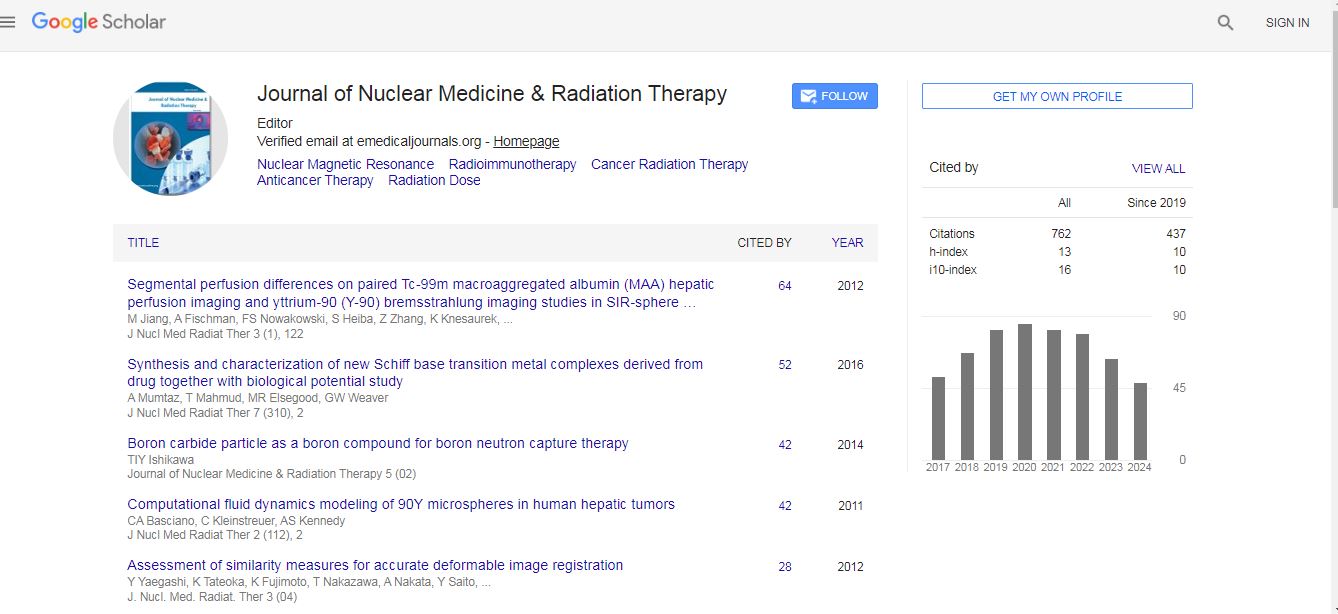
Nuclear Medicine & Radiation Therapy received 706 citations as per Google Scholar report