Opinion - (2025) Volume 15, Issue 2
Received: 02-Jun-2025, Manuscript No. jttr-25-175372;
Editor assigned: 04-Jun-2025, Pre QC No. P-175372;
Reviewed: 18-Jun-2025, QC No. Q-175372;
Revised: 23-Jun-2025, Manuscript No. R-175372;
Published:
30-Jun-2025
, DOI: 10.37421/2161-0991.2025.15.298
Citation: Tanaka, Hiroshi. ”Advancing HSCT: Diverse Applications, Better Outcomes.” J Transplant Technol Res 15 (2025):298.
Copyright: © 2025 Tanaka H. This is an open-access article distributed under the terms of the Creative Commons Attribution License, which permits unrestricted use, distribution and reproduction in any medium, provided the original author and source are credited.
Hematopoietic stem cell transplantation (HSCT) for severe autoimmune diseases offers a potentially curative option by resetting the immune system. This approach is vital when standard therapies fail for conditions like multiple sclerosis, systemic sclerosis, and Crohn's disease. Ongoing efforts focus on understanding immune modulation, improving patient selection, and minimizing complications, a crucial area for future therapeutic advancements [1].
Allogeneic hematopoietic stem cell transplantation (allo-HSCT) is evolving for acute myeloid leukemia (AML) patients. Significant progress in conditioning regimens, Graft-Versus-Host Disease (GVHD) prevention, and supportive care strategies enhances survival and reduces toxicity. While complex, ongoing research refines allo-HSCT, making it a more effective treatment option for many [2].
Allogeneic hematopoietic stem cell transplantation remains a primary curative option for myelodysplastic syndromes (MDS). Transplantation strategies adapt considering patient age, disease risk, and donor availability. Discussion centers on refining conditioning regimens and managing post-transplant complications, aiming for improved long-term survival and quality of life for MDS patients [3].
Gene therapy and hematopoietic stem cell transplantation (HSCT) revolutionize treatment for primary immunodeficiency diseases (PIDs). These approaches correct underlying genetic defects, moving beyond symptom management. Improvements in gene editing technologies and safer transplantation protocols bring us closer to definitive cures for a range of severe PIDs [4].
Autologous stem cell transplantation (ASCT) plays a crucial role in relapsed/refractory Hodgkin lymphoma. This review outlines its efficacy and place in the treatment paradigm. New targeted therapies and immunotherapies are being integrated, potentially shaping future strategies and improving outcomes for patients undergoing transplantation [5].
Mesenchymal stem cells (MSCs) are gaining traction in regenerative medicine and transplantation. Their unique properties, like immune modulation and tissue repair, make them valuable in orthopedic conditions and treating Graft-Versus-Host Disease in HSCT. MSCs are versatile and hold significant promise, with ongoing research pushing clinical utility forward [6].
Autologous stem cell transplantation (ASCT) is a cornerstone therapy for multiple myeloma. It extends remission and improves survival, especially combined with novel agents. Optimizing patient selection, managing side effects, and fitting ASCT into evolving treatment sequences are key to maximizing patient benefit from this established procedure [7].
Reduced-intensity conditioning (RIC) regimens for allogeneic hematopoietic cell transplantation (allo-HCT) in adult Acute Myeloid Leukemia (AML) patients have expanded access. RIC allows transplantation for older or frailer patients. Balancing disease control with minimizing toxicity is crucial, with ongoing research refining approaches to improve safety and efficacy [8].
New targets and immune mechanisms are exciting developments in allogeneic hematopoietic cell transplantation (allo-HCT) to overcome resistance. Strategies aim to enhance the graft-versus-leukemia effect while minimizing Graft-Versus-Host Disease. Innovative approaches, including modulating immune checkpoints and novel cellular therapies, are pushing boundaries to make allo-HCT more effective for more patients [9].
Graft-Versus-Host Disease (GVHD) remains a significant challenge after allogeneic stem cell transplantation. This article highlights current strategies for prevention and treatment, detailing evolving immunosuppressive regimens, targeted therapies, and novel cellular approaches. Researchers constantly find ways to better manage this complex complication, improving overall safety and success of life-saving transplants [10].
Hematopoietic stem cell transplantation (HSCT) has emerged as a transformative therapeutic strategy with a wide range of applications in severe medical conditions. A significant area of focus is its use in treating severe autoimmune diseases. Here, HSCT can effectively reset the immune system, providing a potentially curative option for patients who have not responded adequately to standard therapies [1]. This approach is particularly relevant for conditions such as multiple sclerosis, systemic sclerosis, and Crohn's disease, with ongoing research focused on understanding immune modulation, refining patient selection, and minimizing potential complications, positioning HSCT as a crucial area for future therapeutic advancements in this field [1].
The landscape of allogeneic hematopoietic stem cell transplantation (allo-HSCT) is continuously evolving, particularly for patients battling acute myeloid leukemia (AML). Recent advancements highlight substantial progress in improving patient outcomes, encompassing new conditioning regimens, more effective prevention strategies for Graft-Versus-Host Disease (GVHD), and comprehensive supportive care [2]. These combined efforts are contributing to enhanced survival rates and a reduction in treatment-related toxicity, signifying a more effective application of this complex procedure for many individuals with AML [2]. Similarly, for patients diagnosed with myelodysplastic syndromes (MDS), allo-HSCT remains a primary curative choice. Transplantation strategies in MDS are continually adapted based on critical factors like patient age, disease risk, and the availability of suitable donors. Key discussions revolve around refining conditioning regimens and proactively managing post-transplant complications, all with the overarching goal of improving long-term survival and enhancing the quality of life for MDS patients [3].
Autologous stem cell transplantation (ASCT) holds a pivotal role in the treatment paradigm for specific hematologic malignancies. For instance, when Hodgkin lymphoma recurs or fails to respond to initial treatments, ASCT often becomes an essential intervention [5]. This approach has demonstrated considerable efficacy, and its integration with novel targeted therapies and immunotherapies is actively shaping future treatment strategies, leading to improved outcomes for patients undergoing transplantation [5]. In the realm of multiple myeloma, ASCT continues to be a cornerstone therapy, notably extending remission periods and improving overall survival, particularly when administered in conjunction with novel therapeutic agents [7]. The focus in this area is on optimizing patient selection, diligently managing potential side effects, and strategically integrating ASCT into evolving treatment sequences, ensuring that patients derive the maximum possible benefit from this well-established procedure [7].
Another significant frontier where HSCT is making profound impacts is in primary immunodeficiency diseases (PIDs). Here, gene therapy, often combined with HSCT, is truly revolutionizing treatment by moving beyond mere symptom management to directly correct the underlying genetic defects [4]. This progress is driven by remarkable improvements in gene editing technologies and the development of safer, more effective transplantation protocols. Ultimately, these advances are bringing us closer to definitive cures for a broad spectrum of severe PIDs, offering new hope to affected individuals [4].
Efforts to broaden patient access to transplantation include the development of reduced-intensity conditioning (RIC) regimens for allogeneic hematopoietic cell transplantation (allo-HCT) in adult AML patients. RIC has been instrumental in expanding treatment options for older or frailer individuals who might not tolerate traditional, more intensive conditioning. The crucial insight here is to carefully balance effective disease control with the imperative of minimizing toxicity, with continuous research dedicated to refining these approaches for enhanced safety and efficacy [8]. A persistent and significant challenge following allogeneic stem cell transplantation is Graft-Versus-Host Disease (GVHD). However, this field is dynamic, with current strategies highlighting an evolving landscape of immunosuppressive regimens, targeted therapies, and novel cellular approaches aimed at both preventing and treating GVHD [10]. What this really means for patients is that researchers are relentlessly pursuing new ways to better manage this complex complication, thereby improving the overall safety and success rates of these life-saving transplants [10]. Furthermore, mesenchymal stem cells (MSCs) are gaining substantial traction in regenerative medicine and transplantation. Their unique properties, including immune modulation and tissue repair capabilities, make them highly valuable in various applications, from orthopedic conditions to actively treating GVHD in HSCT, showcasing their significant therapeutic promise [6].
Hematopoietic stem cell transplantation (HSCT) is a rapidly advancing therapeutic approach for a range of severe diseases. For autoimmune conditions such as multiple sclerosis and Crohn's disease, HSCT effectively resets the immune system, offering a potentially curative path when conventional treatments prove insufficient. This involves careful patient selection and immune modulation to minimize complications. Similarly, allogeneic HSCT (allo-HSCT) has seen significant progress in treating acute myeloid leukemia (AML) and myelodysplastic syndromes (MDS), with improved conditioning regimens, better Graft-Versus-Host Disease (GVHD) prevention, and enhanced supportive care leading to improved survival and reduced toxicity. The field is continuously refining these complex procedures, adapting strategies to individual patient factors like age and disease risk. Beyond blood cancers, gene therapy, combined with HSCT, is revolutionizing the treatment of primary immunodeficiency diseases (PIDs) by correcting underlying genetic defects and moving towards definitive cures through advanced gene editing and safer protocols. Autologous stem cell transplantation (ASCT) remains vital for conditions like relapsed/refractory Hodgkin lymphoma and multiple myeloma, effectively extending remission and improving survival, often in conjunction with novel agents. There's also a strong focus on reduced-intensity conditioning regimens to make transplantation accessible to a wider patient population, including older or frailer individuals, while balancing disease control with minimal toxicity. Innovative research is also exploring mesenchymal stem cells (MSCs) for their immune modulation and tissue repair capabilities, useful in treating GVHD and other conditions. The ongoing efforts against GVHD involve evolving immunosuppressive strategies and novel cellular approaches, which are crucial for enhancing transplant safety and success.
None
None
Tobias A, Marlen AR, Steffen K. "Hematopoietic stem cell transplantation for severe autoimmune diseases.".Semin Immunopathol 46 (2024):101-118.
Indexed at, Google Scholar, Crossref
Arjun D, Amanda FN, Siddharth BJ. "Recent advances in allogeneic hematopoietic stem cell transplantation for acute myeloid leukemia.".Hematol Oncol 41 (2023):e3507.
Indexed at, Google Scholar, Crossref
Uwe P, Michael WF, Sophie SS. "Allogeneic Hematopoietic Stem Cell Transplantation in Myelodysplastic Syndromes.".HemaSphere 7 (2023):e957.
Indexed at, Google Scholar, Crossref
Claire B, Nao R, Kanchan R. "Advances in Gene Therapy and Hematopoietic Stem Cell Transplantation for Primary Immunodeficiency Diseases.".Front Immunol 14 (2023):1221146.
Indexed at, Google Scholar, Crossref
Anna Z, Sara S, Claudio D. "The role of hematopoietic stem cell transplantation in relapsed/refractory Hodgkin lymphoma.".Front Oncol 13 (2023):1152018.
Indexed at, Google Scholar, Crossref
Arnold IC, Douglas SD, Wolfgang D. "Update on clinical applications of mesenchymal stem cells.".J Orthop Res 42 (2024):227-234.
Indexed at, Google Scholar, Crossref
Meletios AD, Theodora P, Angelos K. "Autologous stem cell transplantation for multiple myeloma: current status and future perspectives.".Blood Cancer J 12 (2022):11.
Indexed at, Google Scholar, Crossref
Jill S, Craig HK, Dominik MK. "Reduced-intensity conditioning for allogeneic hematopoietic cell transplantation in adults with acute myeloid leukemia: An updated perspective.".Hematol Oncol Stem Cell Ther 15 (2022):134-142.
Indexed at, Google Scholar, Crossref
Sarah MG, Ryan WMM, Scott WB. "Emerging targets and immune mechanisms to overcome resistance to allogeneic hematopoietic cell transplantation.".Blood 137 (2021):1729-1740.
Indexed at, Google Scholar, Crossref
Robert Z, Daniel RT, Anthony VR. "Current Strategies to Prevent and Treat Graft-Versus-Host Disease.".J Clin Oncol 38 (2020):2991-3001.
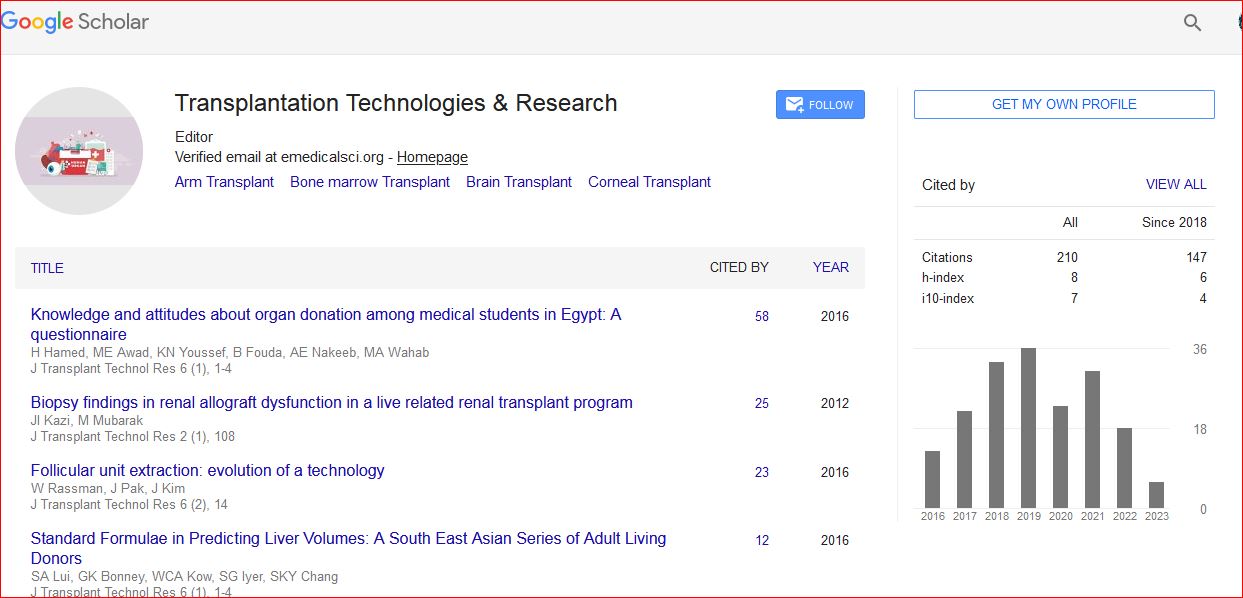
Transplantation Technologies & Research received 223 citations as per Google Scholar report