Short Communication - (2025) Volume 11, Issue 5
Received: 01-Sep-2025, Manuscript No. aso-25-184653;
Editor assigned: 03-Sep-2025, Pre QC No. P-184653;
Reviewed: 17-Sep-2025, QC No. Q-184653;
Revised: 22-Sep-2025, Manuscript No. R-184653;
Published:
29-Sep-2025
, DOI: 10.37421/2471-2671.2025.11.192
Citation: Rossi, Maria. ”Advancing Hepatobiliary and Pancreatic
Cancer Surgery.” Arch Surg Oncol 11 (2025):192.
Copyright: © 2025 Rossi M. This is an open-access article distributed under the terms of the Creative Commons Attribution License, which permits unrestricted use, distribution
and reproduction in any medium, provided the original author and source are credited.
Hepatobiliary and pancreatic (HBP) oncologic surgery confronts substantial difficulties owing to the intricate nature of these organs and the advanced stage of numerous tumors. Nevertheless, recent advancements are contributing to improved patient outcomes and management strategies [1].
Minimally invasive techniques, such as laparoscopy and robotic surgery, are progressively becoming more widespread, offering the distinct advantages of reduced patient morbidity and accelerated recovery periods. This shift towards less invasive approaches is transforming the landscape of complex oncologic resections [1].
The development of neoadjuvant therapies has markedly enhanced the resectability rates and overall survival for patients diagnosed with pancreatic cancer, particularly those presenting with borderline resectable or locally advanced disease. These multimodal treatments aim to downstage tumors, thereby enabling a greater number of patients to undergo potentially curative surgical interventions. This strategic approach has cemented its position as a vital component in the contemporary management of pancreatic malignancies [2].
Robotic surgery is experiencing a notable increase in adoption for intricate hepatobiliary procedures. The enhanced visualization, superior precision, and advanced dexterity afforded by robotic systems facilitate more complex dissections and intricate reconstructions, particularly when operating in anatomically challenging regions. Initial research indicates that robotic methodologies can result in diminished blood loss, shorter hospital stays, and oncologic outcomes that are either comparable to or better than those achieved with open surgical techniques, although long-term data and standardization efforts are ongoing [3].
The surgical management of intrahepatic cholangiocarcinoma (ICC) presents considerable complexity, with surgical resection remaining the sole curative modality. Progress in advanced imaging techniques has led to improved preoperative staging and more accurate identification of resectable disease. Surgical strategies are continually evolving to encompass extended hepatectomy and lymphadenectomy for carefully selected patient cohorts. Furthermore, adjuvant therapies are under investigation to further enhance outcomes for individuals with advanced disease or positive surgical margins [4].
Precision medicine is actively reshaping HBP oncologic surgery by enabling the tailoring of treatment regimens to the unique molecular characteristics of individual tumors. The genetic profiling of pancreatic and liver cancers is instrumental in identifying actionable mutations, which in turn guides the selection of targeted therapies, often administered in conjunction with surgical interventions. This personalized therapeutic paradigm holds significant promise for improving response rates and overall survival in patients afflicted with challenging HBP malignancies [5].
The application of artificial intelligence (AI) and machine learning (ML) within the domain of HBP surgery represents an emergent and rapidly developing field. AI is being actively explored for its potential in image analysis to enhance diagnostic accuracy, predict surgical outcomes with greater precision, and optimize treatment planning strategies. Although still in its nascent stages, the integration of AI/ML technologies holds considerable potential to improve operational efficiency and augment decision-making processes in the context of complex oncologic surgeries [6].
Reconstruction techniques employed following major hepatectomy and pancreaticoduodenectomy (Whipple procedure) continue to undergo refinement with the primary objective of minimizing postoperative complications, such as anastomotic leaks and fistulas. Innovations in surgical materials and the adoption of advanced techniques, including sophisticated suture methods and a deeper understanding of physiological fluid dynamics, are collectively contributing to safer reconstructions and facilitating improved patient recovery trajectories [7].
The management of unresectable liver tumors has witnessed significant advancements, particularly through the enhancement of locoregional therapeutic approaches. Techniques such as transarterial chemoembolization (TACE) and radiofrequency ablation (RFA) are becoming increasingly refined and are often employed in combination with systemic therapies to effectively control disease burden and extend survival for patients diagnosed with metastatic or unresectable primary liver cancers. The advent of techniques like balloon-occluded TACE and drug-eluting beads has further contributed to greater treatment precision [8].
A thorough understanding of the tumor microenvironment (TME) is recognized as paramount for the successful development of efficacious therapeutic strategies for HBP cancers. Recent scientific investigations underscore the intricate interplay among immune cells, stromal components, and various signaling molecules within the TME. This accumulating knowledge is actively paving the way for the development of novel immunotherapies and innovative combination strategies designed to modulate the TME, thereby enhancing the effectiveness of surgical resection and subsequent adjuvant treatments [9].
Postoperative care and the meticulous management of complications following HBP oncologic surgery remain areas of critical importance and ongoing focus. Progress in intensive care unit (ICU) management, the implementation of early mobilization protocols, and the adoption of evidence-based strategies for the prevention and management of pancreatic fistulas (POPF) and bile leaks are demonstrably leading to reductions in patient morbidity and mortality rates. Enhanced recovery after surgery (ERAS) protocols are increasingly being adopted and integrated into routine clinical practice [10].
Hepatobiliary and pancreatic (HBP) oncologic surgery is characterized by significant complexities stemming from the delicate anatomy of these organs and the advanced stage at which many tumors are diagnosed. Recent technological and therapeutic advancements, however, are progressively leading to improved patient outcomes. The increasing adoption of minimally invasive techniques, including laparoscopy and robotic surgery, is noteworthy for their potential to reduce postoperative morbidity and accelerate patient recovery times, thereby transforming the approach to these challenging operations [1].
Significant strides have been made in the realm of neoadjuvant therapy for pancreatic cancer, particularly through the judicious combination of chemotherapy and chemoradiation. This integrated approach has demonstrably improved the rates of resectability and overall survival for patients afflicted with borderline resectable and locally advanced disease. The primary objective of these neoadjuvant strategies is to effectively downstage tumors, thereby facilitating surgical intervention and enabling a greater proportion of patients to be considered for potentially curative surgery, establishing this as a cornerstone of modern pancreatic cancer management [2].
Robotic surgery is becoming increasingly integrated into the surgical armamentarium for complex hepatobiliary procedures. The enhanced visual acuity, precision, and dexterity offered by advanced robotic platforms enable surgeons to perform more intricate dissections and complex reconstructions, especially within challenging anatomical locations. Preliminary studies suggest that robotic approaches may be associated with reduced intraoperative blood loss, shorter hospital stays, and oncologic outcomes that are either comparable or superior to those achieved with traditional open surgery, though further long-term data and standardization are anticipated [3].
The management of intrahepatic cholangiocarcinoma (ICC) poses a significant clinical challenge, with surgical resection identified as the only definitive curative option. Improvements in diagnostic imaging technologies have enhanced preoperative staging accuracy and facilitated the identification of resectable disease. Current surgical strategies are evolving to include more extensive hepatectomy and lymphadenectomy in appropriately selected patients. Research into adjuvant therapies continues, aiming to improve outcomes for patients with advanced disease or positive surgical margins following resection [4].
Precision medicine is revolutionizing HBP oncologic surgery by enabling the customization of treatment plans based on the specific molecular and genetic profiles of individual tumors. The comprehensive genetic profiling of pancreatic and liver cancers is identifying key actionable mutations that guide the selection of targeted therapeutic agents, often in conjunction with surgical management. This personalized approach holds considerable promise for enhancing treatment response rates and improving survival outcomes for patients with difficult-to-treat HBP malignancies [5].
The integration of artificial intelligence (AI) and machine learning (ML) into HBP surgery represents a burgeoning area of innovation. AI is being investigated for its utility in image analysis to improve diagnostic accuracy, predict patient outcomes following surgery, and optimize treatment planning. While still in its early phases of development, the incorporation of AI/ML technologies is anticipated to enhance operational efficiency and refine decision-making processes within the context of complex oncologic surgical procedures [6].
Reconstruction techniques following major hepatectomy and pancreaticoduodenectomy, commonly known as the Whipple procedure, are continually being refined to minimize the incidence of postoperative complications, particularly anastomotic leaks and fistulas. Advances in surgical biomaterials and innovative techniques, including enhanced suture methods and a more profound understanding of physiological fluid dynamics, are contributing to safer reconstructions and ultimately to improved patient recovery [7].
The therapeutic landscape for unresectable liver tumors has been significantly advanced by improvements in locoregional therapies. Techniques such as transarterial chemoembolization (TACE) and radiofrequency ablation (RFA) are becoming more sophisticated and are frequently combined with systemic treatments to effectively manage disease burden and extend survival in patients with metastatic or unresectable primary liver cancers. Innovations like balloon-occluded TACE and the use of drug-eluting beads have further enhanced treatment precision [8].
A comprehensive understanding of the tumor microenvironment (TME) is deemed essential for the development of effective therapeutic strategies targeting HBP cancers. Recent scientific inquiries highlight the complex interplay between immune cells, stromal elements, and various signaling molecules within the TME. This evolving knowledge is actively driving the development of novel immunotherapies and synergistic combination strategies aimed at modulating the TME to enhance the efficacy of both surgical resection and adjuvant treatments [9].
Postoperative care and the vigilant management of complications following HBP oncologic surgery remain paramount. Advances in intensive care unit (ICU) management, the implementation of early mobilization protocols, and the application of evidence-based strategies for preventing and managing pancreatic fistulas (POPF) and bile leaks are directly contributing to reduced patient morbidity and mortality. Enhanced recovery after surgery (ERAS) protocols are increasingly being adopted and integrated into standard clinical practice [10].
Hepatobiliary and pancreatic (HBP) oncologic surgery faces complex challenges, but recent advancements are improving outcomes. Minimally invasive techniques like laparoscopy and robotics offer reduced morbidity and faster recovery. Neoadjuvant therapies, especially for pancreatic cancer, enhance resectability and survival by downstaging tumors. Robotic surgery provides enhanced precision for complex hepatobiliary procedures. Surgical management of intrahepatic cholangiocarcinoma relies on resection, with improved staging and evolving surgical strategies. Precision medicine tailors treatments based on tumor molecular characteristics. Artificial intelligence and machine learning are emerging tools for diagnosis and treatment planning. Reconstruction techniques after major surgeries are being refined to minimize complications. Locoregional therapies for unresectable liver tumors are advancing. Understanding the tumor microenvironment is key to developing new therapies. Postoperative care, including ERAS protocols, focuses on reducing complications and improving recovery.
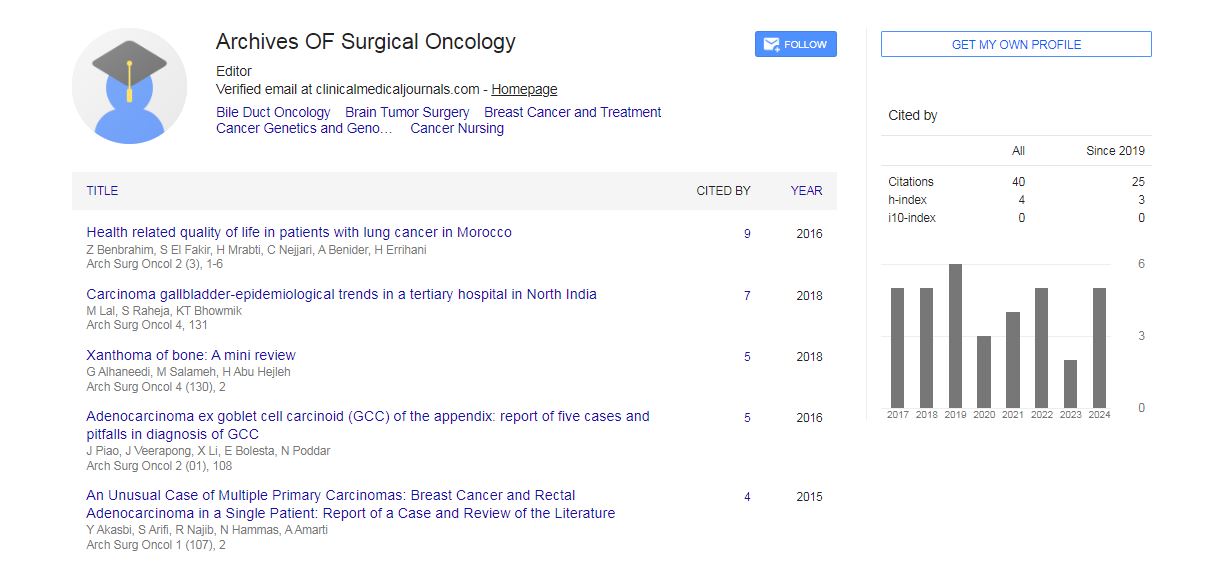
Archives of Surgical Oncology received 37 citations as per Google Scholar report