Brief Report - (2025) Volume 16, Issue 2
Received: 01-Apr-2025, Manuscript No. csj-26-183428;
Editor assigned: 03-Apr-2025, Pre QC No. P-183428;
Reviewed: 17-Apr-2025, QC No. Q-183428;
Revised: 22-Apr-2025, Manuscript No. R-183428;
Published:
29-Apr-2025
, DOI: 10.37421/2160-3494.2025.16.445
Citation: Hsu, Daniel K. ”Advancing Green Chemistry: Catalysts, Feedstocks, and Processes.” Chem Sci J 16 (2025):445.
Copyright: © 2025 Hsu K. Daniel This is an open-access article distributed under the terms of the Creative Commons Attribution License, which permits unrestricted use, distribution and reproduction in any medium, provided the original author and source are credited.
The modern chemical industry is undergoing a transformative shift, driven by the urgent need to adopt sustainable and environmentally responsible practices throughout the synthesis process. This paradigm change is essential to mitigate the detrimental effects of traditional chemical manufacturing on ecosystems and resource availability. A core tenet of this evolution is the widespread embrace of green chemistry principles, which aim to design chemical products and processes that reduce or eliminate the use and generation of hazardous substances. Novel catalytic systems are at the forefront of this movement, offering more efficient and selective transformations that minimize waste and energy consumption, thereby enhancing the overall sustainability of chemical production [1].
The advancement of heterogeneous catalysis plays a pivotal role in achieving sustainable synthesis goals. These catalysts, by virtue of their solid nature, facilitate easier separation from reaction mixtures and enable efficient recycling, leading to reduced waste and improved process economics. Tailoring the properties of these solid catalysts, such as their surface area and the nature of their active sites, is key to enhancing selectivity and activity. This focus on catalyst design promotes greener reaction pathways and contributes significantly to the development of more environmentally benign chemical processes [2].
Furthermore, the utilization of biomass-derived platform chemicals as renewable feedstocks represents a significant stride towards reducing our reliance on finite petrochemical resources. Innovative methodologies are being developed to convert abundant lignocellulosic biomass into versatile intermediates. These approaches include efficient deconstruction strategies and selective functionalization techniques, paving the way for a more sustainable chemical manufacturing sector that leverages renewable raw materials and minimizes its carbon footprint [3].
Continuous flow chemistry has emerged as a powerful technology for advancing green synthesis. Its inherent advantages, including improved heat and mass transfer, enhanced safety profiles, and simplified scalability, make it highly suitable for complex organic transformations. The application of continuous flow reactors has demonstrated higher yields, reduced reaction times, and significantly minimized waste generation when compared to traditional batch processes, underscoring its potential to revolutionize chemical manufacturing towards greater sustainability [4].
A particularly promising area within green chemistry is the development and application of bio-based catalysts, such as enzymes and whole microbial cells. Biocatalysis offers a highly selective and efficient route for the synthesis of pharmaceuticals and fine chemicals. The advantages are manifold, including mild reaction conditions, exceptional stereo- and regioselectivity, and the inherent biodegradability of the catalysts, all contributing to environmentally friendly processes that demand less energy and generate less waste [5].
The design of inherently safer chemical processes is another critical aspect of sustainable synthesis. This involves a conscious effort to minimize the use and generation of hazardous substances throughout the entire lifecycle of a chemical product. Strategies include the implementation of solvent-free reactions, the judicious selection of benign solvents like water or supercritical CO2, and the development of less toxic reagents, all aimed at inherently reducing risks to human health and the environment [6].
In parallel, the integration of computational methods with experimental approaches is rapidly accelerating the discovery and optimization of green synthetic routes. Advanced techniques such as molecular modeling, machine learning, and high-throughput screening are instrumental in predicting reaction outcomes, identifying optimal catalysts, and designing energy-efficient processes. This synergistic approach enables a more rational and accelerated development of sustainable chemical technologies, bridging the gap between theoretical prediction and practical application [7].
Electrochemical synthesis presents a compelling sustainable alternative to conventional chemical transformations. By harnessing electricity as a clean reagent, electrosynthesis facilitates the efficient generation of valuable chemical intermediates and products while significantly reducing waste and energy consumption. The focus here lies on the design of effective electrocatalysts and the development of optimized electrochemical cell configurations to maximize efficiency and minimize environmental impact [8].
Process intensification strategies, including microwave-assisted synthesis and ultrasonic irradiation, are proving to be highly effective in enhancing reaction rates and energy efficiency. These techniques are being applied to significantly shorten reaction times, improve product yields, and minimize the overall environmental footprint of chemical manufacturing. The overarching goal is to achieve more sustainable and economically viable production methods by optimizing reaction conditions and energy utilization [9].
Finally, the principles of the circular economy are being increasingly integrated into chemical synthesis to promote waste minimization and maximize resource utilization. This involves designing synthetic processes that adhere to principles of atom economy, waste valorization, and the incorporation of recycled materials. The ultimate objective is to create closed-loop systems that drastically reduce environmental impact and foster long-term industrial sustainability [10].
The imperative shift towards sustainable and green chemistry principles is fundamentally reshaping modern chemical synthesis, emphasizing the development of novel catalytic systems, the utilization of renewable feedstocks, and the implementation of energy-efficient processes. This comprehensive approach aims to significantly minimize environmental impact and curb resource depletion, thereby fostering a more responsible chemical industry. Key insights include the widespread adoption of atom-economical reactions, the design of biodegradable materials, and the strategic integration of process intensification strategies to reduce waste and energy consumption. The overarching focus is on creating synthetic methodologies that are not only highly effective but also environmentally benign and economically viable, ensuring a balance between scientific advancement and ecological stewardship [1].
The continuous advancement of heterogeneous catalysis is a cornerstone for achieving sustainable chemical synthesis. These catalysts offer practical advantages such as easier separation from reaction mixtures and enhanced recyclability, contributing to a more efficient and less wasteful chemical industry. This work meticulously explores the development of novel solid catalysts engineered to enable efficient chemical transformations with a significant reduction in byproducts. The emphasis is placed on meticulously tailoring catalyst properties, including surface area and the precise arrangement of active sites, to optimize selectivity and activity, thereby actively promoting greener and more sustainable reaction pathways [2].
A crucial aspect of sustainable chemical manufacturing involves the strategic utilization of biomass-derived platform chemicals as renewable feedstocks. This research showcases innovative and effective methodologies for the conversion of lignocellulosic biomass into versatile chemical intermediates. By successfully reducing the dependence on traditional petrochemicals, this approach contributes to a more sustainable chemical industry. The research highlights the importance of efficient deconstruction strategies and precise selective functionalization techniques to achieve truly sustainable chemical manufacturing, leveraging the abundance of renewable resources [3].
Continuous flow chemistry presents a suite of significant advantages that greatly benefit green synthesis. These advantages include notably improved heat and mass transfer characteristics, substantially enhanced safety protocols, and the inherent ease of scalability, making it an ideal technology for complex organic transformations. This paper meticulously details the successful application of continuous flow reactors for intricate organic transformations, demonstrating superior yields, considerably reduced reaction times, and demonstrably minimized waste generation when directly contrasted with conventional batch processes. The work unequivocally underscores the profound potential of flow chemistry to fundamentally revolutionize chemical manufacturing towards a more sustainable future [4].
The exploration and application of bio-based catalysts, encompassing enzymes and whole microbial cells, represent a dynamic frontier in the field of green chemistry. This research delves into the practical application of biocatalysis for the highly selective and efficient synthesis of vital pharmaceuticals and valuable fine chemicals. The inherent advantages of this approach include the use of mild reaction conditions, exceptionally high stereo- and regioselectivity, and the inherent biodegradability of the catalysts, collectively leading to the development of environmentally friendly processes characterized by reduced energy input and minimal waste generation [5].
The design of inherently safer chemical processes is a paramount objective in the pursuit of sustainable synthesis. This involves a concerted effort to minimize the use and generation of hazardous substances throughout all stages of chemical production. The research examines the practical application of solvent-free reactions, the strategic employment of benign solvents such as water and supercritical CO2, and the innovative development of less toxic reagents. The ultimate aim is to achieve synthetic routes that fundamentally and inherently reduce risks to both human health and the broader environment, promoting a culture of safety and responsibility [6].
The synergistic integration of advanced computational methods with meticulous experimental approaches is proving to be a powerful catalyst for accelerating the discovery and optimization of green synthetic routes. This article discusses in detail how sophisticated tools such as molecular modeling, machine learning algorithms, and high-throughput screening capabilities can be effectively employed to accurately predict reaction outcomes, precisely identify optimal catalysts, and design highly energy-efficient processes. This collaborative approach facilitates a more rational, rapid, and effective development of cutting-edge sustainable chemical technologies [7].
Electrochemical synthesis offers a highly promising and sustainable alternative to traditional chemical transformations by ingeniously utilizing electricity as a clean and readily available reagent. This work thoroughly explores the practical applications of electrochemical methods for the synthesis of valuable chemical intermediates and final products, with a strong emphasis on significantly reducing waste generation and optimizing energy consumption. Key aspects examined include the critical design of efficient electrocatalysts and the development of robust and effective electrochemical cell configurations to maximize performance and sustainability [8].
Process intensification strategies, such as microwave-assisted synthesis and ultrasonic irradiation, are demonstrating a remarkable ability to significantly enhance reaction rates and improve energy efficiency in chemical synthesis. This paper provides detailed accounts of the successful application of these advanced technologies to achieve substantial reductions in reaction times, marked improvements in product yields, and a minimized environmental footprint across various chemical manufacturing processes. The central focus remains on achieving production methods that are both highly sustainable and demonstrably economically viable, aligning operational efficiency with ecological responsibility [9].
The integration of the circular economy model into chemical synthesis is rapidly gaining momentum as a critical strategy for minimizing waste and maximizing resource utilization. This article critically discusses the design of innovative synthetic processes that explicitly incorporate fundamental principles of atom economy, effective waste valorization, and the judicious use of recycled materials. The overarching emphasis is on creating robust closed-loop systems that significantly reduce environmental impact and robustly promote long-term industrial sustainability, ensuring the efficient and responsible use of resources [10].
This collection of research highlights the critical advancements and strategies driving sustainable and green chemistry. Key areas of focus include novel catalytic systems, renewable feedstocks derived from biomass, and energy-efficient processes like continuous flow chemistry and electrochemistry. The development of bio-based catalysts and safer reaction conditions are emphasized for their environmental benefits. Computational approaches are accelerating the design of greener synthetic routes, while process intensification and circular economy principles are crucial for reducing waste and maximizing resource utilization. Overall, the research underscores a collective effort towards creating chemical synthesis methods that are environmentally benign, economically viable, and inherently safer.
None
None
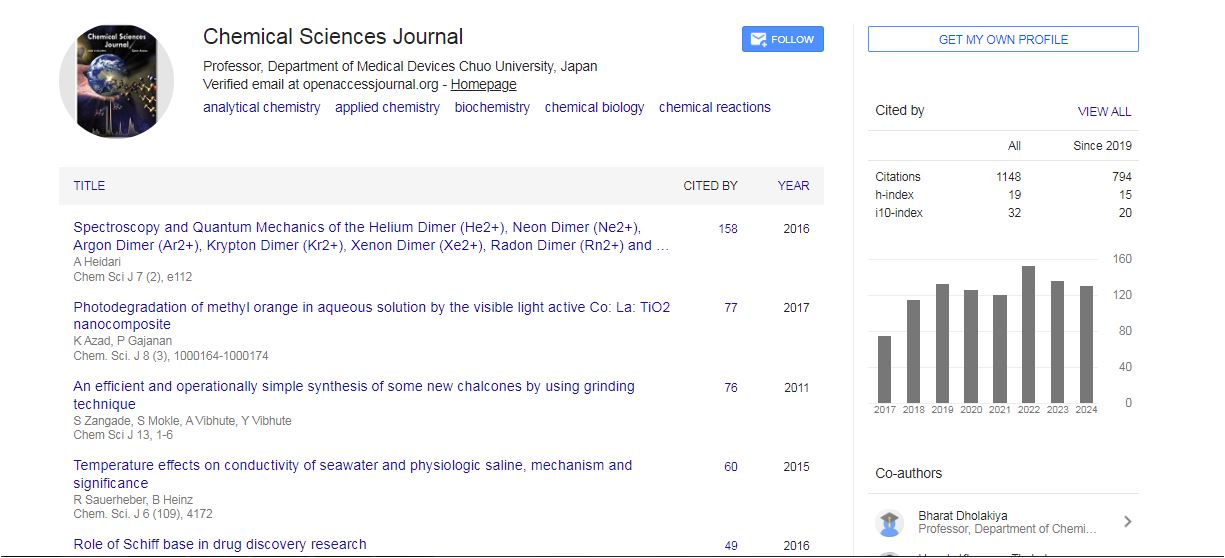
Chemical Sciences Journal received 912 citations as per Google Scholar report