Commentary - (2025) Volume 16, Issue 6
Received: 01-Dec-2025, Manuscript No. jbsbe-26-183331;
Editor assigned: 03-Dec-2025, Pre QC No. P-183331;
Reviewed: 17-Dec-2025, QC No. Q-183331;
Revised: 22-Dec-2025, Manuscript No. R-183331;
Published:
29-Dec-2025
, DOI: 10.37421/2165-6210.2025.16.536
Citation: Malhotra, Arjun. ”Advancing Disease Detection Through Non-invasive Biosensing.” J Biosens Bioelectron 16 (2025):536.
Copyright: © 2025 Malhotra A. This is an open-access article distributed under the terms of the Creative Commons Attribution License, which permits unrestricted use, distribution and reproduction in any medium, provided the original author and source are credited.
Recent advancements in non-invasive biosensing are profoundly transforming the landscape of disease detection and health monitoring. These cutting-edge technologies, including sophisticated wearable sensors, advanced imaging modalities, and innovative breath analysis systems, are ushering in an era of real-time data acquisition without the need for invasive sample extraction. This shift offers substantial benefits for early disease diagnosis, the development of personalized treatment strategies, and the provision of remote patient care services. The primary focus of these developments is to enhance the sensitivity and specificity of diagnostic tools while simultaneously improving user comfort and adoption [1].
Wearable electrochemical biosensors are rapidly emerging as indispensable tools for the continuous, real-time monitoring of critical biomarkers found in biofluids such as sweat and interstitial fluid. The ongoing research in this area is actively contributing to the development of flexible and stretchable sensor platforms, often integrated with microfluidic systems. These integrated systems are designed for multiplexed analyte detection, thereby paving the way for highly personalized health management approaches [2].
Optical biosensing methodologies, particularly those leveraging surface plasmon resonance (SPR) and fluorescence-based detection, are undergoing significant refinement. These techniques are being optimized for label-free and exceptionally sensitive detection of various disease markers. Concurrent advancements in nanomaterials and microfluidic integration are instrumental in creating miniaturized and portable optical sensing devices suitable for point-of-care applications, bringing diagnostic capabilities closer to the patient [3].
Breath analysis as a non-invasive method for disease diagnostics is steadily gaining momentum, driven by the development of advanced sensor arrays and sophisticated machine learning algorithms. The rationale behind this approach lies in the unique profiles of volatile organic compounds (VOCs) present in exhaled breath, which can serve as reliable biomarkers for a wide range of conditions, including various cancers, metabolic disorders, and infectious diseases [4].
CRISPR-based biosensing platforms represent a significant leap forward, offering unparalleled specificity and sensitivity for the detection of nucleic acids. These versatile systems are being adapted for non-invasive sample types such as saliva and urine, making them highly promising for rapid and accurate diagnosis of infectious diseases and genetic disorders, thus expanding the scope of molecular diagnostics [5].
The integration of artificial intelligence (AI) and machine learning (ML) with biosensing data is becoming increasingly critical for the effective interpretation of complex, high-dimensional information derived from non-invasive sources. AI/ML algorithms excel at recognizing intricate patterns within data streams generated by wearable sensors and breath analysis devices, leading to more accurate diagnostic outcomes and predictive health insights [6].
Microfluidic technologies serve as a fundamental enabling component for the miniaturization and automation of non-invasive biosensing systems. These technologies allow for precise control over minuscule fluid volumes, which is essential for streamlined sample handling, efficient reagent mixing, and controlled reaction processes within compact, portable devices, particularly for lab-on-a-chip applications [7].
Nanomaterials play a pivotal role in significantly enhancing the performance characteristics of non-invasive biosensors. Their application leads to increased surface areas, improved electrical conductivity, and the enablement of novel detection mechanisms. Commonly employed nanomaterials such as gold nanoparticles, quantum dots, and graphene derivatives are instrumental in boosting sensor sensitivity and reducing detection limits, thereby improving diagnostic accuracy [8].
The development of implantable and minimally invasive biosensors is advancing the field of continuous physiological parameter monitoring, including glucose, lactate, and oxygen levels. These advanced sensors offer considerable advantages for the management of chronic diseases and the optimization of athletic performance. However, challenges related to biocompatibility and long-term operational stability continue to be addressed [9].
Point-of-care (POC) testing is experiencing a substantial boost due to the advent of non-invasive biosensors, which facilitate rapid diagnostics outside of conventional laboratory settings. Innovations in smartphone-integrated sensors and other portable analytical devices are instrumental in democratizing access to health information and promoting early disease intervention strategies [10].
Recent breakthroughs in non-invasive biosensing are revolutionizing disease detection and health monitoring. Technologies such as wearable sensors, advanced imaging techniques, and breath analysis enable real-time data collection without sample extraction, offering significant advantages in early diagnosis, personalized medicine, and remote patient care. These advances focus on improving sensitivity, specificity, and user comfort [1].
Wearable electrochemical biosensors are emerging as powerful tools for continuous, real-time monitoring of various biomarkers in biofluids like sweat and interstitial fluid. Research highlights the development of flexible and stretchable sensor platforms integrated with microfluidics for multiplexed analyte detection, paving the way for personalized health management [2].
Optical biosensing approaches, particularly those employing surface plasmon resonance (SPR) and fluorescence, are being refined for label-free and highly sensitive detection of disease markers. Advances in nanomaterials and microfluidic integration are enabling miniaturized and portable optical sensing devices for point-of-care applications [3].
Breath analysis for non-invasive disease diagnostics is gaining traction with the development of sophisticated sensor arrays and machine learning algorithms. Volatile organic compounds (VOCs) in exhaled breath can serve as unique biomarkers for various conditions, including cancers, metabolic disorders, and infectious diseases [4].
CRISPR-based biosensing platforms offer unprecedented specificity and sensitivity for nucleic acid detection. These systems, adaptable for non-invasive sample types like saliva or urine, are being explored for rapid and accurate diagnosis of infectious diseases and genetic disorders [5].
The integration of artificial intelligence (AI) and machine learning (ML) with biosensing data is crucial for interpreting complex, high-dimensional information from non-invasive sources. AI/ML algorithms enhance pattern recognition in data from wearable sensors and breath analysis, leading to more accurate diagnoses and predictive health insights [6].
Microfluidic technologies are fundamental to the miniaturization and automation of non-invasive biosensing systems. They enable precise control of small fluid volumes, facilitating sample handling, reagent mixing, and reaction processes in compact, portable devices for lab-on-a-chip applications [7].
Nanomaterials play a pivotal role in enhancing the performance of non-invasive biosensors by increasing surface area, improving conductivity, and enabling novel detection mechanisms. Gold nanoparticles, quantum dots, and graphene derivatives are frequently employed to boost sensitivity and reduce detection limits [8].
The development of implantable and minimally invasive biosensors is advancing continuous monitoring of physiological parameters like glucose, lactate, and oxygen. These sensors offer advantages for managing chronic diseases and optimizing athletic performance, though challenges remain in biocompatibility and long-term stability [9].
Point-of-care (POC) testing is significantly boosted by non-invasive biosensors, enabling rapid diagnostics outside traditional laboratory settings. Innovations in smartphone-integrated sensors and portable analytical devices are democratizing access to health information and facilitating early disease intervention [10].
Non-invasive biosensing technologies are rapidly advancing disease detection and health monitoring. Wearable sensors, advanced imaging, and breath analysis allow for real-time data collection, enhancing early diagnosis, personalized medicine, and remote care. Electrochemical and optical biosensors, coupled with nanomaterials and microfluidics, offer improved sensitivity and portability for point-of-care applications. CRISPR-based systems provide high specificity for nucleic acid detection, while AI and machine learning are crucial for interpreting complex data. Breath analysis leverages volatile organic compounds as biomarkers. Although implantable sensors show promise for continuous monitoring, challenges persist. Overall, these innovations are democratizing healthcare access and enabling earlier disease intervention.
None
None
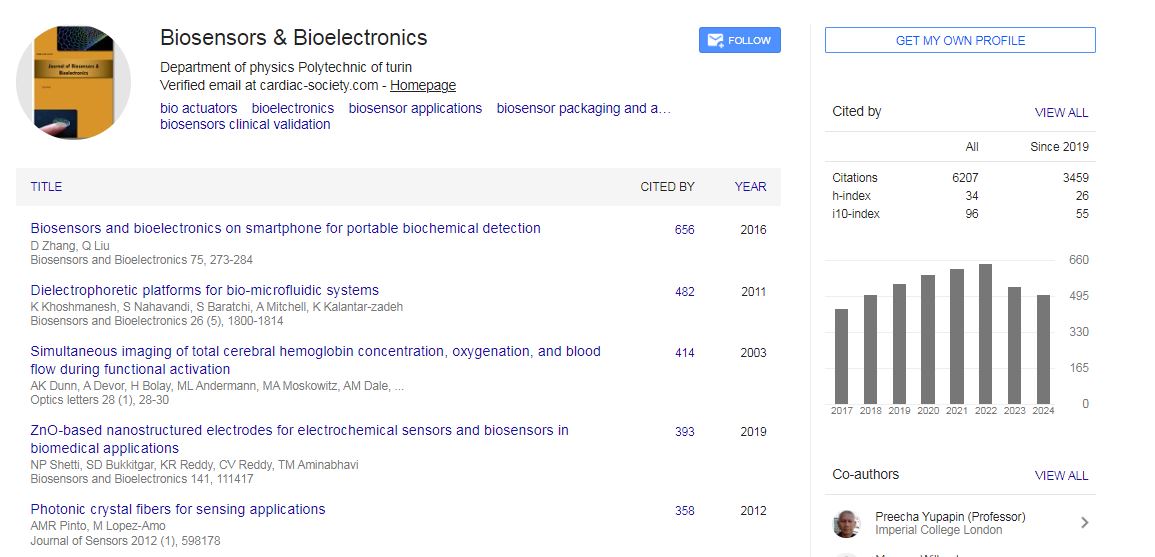
Biosensors & Bioelectronics received 6207 citations as per Google Scholar report