Opinion - (2025) Volume 10, Issue 4
Received: 01-Aug-2025, Manuscript No. jcct-26-183224;
Editor assigned: 04-Aug-2025, Pre QC No. P-183224;
Reviewed: 18-Aug-2025, QC No. Q-183224;
Revised: 22-Aug-2025, Manuscript No. R-183224;
Published:
29-Aug-2025
, DOI: 10.37421/2577-0535.2025.9.322
Citation: Morgan, Rebecca L.. ”Advancing Cancer Trials: Novel Therapies and Precision Medicine.” J Cancer Clin Trials 10 (2025):322.
Copyright: © 2025 Morgan L. Rebecca This is an open-access article distributed under the terms of the Creative Commons Attribution License, which permits unrestricted use, distribution and reproduction in any medium, provided the original author and source are credited.
The landscape of cancer treatment is rapidly evolving, with a significant focus on addressing advanced stages of the disease, including metastatic and recurrent cancers. These challenging conditions necessitate innovative therapeutic strategies and refined patient selection criteria to improve outcomes. Advances in clinical trials are at the forefront of this progress, exploring novel agents and treatment modalities designed to overcome the complexities of advanced malignancy [1].
The development of effective treatments for metastatic non-small cell lung cancer (NSCLC) remains a critical area of research. Recent investigations have concentrated on the efficacy of combination therapies in patients who have previously undergone treatment. These studies are vital for identifying synergistic drug combinations that can offer improved clinical benefit over monotherapy, thereby enhancing survival and progression-free survival rates [2].
For rare metastatic cancers, the challenges in conducting clinical trials are particularly pronounced. Patient recruitment and the design of adaptive trials are significant hurdles. Efforts to facilitate the efficient translation of promising therapies from preclinical research to clinical settings are ongoing, often involving international collaboration and the use of specific biomarkers to identify eligible patients [3].
Biomarkers are increasingly playing a pivotal role in guiding cancer treatment, especially in the context of clinical trials. Circulating tumor DNA (ctDNA) has emerged as a valuable tool for monitoring treatment response and detecting resistance mechanisms. Its application in trials for metastatic colorectal cancer can inform treatment decisions and potentially lead to earlier detection of recurrence, thereby improving patient management [4].
Immunotherapy, particularly the use of checkpoint inhibitors, has revolutionized the treatment of several advanced cancers, including melanoma. Clinical trials in this domain are focused on understanding the evolution of treatment paradigms, identifying predictive biomarkers, and developing strategies to overcome resistance to these agents, aiming for durable patient responses [5].
Antibody-drug conjugates (ADCs) represent a promising class of targeted therapies for metastatic and recurrent solid tumors. Ongoing research and clinical trials are evaluating the efficacy of various ADC platforms, focusing on optimal target selection and assessing clinical outcomes. ADCs hold significant potential as a targeted therapeutic modality for patients with advanced disease [6].
Ensuring diversity in clinical trials for metastatic and recurrent cancers is paramount for the generalizability of findings and for addressing health disparities. Strategies aimed at improving access, overcoming cultural barriers, and achieving equitable representation are crucial for the advancement of cancer research and care for all patient populations [7].
In the realm of breast cancer, particularly in recurrent and metastatic settings, next-generation sequencing (NGS) is transforming treatment decisions. Comprehensive genomic profiling facilitated by NGS helps identify actionable mutations, guiding the selection of targeted therapies and enabling participation in specialized basket trials, thereby personalizing treatment approaches [8].
The evaluation of treatment efficacy in clinical trials for advanced cancers is also evolving. There is a growing emphasis on developing and validating novel endpoints beyond traditional metrics. The inclusion of patient-reported outcomes (PROs), quality of life measures, and advanced radiographic assessments provides a more comprehensive understanding of treatment benefits [9].
Innovative therapies such as cell-based treatments and oncolytic viruses are being investigated for refractory metastatic cancers. These approaches present unique ethical and regulatory challenges, including manufacturing complexities, safety monitoring, and informed consent processes, requiring careful consideration as they move through clinical trials [10].
The current research in clinical trials for metastatic and recurrent cancers is characterized by a strong emphasis on refining therapeutic strategies and patient selection. This includes exploring new agents and approaches to improve outcomes in patients with advanced disease. The integration of precision medicine, immunotherapies, and targeted agents is a key theme, aiming to enhance the effectiveness of treatments and minimize toxicity [1].
For metastatic non-small cell lung cancer (NSCLC), the focus of recent clinical trials is on evaluating the efficacy of novel combination therapies. These studies, often conducted in phase II and III settings, involve specific drug combinations and patient populations, with key endpoints like overall survival and progression-free survival being meticulously tracked. The findings often highlight the superior clinical benefit achievable with dual-acting agents compared to monotherapy [2].
Early-phase clinical trials for rare metastatic cancers face unique challenges, particularly in patient recruitment and the development of adaptive trial designs. The article reviews the strategies being employed to overcome these obstacles, emphasizing the importance of international collaboration and the use of biomarkers to efficiently advance promising investigational agents from preclinical stages to clinical evaluation [3].
The utility of circulating tumor DNA (ctDNA) as a biomarker in clinical trials for metastatic colorectal cancer is a significant area of investigation. This research explores how ctDNA analysis can be used to monitor treatment response, detect resistance mechanisms, and inform therapeutic adjustments, potentially leading to earlier identification of disease recurrence and improved patient management [4].
In advanced melanoma, clinical trials are critically examining the impact of immunotherapies, especially checkpoint inhibitors. The research highlights the ongoing evolution of treatment paradigms, the identification of predictive biomarkers for response, and the development of strategies to overcome both primary and acquired resistance. The ultimate goal is to optimize patient selection and combination approaches for durable responses [5].
A clinical trial update on antibody-drug conjugates (ADCs) in metastatic and recurrent solid tumors is provided, detailing the mechanisms of action of various ADC platforms. The research focuses on target selection and the observed clinical outcomes, underscoring the potential of ADCs as a targeted therapeutic modality that can deliver cytotoxic payloads directly to cancer cells [6].
Efforts to enhance diversity in clinical trials for metastatic and recurrent cancers are critically important. The article addresses the challenges and opportunities in recruiting diverse patient populations, discussing strategies to improve access, mitigate cultural barriers, and ensure equitable representation, which is essential for the generalizability of trial results and for addressing health disparities in cancer care [7].
For recurrent and metastatic breast cancer, the application of next-generation sequencing (NGS) in clinical trials is being reviewed. The paper highlights how comprehensive genomic profiling using NGS aids in identifying actionable mutations, which in turn guides the selection of targeted therapies and facilitates enrollment in basket trials, thereby personalizing treatment for individual patients [8].
The development and validation of novel endpoints in clinical trials for metastatic and recurrent cancers are crucial for a more comprehensive assessment of patient benefit. This includes the incorporation of patient-reported outcomes (PROs), quality of life measures, and advanced radiographic assessments to provide a holistic view of treatment efficacy beyond traditional metrics [9].
Ethical and regulatory considerations surrounding innovative therapies for refractory metastatic cancers are explored. The article examines the challenges associated with cell-based treatments and oncolytic viruses in clinical trials, including issues related to manufacturing, safety monitoring, and the complexities of informed consent for these advanced therapeutic modalities [10].
This collection of research explores advancements in clinical trials for metastatic and recurrent cancers. Key areas of focus include novel therapeutic strategies such as immunotherapies, targeted agents, and antibody-drug conjugates, alongside the role of precision medicine and next-generation sequencing in guiding treatment decisions. The research also addresses critical aspects of trial design, including adaptive designs, novel endpoints, and the importance of patient-reported outcomes. Furthermore, it highlights the challenges and strategies for patient recruitment, with a particular emphasis on enhancing diversity and ensuring equitable representation. The utility of biomarkers like circulating tumor DNA for monitoring response and resistance, and the ethical and regulatory considerations for innovative therapies, are also discussed, all aimed at improving outcomes for patients with advanced cancer.
None
None
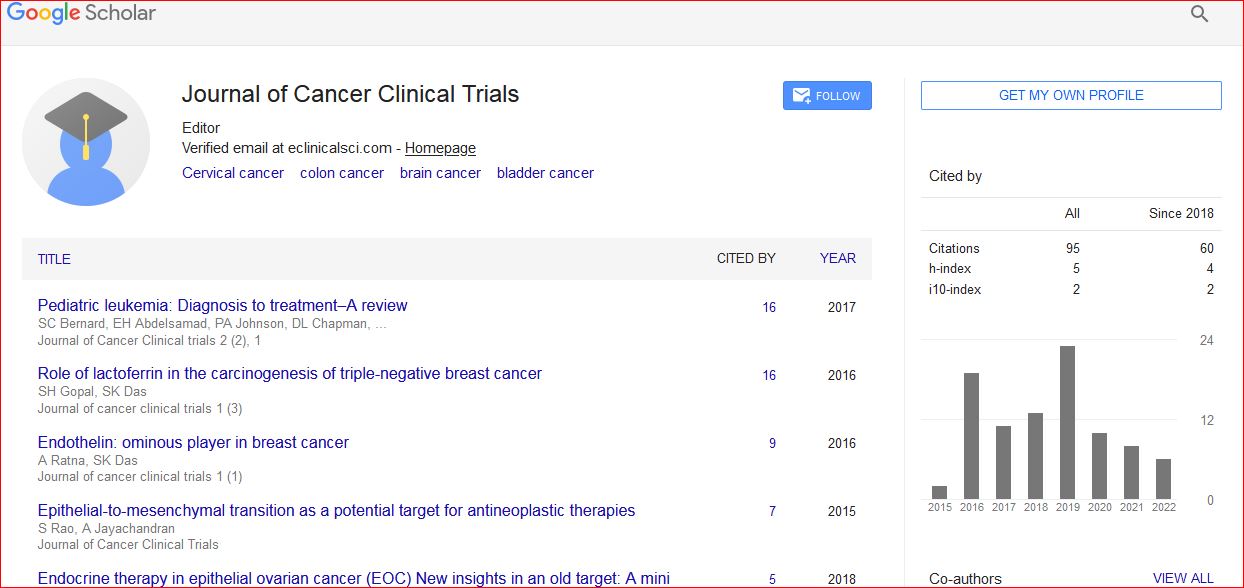
Journal of Cancer Clinical Trials received 95 citations as per Google Scholar report