Brief Report - (2025) Volume 16, Issue 6
Received: 01-Dec-2025, Manuscript No. jbsbe-26-183325;
Editor assigned: 03-Dec-2025, Pre QC No. P-183325;
Reviewed: 17-Dec-2025, QC No. Q-183325;
Revised: 22-Dec-2025, Manuscript No. R-183325;
Published:
29-Dec-2025
, DOI: 10.37421/2165-6210.2025.16.531
Citation: Hrytsenko, Oksana. ”Advancing Biosensors for Personalized Health Monitoring.” J Biosens Bioelectron 16 (2025):531.
Copyright: © 2025 Hrytsenko O. This is an open-access article distributed under the terms of the Creative Commons Attribution License, which permits unrestricted use, distribution and reproduction in any medium, provided the original author and source are credited.
The field of wearable biosensors has witnessed remarkable advancements, paving the way for continuous and non-invasive monitoring of various physiological parameters. These devices are increasingly integrated into daily life, offering unprecedented insights into individual health and well-being. One significant area of development focuses on biosensors designed for the continuous monitoring of physical activity and vital signs, highlighting innovations in miniaturization, power efficiency, and signal processing to enhance accuracy and user comfort in wearable technologies[1].
Parallel to this, the development of novel electrochemical biosensor arrays has enabled simultaneous detection of crucial biomarkers like lactate and glucose in sweat, providing critical data for athletes and individuals managing metabolic conditions through non-invasive, real-time analysis[2].
The integration of flexible and stretchable sensors into wearable textiles is another frontier, facilitating continuous monitoring of parameters such as electrocardiogram (ECG) and respiration rate through comfortable, unnoticeable garments, thereby advancing smart clothing for healthcare and fitness[3].
Furthermore, microfluidic-based biosensors are emerging as powerful tools for on-demand sweat analysis, allowing for rapid detection of key analytes including cortisol and electrolytes, with significant implications for stress monitoring and personalized hydration strategies[4].
The exploration of wearable optical biosensors is also a growing area, focusing on non-invasive monitoring of blood oxygen saturation (SpO2) and heart rate by leveraging optical principles and sophisticated signal processing for accurate readings even during dynamic activities[5].
In parallel, research into robust electrochemical sensors for non-invasive detection of ketone bodies in exhaled breath offers a promising alternative to blood tests for monitoring metabolic status, crucial for diabetes management and adherence to ketogenic diets[6].
Another critical aspect of wearable health monitoring involves systems designed for continuous tracking of body temperature and hydration levels, utilizing integrated thermistors and impedance sensors, with ongoing efforts to overcome measurement challenges in dynamic environments[7].
The realm of implantable biosensors is also advancing, with wireless and implantable devices offering long-term monitoring of parameters like intraocular pressure (IOP), a key indicator for glaucoma, thus providing a proactive approach to disease management[8].
The development of wearable sensor patches capable of real-time monitoring of sweat rate, pH, and sodium concentration showcases advancements in materials science and engineering for skin-conformable devices that can withstand physical activity, relevant for optimizing athletic performance and fluid balance[9].
Finally, the utilization of graphene-based biosensors for detecting cardiovascular biomarkers, such as troponin I, is being explored for its potential in developing highly sensitive and selective sensors for early detection of cardiac events through wearable monitoring, capitalizing on graphene's unique properties[10].
The continuous evolution of biosensing technology is profoundly impacting how we monitor our health. Wearable biosensors, a cornerstone of this revolution, are increasingly sophisticated, enabling detailed physiological assessments outside of clinical settings. A comprehensive review highlights the advancements in biosensors for continuous monitoring of physical activity and vital signs, emphasizing miniaturization, power efficiency, and advanced signal processing to create more accurate and comfortable wearable devices[1].
Simultaneously, innovative electrochemical biosensor arrays are being developed for the simultaneous detection of lactate and glucose in sweat, offering a non-invasive and real-time solution for metabolic monitoring, which is vital for athletes and individuals with diabetes[2].
The integration of flexible and stretchable sensor technologies into wearable textiles represents a significant leap forward, allowing for unobtrusive, continuous monitoring of crucial indicators like ECG and respiration rate, thereby enhancing the utility of smart clothing in healthcare and fitness applications[3].
The application of microfluidic principles to biosensor design has led to the development of devices for on-demand sweat analysis, enabling rapid and accurate measurement of analytes such as cortisol and electrolytes, which has direct implications for managing stress and optimizing hydration[4].
Optical sensing technologies are also being harnessed for wearable applications, with a focus on non-invasive monitoring of blood oxygen saturation (SpO2) and heart rate, leveraging optical principles and advanced algorithms to ensure accuracy under various conditions and enhance user convenience[5].
The pursuit of non-invasive diagnostic tools extends to the detection of ketone bodies in exhaled breath using robust electrochemical sensors, presenting a viable alternative to traditional blood tests for metabolic status monitoring, particularly relevant for diabetes management and ketogenic diet adherence[6].
Furthermore, the development of wearable systems for continuous monitoring of body temperature and hydration levels is addressing the complexities of accurate measurements in dynamic physiological environments through intelligent signal processing techniques[7].
In the context of serious medical conditions, wireless and implantable biosensors are being engineered for long-term monitoring of intraocular pressure (IOP), a critical factor in glaucoma management, offering a promising avenue for proactive patient care and vision preservation[8].
Materials science and engineering play a pivotal role in the creation of advanced wearable sensor patches designed for real-time monitoring of sweat composition, including sweat rate, pH, and sodium concentration, with direct benefits for athletic performance and electrolyte balance[9].
Finally, the unique electrical and surface properties of graphene are being exploited to create highly sensitive and selective biosensors capable of detecting cardiovascular biomarkers, such as troponin I, thereby facilitating early detection of cardiac events through wearable technologies[10].
This collection of research explores advancements in biosensor technology for health monitoring. Key areas include wearable sensors for continuous tracking of physical activity and vital signs, emphasizing miniaturization and accuracy. Novel electrochemical and optical biosensors are presented for non-invasive monitoring of sweat biomarkers like glucose and lactate, as well as blood oxygen saturation and heart rate. Integration of flexible sensors into textiles and microfluidic systems for on-demand analysis are also discussed. Furthermore, research covers non-invasive detection of ketone bodies in breath, continuous monitoring of body temperature and hydration, implantable sensors for intraocular pressure, and graphene-based sensors for cardiovascular biomarkers. These developments collectively aim to enhance personalized health management, early disease detection, and athletic performance optimization through accessible and sophisticated sensing solutions.
None
None
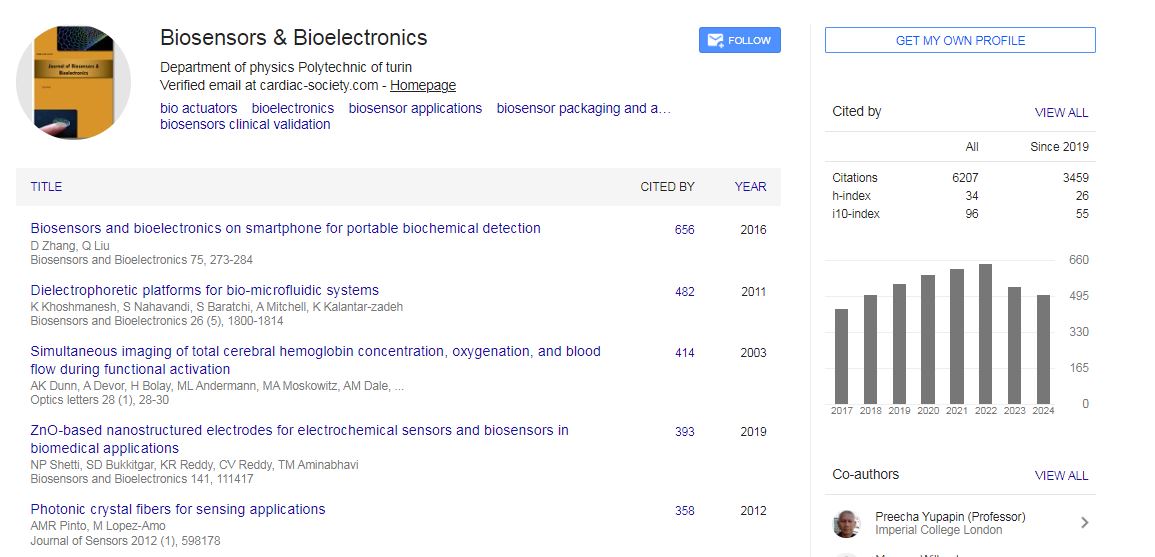
Biosensors & Bioelectronics received 6207 citations as per Google Scholar report