Brief Report - (2025) Volume 16, Issue 2
Received: 01-Apr-2025, Manuscript No. jbsbe-26-183285;
Editor assigned: 03-Apr-2025, Pre QC No. P-183285;
Reviewed: 17-Apr-2025, QC No. Q-183285;
Revised: 22-Apr-2025, Manuscript No. R-183285;
Published:
29-Apr-2025
, DOI: 10.37421/2165-6210.2025.16.491
Citation: Kovarik, Elena. ”Advancing Biosensor Technology for Diverse Health Solutions.” J Biosens Bioelectron 16 (2025):491.
Copyright: © 2025 Kovarik E. This is an open-access article distributed under the terms of the Creative Commons Attribution License, which permits unrestricted use, distribution and reproduction in any medium, provided the original author and source are credited.
Recent advancements in biosensor technology have significantly broadened their applicability across various biomedical fields, enabling more sensitive and selective detection of biomarkers. The development of novel materials and fabrication techniques is at the forefront of this progress, promising enhanced performance and portability for diagnostic devices. Nanomaterials, in particular, have emerged as crucial components, offering unique properties that amplify signals and improve detection limits for a wide range of analytes [1].
The field of infectious disease diagnostics has been profoundly impacted by the development of highly specific biosensing platforms. Aptamers, short nucleic acid or peptide sequences that bind to specific targets with high affinity, have been leveraged to create sensitive and selective aptasensors. These biosensors are critical for early detection and effective management of disease outbreaks, allowing for rapid identification of pathogens and their biomarkers [2].
Integration with microfluidic devices represents another significant stride in biosensor technology, particularly for point-of-care applications. Microfluidics facilitates precise control over sample manipulation, enabling miniaturized, automated, and cost-effective biosensing systems. This integration allows for rapid analysis of biological samples directly at the patient's bedside, streamlining the diagnostic process [3].
Wearable biosensors are revolutionizing health monitoring by enabling continuous and real-time tracking of physiological parameters. The development of flexible and stretchable biosensors, utilizing advanced electrode materials and substrates, ensures long-term stability and high accuracy. These devices are particularly crucial for managing chronic conditions such as diabetes, offering diabetic patients continuous glucose monitoring capabilities [4].
The application of advanced materials like graphene has opened new avenues for biosensor development, especially in the detection of challenging analytes such as cancer biomarkers. Graphene's exceptional electrical and mechanical properties enhance signal amplification, leading to improved sensitivity and specificity for early cancer detection, a critical factor in patient prognosis and treatment [5].
Optical biosensors, utilizing techniques like surface plasmon resonance (SPR), offer label-free detection with remarkable sensitivity for real-time monitoring of complex biological interactions. These biosensors are instrumental in studying protein-protein interactions, providing valuable insights into fundamental biological processes and aiding in the drug discovery and development pipeline [6].
The integration of artificial intelligence (AI) with biosensor data analysis is a rapidly growing area, enhancing diagnostic accuracy and predictive capabilities. Machine learning algorithms can discern subtle patterns within complex biosensor signals, leading to more personalized medicine approaches and improved disease diagnosis by identifying early indicators of illness [7].
Enzymatic biosensors continue to play a vital role in the detection of various analytes, including essential metabolites like glucose, lactate, and cholesterol. Advances in enzyme immobilization techniques and strategies for enhancing biosensor stability and performance are expanding their utility in both clinical diagnostics and industrial applications [8].
Flexible and stretchable biosensors are integral to the future of wearable health monitoring, designed to conform to the body's movements without compromising performance. Innovations in materials and fabrication methods allow these biosensors to continuously detect physiological signals, offering a non-invasive and convenient way to track health metrics over time [9].
Developing biosensors that can reliably detect biomarkers in complex biological matrices such as blood and saliva presents significant challenges. Strategies to mitigate interference and enhance analyte capture are crucial for achieving accurate and precise measurements in real-world samples, ensuring the clinical utility of these advanced diagnostic tools [10].
The continuous evolution of biosensor technology is driven by advancements in material science and engineering, leading to enhanced sensitivity, selectivity, and portability for biomedical applications. Novel materials, including nanomaterials, alongside innovative fabrication techniques and integration strategies, are revolutionizing disease diagnostics and real-time health monitoring. These developments are crucial for accelerating drug discovery and improving patient outcomes through more precise detection of biomarkers [1].
In the realm of infectious diseases, the development of highly sensitive and specific aptamer-based biosensors is paramount. These aptasensors enable low detection limits through careful strategies for aptamer selection, immobilization, and signal amplification, which are critical for the early diagnosis and effective management of disease outbreaks. Their specificity ensures reliable identification of target pathogens [2].
The synergy between microfluidics and biosensors has paved the way for sophisticated point-of-care diagnostic devices. Microfluidic platforms facilitate sample pre-treatment, manipulation, and controlled delivery to the sensing element, resulting in miniaturized, automated, and cost-effective systems for rapid analysis of biological samples, thereby reducing turnaround times for diagnoses [3].
Wearable electrochemical biosensors are transforming continuous health monitoring, particularly for chronic conditions. The use of flexible substrates and advanced electrode materials allows for long-term stability and high accuracy in devices designed for real-time health tracking, exemplified by continuous glucose monitoring systems for diabetic patients [4].
The unique properties of graphene have been harnessed to create highly effective biosensors for detecting cancer biomarkers. These graphene-based biosensors offer superior signal amplification and improved sensitivity and specificity, which are essential for the early and accurate detection of cancer, a critical factor in treatment success [5].
Optical biosensors, particularly those employing surface plasmon resonance (SPR), provide a powerful label-free method for real-time monitoring of dynamic biological interactions. Their high sensitivity is indispensable for unraveling complex protein-protein interactions, thereby contributing significantly to our understanding of disease mechanisms and the development of novel therapeutics [6].
The integration of artificial intelligence (AI) with biosensor technology is enhancing diagnostic capabilities by enabling sophisticated analysis of biosensor data. Machine learning algorithms can identify complex patterns indicative of disease, leading to more accurate diagnoses and the development of personalized medicine strategies that tailor treatments to individual patient needs [7].
Enzymatic biosensors remain a cornerstone of biochemical analysis, widely applied for the detection of analytes such as glucose, lactate, and cholesterol. Research into optimizing enzyme immobilization and enhancing sensor stability and performance continues to expand the application scope of enzymatic biosensors in clinical and industrial settings [8].
Flexible and stretchable biosensors represent a significant advancement in wearable health monitoring technology. These biosensors are designed to conform to the body's contours and movements, ensuring high performance for continuous physiological signal detection through innovative material choices and fabrication methodologies [9].
Addressing the challenges of biosensing in complex biological matrices like blood and saliva is crucial for the practical implementation of biosensor technology. Strategies focused on minimizing interference and optimizing analyte capture are vital for achieving the accuracy and precision required for reliable diagnostics in real-world clinical scenarios [10].
This collection of research highlights significant advancements in biosensor technology across various applications. Key areas of development include nanomaterial-based electrochemical biosensors for disease diagnosis, aptasensors for infectious disease detection, and microfluidic devices for point-of-care diagnostics. Wearable biosensors are enabling continuous health monitoring, while graphene-based sensors show promise for early cancer detection. Optical biosensors offer label-free analysis of biological interactions, and the integration of AI is improving diagnostic accuracy. Enzymatic biosensors continue to be vital for analyte detection, and efforts are underway to develop robust biosensors for complex biological samples. The overall trend points towards more sensitive, specific, portable, and integrated biosensing solutions for diverse health-related challenges.
None
None
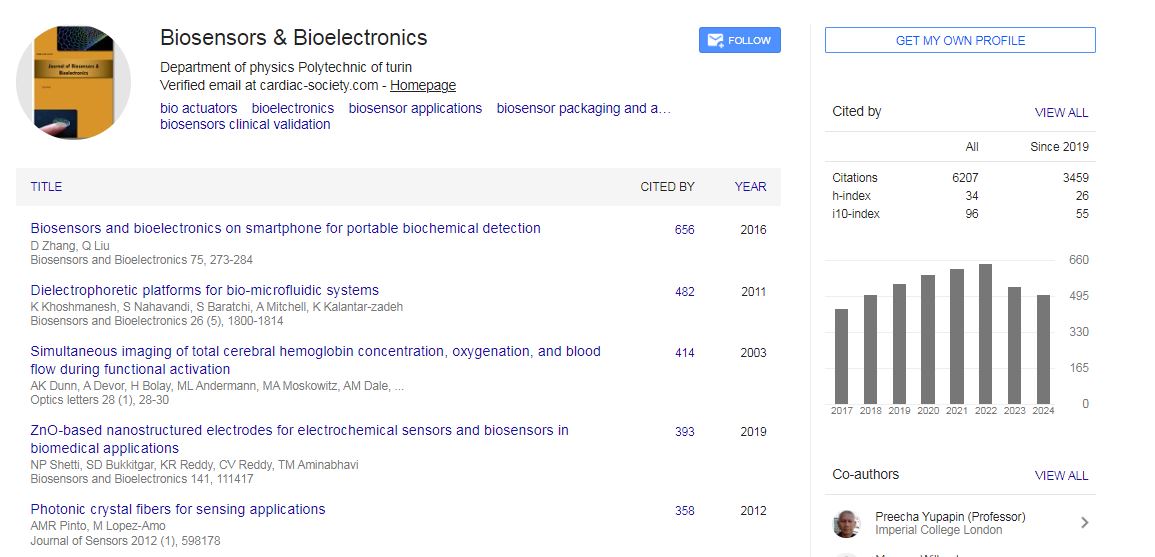
Biosensors & Bioelectronics received 6207 citations as per Google Scholar report