Perspective - (2025) Volume 15, Issue 4
Received: 02-Jul-2025, Manuscript No. jbpbt-25-178514;
Editor assigned: 04-Jul-2025, Pre QC No. P-178514;
Reviewed: 18-Jul-2025, QC No. Q-178514;
Revised: 23-Jul-2025, Manuscript No. R-178514;
Published:
30-Jul-2025
, DOI: 10.37421/2155-9821.2025.15.690
Citation: Alvarez, Pablo R.. ”Advancing Bioprocesses for Sustainable Biofuels And Biochemicals.” J Bioprocess Biotech 15 (2025):690.
Copyright: © 2025 Alvarez R. Pablo This is an open-access article distributed under the terms of the Creative Commons Attribution License, which permits unrestricted use,
distribution and reproduction in any medium, provided the original author and source are credited.
This review highlights recent advancements in bioprocess engineering for sustainable biofuel and biochemical production, emphasizing metabolic engineering of microorganisms, optimization of fermentation conditions, and downstream processing techniques to enhance yields and reduce costs. Key areas explored include the use of lignocellulosic biomass, algal feedstocks, and the integration of synthetic biology tools for novel pathway development, underscoring the economic and environmental benefits of these bioprocesses in transitioning towards a bio-based economy [1].
This article details the development and optimization of a fed-batch fermentation process for the production of polyhydroxyalkanoates (PHAs) using engineered Cupriavidus necator, focusing on controlling substrate feeding strategies and aeration to maximize polymer accumulation and molecular weight. Significant improvements in PHA yield and purity were observed compared to traditional batch processes, demonstrating the effectiveness of fed-batch bioprocessing for industrial PHA synthesis [2].
This research investigates the use of immobilized enzyme bioreactors for the efficient conversion of glucose to lactic acid, exploring different immobilization techniques and operational parameters to enhance enzyme stability and activity. The immobilized system demonstrated improved productivity and reusability, offering a promising alternative to conventional free enzyme processes for lactic acid manufacturing, a key platform chemical [3].
This study evaluates the potential of microalgae as a sustainable feedstock for biodiesel production, examining different cultivation strategies and harvesting methods to improve lipid yield and biomass productivity. The research highlights the advantages of photobioreactor systems and discusses challenges associated with downstream lipid extraction and transesterification, proposing integrated bioprocess designs for commercial viability [4].
This paper presents a novel approach for enhancing biobutanol production through co-culturing of Clostridium acetobutylicum and Saccharomyces cerevisiae, investigating the synergistic effects of this co-culture system on substrate utilization and product yield. The co-culture demonstrated improved butanol tolerance and higher production rates compared to monocultures, suggesting a promising strategy for industrial biobutanol fermentation [5].
This work explores the metabolic engineering of Escherichia coli for the production of succinic acid, a valuable platform chemical, focusing on pathway optimization by downregulating competing pathways and overexpressing key enzymes. The engineered strain achieved a significantly higher succinic acid titer and yield under anaerobic fermentation conditions, demonstrating the power of synthetic biology in bioprocess development [6].
This research investigates the optimization of a continuous fermentation process for the production of ethanol from corn stover, employing a high cell density continuous culture system with integrated cell recycle to enhance volumetric productivity. Results indicate that the continuous process significantly outperforms batch fermentation in terms of ethanol yield and production rate, highlighting its potential for industrial scale-up [7].
This article focuses on the downstream processing strategies for recovering and purifying bioproducts, specifically emphasizing challenges and innovations in membrane-based separation techniques. It reviews various membrane technologies, such as ultrafiltration and nanofiltration, for concentrating and purifying fermentation products like organic acids and enzymes, covering process integration and techno-economic analysis to improve overall efficiency and cost-effectiveness of bioseparation [8].
This study investigates the production of xylitol from xylose using thermophilic yeast Kluyveromyces marxianus, focusing on optimizing fermentation conditions, including temperature, pH, and substrate concentration, to maximize xylitol yield and productivity. The findings demonstrate the potential of this yeast strain and process parameters for efficient and cost-effective xylitol production [9].
This article reviews recent progress in developing genetically engineered microorganisms for the production of biofuels and biochemicals, covering strategies such as CRISPR/Cas9-based genome editing, pathway reconstruction, and adaptive laboratory evolution to improve host cell performance. The review highlights successful examples in the production of isobutanol, fatty acid ethyl esters, and various platform chemicals, underscoring the transformative impact of genetic engineering on bioprocess design [10].
The field of bioprocess engineering has witnessed significant advancements in the sustainable production of biofuels and biochemicals. A central theme involves the metabolic engineering of microorganisms to enhance their capabilities. This includes optimizing fermentation conditions and refining downstream processing techniques to achieve higher yields and reduce production costs. Specific attention is given to utilizing diverse feedstocks such as lignocellulosic biomass and algal sources. Furthermore, the integration of synthetic biology tools facilitates the development of novel metabolic pathways, collectively driving the economic and environmental benefits necessary for a transition to a bio-based economy [1].
The development and optimization of fed-batch fermentation processes are crucial for efficiently producing valuable bioproducts like polyhydroxyalkanoates (PHAs). An engineered strain of Cupriavidus necator was studied, with a focus on meticulously controlling substrate feeding and aeration parameters. These control strategies were designed to maximize both the accumulation of the PHA polymer and its molecular weight. The outcomes demonstrated substantial improvements in PHA yield and purity when compared to conventional batch fermentation methods, confirming the efficacy of fed-batch bioprocessing for industrial-scale synthesis of PHAs [2].
Efficient bioconversion of glucose to lactic acid can be achieved using immobilized enzyme bioreactors. This research explored various immobilization techniques and operational parameters, aiming to enhance both the stability and catalytic activity of the enzymes. The implemented immobilized system exhibited superior productivity and reusability characteristics. This presents a compelling alternative to traditional free enzyme processes, particularly for the large-scale manufacturing of lactic acid, a fundamental platform chemical [3].
Microalgae hold significant promise as a sustainable feedstock for biodiesel production. This study critically examined various cultivation strategies and harvesting methodologies to boost lipid yield and overall biomass productivity. The research underscored the inherent advantages of photobioreactor systems. Moreover, it addressed the persistent challenges associated with downstream lipid extraction and the transesterification process, proposing integrated bioprocess designs to improve commercial viability [4].
A novel approach to enhance biobutanol production has been developed through the co-culturing of Clostridium acetobutylicum and Saccharomyces cerevisiae. This investigation delved into the synergistic interactions within this co-culture system, assessing their impact on substrate utilization and product yield. Notably, the co-culture exhibited enhanced tolerance to butanol and achieved higher production rates than observed in monocultures. This suggests a promising avenue for optimizing industrial biobutanol fermentation processes [5].
The metabolic engineering of Escherichia coli has been extensively explored for the efficient production of succinic acid, a highly valuable platform chemical. The research strategy involved precise pathway optimization, achieved by downregulating competing metabolic routes and overexpressing critical enzymes. The engineered strain demonstrated a remarkable increase in succinic acid titer and yield under anaerobic fermentation conditions, highlighting the profound impact of synthetic biology techniques on bioprocess development [6].
Optimizing continuous fermentation processes is vital for enhancing the production of ethanol from agricultural residues like corn stover. This research employed a high cell density continuous culture system incorporating an integrated cell recycle strategy to significantly boost volumetric productivity. The findings indicated that this continuous approach substantially outperformed traditional batch fermentation in terms of both ethanol yield and production rate, underscoring its potential for efficient industrial scale-up [7].
Downstream processing is a critical phase in the recovery and purification of bioproducts. This article offers a comprehensive review of strategies, with a particular focus on the challenges and innovative solutions offered by membrane-based separation techniques. It examines diverse membrane technologies, including ultrafiltration and nanofiltration, for the concentration and purification of fermentation products such as organic acids and enzymes. The discussion encompasses aspects of process integration and techno-economic analysis to foster improvements in the overall efficiency and cost-effectiveness of bioseparation [8].
The production of xylitol from xylose using the thermophilic yeast Kluyveromyces marxianus was investigated. The research focused on optimizing key fermentation conditions, such as temperature, pH, and substrate concentration, to maximize both the yield and productivity of xylitol. The results presented indicate the significant potential of this specific yeast strain and the identified process parameters for achieving efficient and cost-effective xylitol production [9].
Recent advancements in the genetic engineering of microorganisms for the production of biofuels and biochemicals are reviewed. The article covers a range of sophisticated strategies, including CRISPR/Cas9-based genome editing, metabolic pathway reconstruction, and adaptive laboratory evolution, all aimed at improving host cell performance. It provides examples of successful applications in the production of isobutanol, fatty acid ethyl esters, and various platform chemicals, emphasizing the transformative influence of genetic engineering on the design and execution of bioprocesses [10].
This collection of research covers advancements in bioprocess engineering focused on sustainable biofuel and biochemical production. Key areas include metabolic engineering of microorganisms, optimization of fermentation processes (fed-batch, continuous, and co-culturing), and the utilization of diverse feedstocks like lignocellulosic biomass and microalgae. The role of synthetic biology, immobilized enzymes, and advanced downstream processing techniques such as membrane separation is highlighted. Specific applications discussed include the production of ethanol, polyhydroxyalkanoates (PHAs), lactic acid, biobutanol, succinic acid, and xylitol. The research collectively demonstrates strategies for enhancing yields, reducing costs, and improving the overall efficiency and commercial viability of bioprocesses, paving the way for a bio-based economy.
None
None
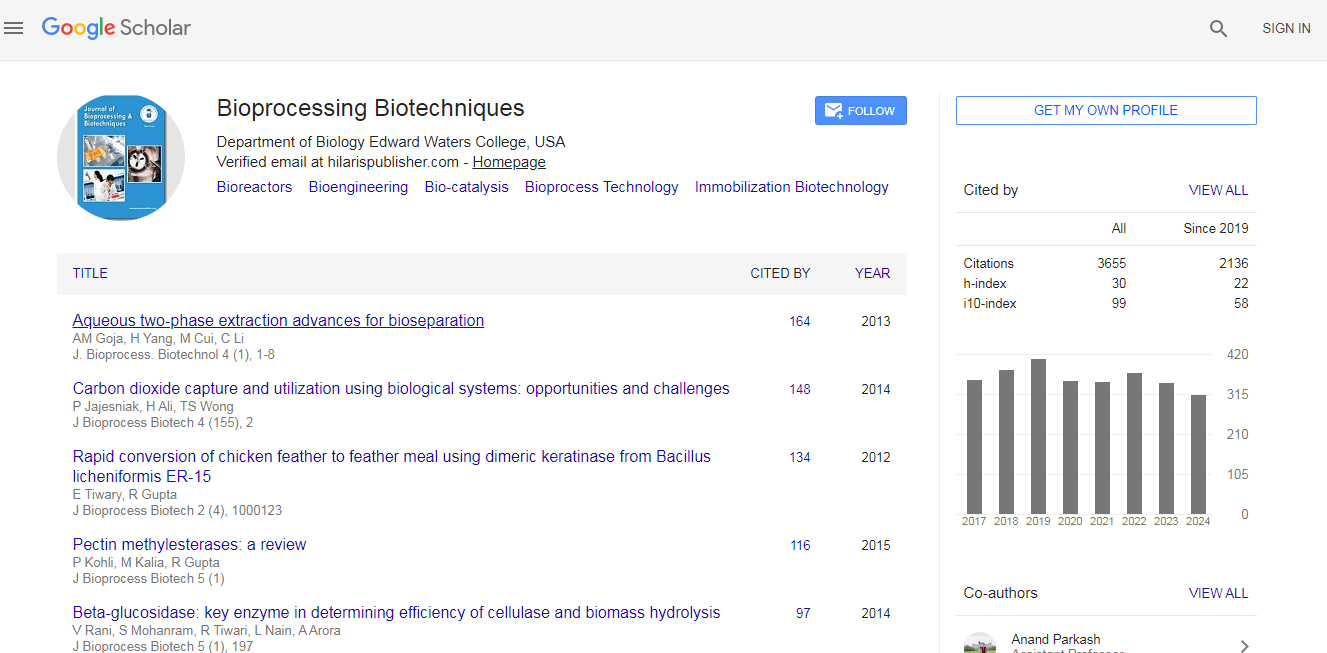
Journal of Bioprocessing & Biotechniques received 3351 citations as per Google Scholar report