Short Communication - (2025) Volume 16, Issue 6
Received: 01-Dec-2025, Manuscript No. jbsbe-26-183336;
Editor assigned: 03-Dec-2025, Pre QC No. P-183336;
Reviewed: 17-Dec-2025, QC No. Q-183336;
Revised: 22-Dec-2025, Manuscript No. R-183336;
Published:
29-Dec-2025
, DOI: 10.37421/2165-6210.2025.16.540
Citation: Amani, Siti Nur. ”Advancing Bioelectronics For Precision Medicine and Health.” J Biosens Bioelectron 16 (2025):540.
Copyright: © 2025 Amani N. Siti This is an open-access article distributed under the terms of the Creative Commons Attribution License, which permits unrestricted use, distribution and reproduction in any medium, provided the original author and source are credited.
The integration of advanced materials, miniaturization, and sophisticated analytical techniques is propelling biosensors and bioelectronics toward unprecedented capabilities, marking a significant advancement in diagnostic and monitoring technologies [1].
Innovations in nanomaterials, such as graphene and quantum dots, are fundamentally enhancing the sensitivity and selectivity of these devices, allowing for more precise detection of biological analytes [3].
The development of flexible and wearable bioelectronic devices is actively paving the way for continuous, real-time health monitoring and diagnostics, shifting healthcare paradigms towards proactive and personalized approaches [4].
Furthermore, the convergence of artificial intelligence and machine learning with biosensing platforms promises more intelligent data interpretation and the realization of personalized healthcare solutions, optimizing treatment strategies and patient outcomes [2].
Future directions in this dynamic field include the ambitious creation of fully implantable and self-powered systems designed for long-term physiological tracking and sophisticated therapeutic interventions, offering continuous insight into bodily functions and targeted treatments [6].
The synergy between biosensing and microfluidics is also leading to the development of lab-on-a-chip devices, which enable sample preparation, reaction, and detection on a single, miniaturized platform, significantly reducing analysis time and reagent consumption [5].
The application of biosensors and bioelectronics in precision medicine is rapidly expanding, enabling the real-time monitoring of individual physiological parameters and the early detection of disease biomarkers, which allows for tailored treatment strategies and improved patient outcomes [9].
The development of advanced electrode materials is crucial for efficient signal transduction in bioelectronic devices, with materials like conductive polymers and porous carbon being explored to increase surface area and enhance conductivity [7].
Biocompatible materials are essential for the long-term success of bioelectronic implants and wearable devices, focusing on materials that minimize immune response and promote integration with biological tissues [8].
The integration of neuromorphic computing with bioelectronic interfaces is a burgeoning field, aiming to create devices that process biological signals in a brain-like manner for more sophisticated analysis of complex biological data [10].
The integration of advanced materials, miniaturization, and sophisticated analytical techniques is driving the evolution of biosensors and bioelectronic devices to achieve remarkable new functionalities [1].
Specific advancements in nanomaterials, including graphene and quantum dots, are crucial for augmenting the sensitivity and selectivity of these biosensing platforms [3].
Simultaneously, the creation of flexible and wearable bioelectronic devices is opening new avenues for continuous, real-time health monitoring and diagnostic capabilities, representing a significant shift in how health is managed [4].
The synergistic integration of artificial intelligence and machine learning with biosensing technologies is leading to more intelligent data interpretation and the development of truly personalized healthcare solutions [2].
Looking ahead, the research landscape is focused on the development of fully implantable and self-powered systems, which are intended for long-term physiological tracking and the precise execution of therapeutic interventions [6].
A key area of development is the convergence of biosensing with microfluidics, leading to the creation of lab-on-a-chip devices that integrate sample preparation, reaction, and detection onto a single, compact platform, thereby reducing analysis time and the volume of reagents required [5].
The application of biosensors and bioelectronics within the realm of precision medicine is experiencing rapid growth, facilitating real-time monitoring of individual physiological parameters and early disease biomarker detection, which in turn supports tailored treatment strategies and improved patient outcomes [9].
Essential to the functionality of bioelectronic devices is the development of advanced electrode materials, with research exploring conductive polymers, metal nanoparticles, and porous carbon materials to enhance surface area and conductivity [7].
The long-term viability of bioelectronic implants and wearable devices hinges on the use of biocompatible materials, with ongoing research focusing on materials that minimize adverse immune responses and encourage integration with surrounding biological tissues [8].
Emerging research is also exploring the integration of neuromorphic computing with bioelectronic interfaces, aiming to develop devices capable of processing biological signals in a manner akin to the human brain, thereby enabling more sophisticated analysis of complex biological data [10].
Biosensors and bioelectronics are advancing rapidly due to innovations in advanced materials like graphene and quantum dots, enhancing sensitivity and selectivity. Flexible and wearable devices are enabling continuous health monitoring. The integration of AI and machine learning promises intelligent data interpretation and personalized healthcare. Future developments include implantable, self-powered systems for long-term monitoring and therapy. Microfluidic integration leads to lab-on-a-chip devices for faster, reagent-efficient analysis. These technologies are crucial for precision medicine, allowing tailored treatments and early disease detection. Advanced electrode materials improve signal transduction, while biocompatible materials are vital for implants. Neuromorphic computing integration aims for brain-like signal processing in bioelectronic interfaces.
None
None
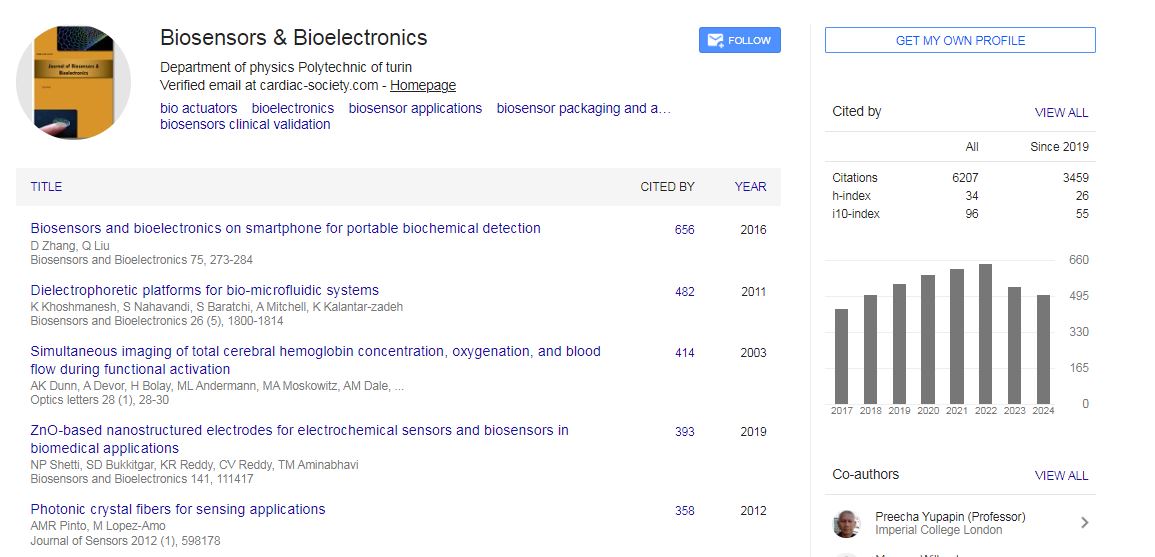
Biosensors & Bioelectronics received 6207 citations as per Google Scholar report