Commentary - (127) Volume 17, Issue 6
Received: 01-Dec-2025, Manuscript No. jbabm-26-182363;
Editor assigned: 03-Dec-2025, Pre QC No. P-182363;
Reviewed: 17-Dec-2025, QC No. Q-182363;
Revised: 22-Dec-2025, Manuscript No. R-182363;
Published:
29-Dec-2025
, DOI: 10.37421/1948-593X.2025.17.521
Citation: Deshpande, Anil R.. ”Advances in Rapid Infectious Disease Diagnostics.” J Bioanal Biomed 17 (2025):521.
Copyright: © 2025 Deshpande R. Anil This is an open-access article distributed under the terms of the Creative Commons Attribution License, which permits unrestricted use, distribution and reproduction in any medium, provided the original author and source are credited.
The field of infectious disease diagnostics is undergoing a significant transformation driven by advancements in bioanalytical techniques. These innovations are critical for achieving rapid and accurate detection, which is paramount for effective patient management and robust public health surveillance. Molecular diagnostics, such as Polymerase Chain Reaction (PCR) and isothermal amplification methods, have become indispensable tools for identifying the genetic material of pathogens. Furthermore, serological assays, including Enzyme-Linked Immunosorbent Assays (ELISA) and lateral flow devices, play a crucial role in detecting the body's immune response to infection, providing complementary diagnostic information. The integration of emerging technologies like biosensors and microfluidics is further enhancing diagnostic capabilities. These platforms facilitate the development of point-of-care (POC) applications, offering improved sensitivity, specificity, and drastically reduced turnaround times. This shift towards decentralized and rapid diagnostics is essential for controlling outbreaks and ensuring timely intervention, especially in resource-limited settings. Specific advancements in biosensor technology are showing great promise for the detection of viral pathogens. Electrochemical biosensors, for instance, are being developed with high sensitivity and selectivity, often employing antibodies for pathogen recognition. The potential for multiplexed detection, allowing for the simultaneous identification of multiple viral strains, is a key area of development, expediting clinical decision-making and patient care. Complementing these efforts, CRISPR-based diagnostic systems represent a revolutionary paradigm in infectious disease detection. Their inherent high specificity and capacity for multiplexing enable the identification of a wide array of viral pathogens with performance characteristics that rival traditional methods like PCR, but with the advantage of simpler instrumentation. This accessibility broadens the potential for widespread application. Microfluidic platforms are also playing a pivotal role in accelerating pathogen detection, particularly in the context of outbreak response. These systems can integrate complex processes such as sample preparation and nucleic acid amplification onto a single chip, enabling the simultaneous detection of multiple targets. Their application in clinical settings is crucial for timely and accurate diagnosis, especially for respiratory viruses. Lateral flow assays (LFAs) continue to be a vital component of point-of-care diagnostics due to their inherent simplicity, low cost, and ease of use. Recent innovations in LFA technology are focused on enhancing their capabilities, including improved sensitivity through the incorporation of nanotechnology and the development of multiplexed detection formats, making them increasingly valuable for broad infectious disease screening. Isothermal amplification techniques, such as Loop-Mediated Isothermal Amplification (LAMP), offer a compelling alternative to traditional PCR. LAMP provides rapid pathogen detection without the need for complex thermal cycling equipment, making it highly suitable for resource-limited settings and field diagnostics. Its efficacy in detecting bacterial pathogens highlights its versatility. For applications requiring high precision and absolute quantification of nucleic acids, Digital PCR (dPCR) stands out. This advanced technique offers unparalleled sensitivity for detecting low-abundance nucleic acids, making it invaluable for monitoring minimal residual disease and assessing treatment efficacy in infectious conditions with high confidence. The development of portable, integrated diagnostic devices is transforming the landscape of infectious disease control. Smartphone-based platforms, when coupled with microfluidic immunoassay cartridges, enable rapid disease diagnosis even in remote or low-resource settings. This accessibility democratizes diagnostic capabilities. Finally, the synergy between artificial intelligence (AI) and bioanalytical techniques is poised to revolutionize infectious disease diagnostics. AI algorithms can analyze vast and complex datasets generated by high-throughput assays and imaging, leading to more accurate and accelerated diagnoses, particularly for the detection of emerging and novel pathogens, thereby enhancing our preparedness for future health challenges.
Bioanalytical techniques form the bedrock of modern infectious disease diagnostics, enabling rapid and accurate identification essential for timely patient care and effective public health strategies. Advancements in molecular diagnostics, such as PCR and isothermal amplification, offer high sensitivity for detecting pathogen genetic material. Concurrently, serological assays like ELISA and lateral flow devices provide insights into the host immune response. The convergence of these methods with emerging technologies like biosensors and microfluidics is driving the development of point-of-care (POC) solutions, characterized by enhanced sensitivity, specificity, and significantly reduced assay times. Novel biosensors are demonstrating remarkable potential for rapid viral detection. Electrochemical biosensors, often functionalized with specific antibodies, exhibit high sensitivity and selectivity for targets like the influenza virus. A key advancement is the prospect of multiplexed detection, allowing for the simultaneous identification of multiple viral strains, which is crucial for expediting clinical decisions and improving patient management. CRISPR-based diagnostic systems are revolutionizing the field with their exceptional specificity and multiplexing capabilities. Technologies like SHERLOCK offer a highly sensitive and specific method for detecting various viral pathogens. The simplicity of their instrumentation compared to traditional PCR methods makes them a promising tool for widespread diagnostic application, even in diverse settings. Microfluidic platforms are instrumental in advancing rapid pathogen detection, particularly for outbreak scenarios. These integrated systems can perform sample preparation and nucleic acid amplification on-chip, facilitating the simultaneous identification of multiple respiratory viruses. Their utility in clinical settings for prompt diagnosis is a significant advantage in managing infectious disease outbreaks. Lateral flow assays (LFAs) remain a cornerstone of point-of-care diagnostics due to their simplicity and cost-effectiveness. Recent innovations have focused on improving LFA performance through nanotechnology for enhanced sensitivity and the integration of multiplexed detection capabilities, making them more versatile for infectious disease screening. Loop-mediated isothermal amplification (LAMP) offers a powerful alternative to PCR for pathogen detection. Its isothermal nature eliminates the need for specialized thermocycling equipment, rendering it ideal for resource-limited settings and field-based diagnostics. Its demonstrated efficacy in rapidly detecting bacterial pathogens underscores its practical utility. For precise quantification of nucleic acids, particularly at low concentrations, Digital PCR (dPCR) is highly valuable. This technology provides absolute quantification with enhanced sensitivity, making it indispensable for detecting minimal residual disease and monitoring treatment responses in infectious conditions, ensuring a high level of diagnostic confidence. The development of portable diagnostic devices is crucial for infectious disease control. Smartphone-based platforms integrated with microfluidic immunoassay cartridges empower rapid disease diagnosis in remote or underserved areas. This technological integration democratizes access to essential diagnostic tools. Metagenomic sequencing represents a powerful, unbiased approach for identifying infectious agents directly from clinical samples. It is particularly useful in diagnosing complex infections where conventional methods may be insufficient. This technology is revolutionizing etiological investigations by providing a comprehensive view of the microbial landscape. Lastly, the integration of artificial intelligence (AI) with bioanalytical techniques is transforming infectious disease diagnostics. AI algorithms can analyze complex data from various assays and imaging modalities, leading to more accurate and faster diagnoses, especially for emerging pathogens. This synergy enhances diagnostic capabilities and preparedness.
This compilation highlights advancements in infectious disease diagnostics, focusing on bioanalytical techniques that enable rapid and accurate detection. Key technologies discussed include molecular diagnostics like PCR and isothermal amplification, serological assays such as ELISA and lateral flow devices, and novel biosensors. The integration of microfluidics and CRISPR-based systems offers enhanced specificity and multiplexing capabilities. Point-of-care solutions, including portable smartphone-based platforms and user-friendly lateral flow assays, are emphasized for their accessibility. Digital PCR is noted for its high sensitivity in quantification, while metagenomic sequencing provides an unbiased approach for identifying pathogens. The role of artificial intelligence in interpreting complex diagnostic data is also explored, promising faster and more accurate diagnoses. These innovations collectively aim to improve patient management, public health surveillance, and outbreak response.
None
None
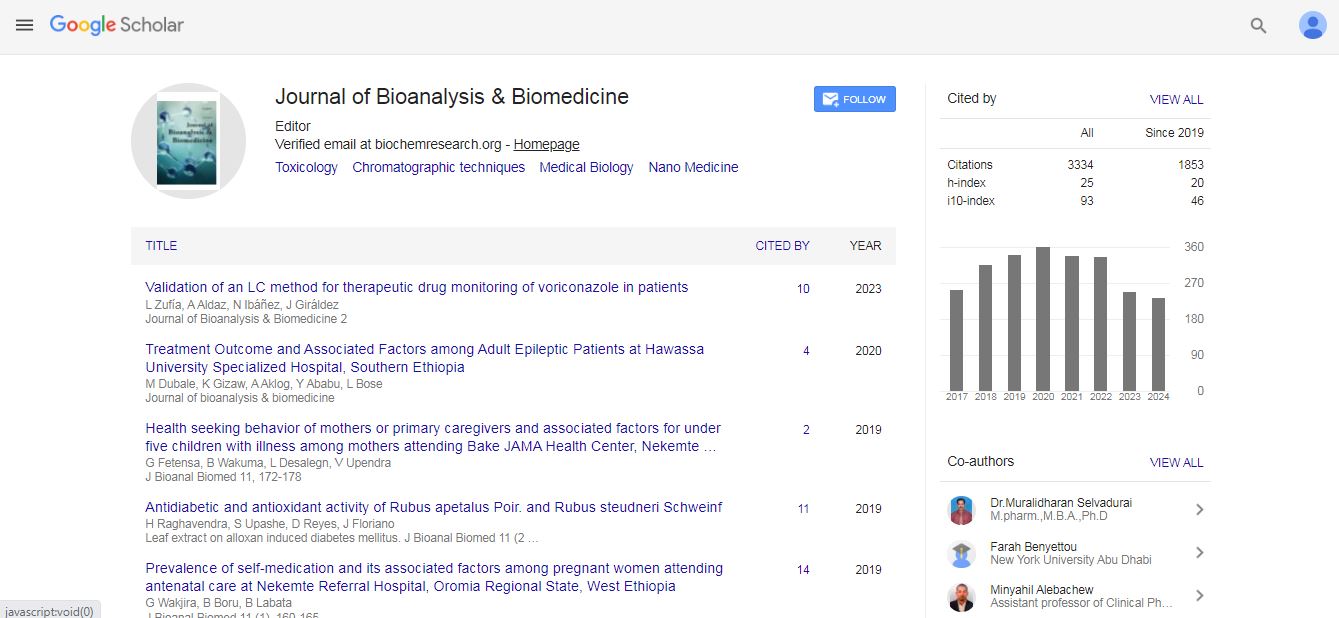
Journal of Bioanalysis & Biomedicine received 3099 citations as per Google Scholar report